Thursday Oct 15, 2026
Thursday Oct 15, 2026
Thursday, 12 March 2026 04:02 - - {{hitsCtrl.values.hits}}
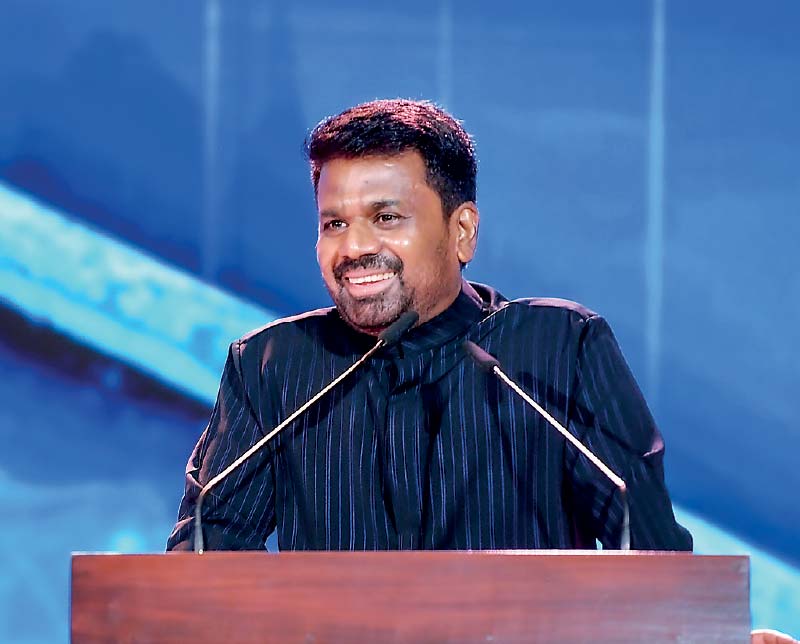
President Anura Kumara Dissanayake
President Anura Kumara Dissanayake on Tuesday warned that Sri Lanka’s economic recovery could face fresh pressure if the war in the Middle East continues to disrupt global energy supply chains, saying the Government can currently assure fuel availability only for the next two months under present conditions.
The President said the sharp escalation in oil prices since early March has created uncertainty in global markets and triggered behavioural shifts in domestic fuel demand, with diesel sales rising sharply within days.
“Continuous energy supply can now be assured. However, it is only possible to forecast and guarantee this reliably for a maximum period of two months,” he said in remarks released by the President’s Media Division. “If the conflict persists beyond this two-month window, predictions based on current assessments will no longer hold.”
Global crude oil prices have risen from about $ 70 a barrel at the beginning of March to around $ 100, an increase of roughly 42%, he said, adding that the volatility is feeding uncertainty across international markets.
The impact has already been reflected in domestic fuel consumption patterns. Diesel sales rose from about 4,500 kilolitres on 1 March to roughly 10,500 kilolitres by 3 March, while petrol sales increased from about 4,000 kilolitres to nearly 9,000 kilolitres before easing back to below 6,000 kilolitres.
The President said the current pressures differ from the 2022 economic crisis, which was triggered primarily by a shortage of foreign exchange to finance fuel imports.
“The 2022 crisis arose due to a shortage of US dollars. Today, that problem does not exist,” he said, noting that Sri Lanka’s foreign reserves now stand at about $ 7.2 billion.
Instead, the current risk stems from disruptions to supply routes and global logistics networks caused by the conflict.
“The war situation in the Middle East is disrupting the supply of goods and services,” he said, adding that, in a globally interconnected market, system shocks in one region quickly transmit to others.
To monitor the evolving risks, the Government has established an Economic Monitoring Committee and begun discussions with friendly countries to ensure continuity in energy supply chains.
The President said maintaining uninterrupted energy supply is critical to protecting the economic stabilisation achieved since the crisis.
“It is the Government’s responsibility to ensure an uninterrupted supply of energy. Any disruption would cause the significant economic gains we have achieved in a short period to stall,” he said.
At the same time, he cautioned that long-term forecasts remain difficult given the unpredictable nature of modern warfare.
“This is an era in which technology and science have given unprecedented power to warfare,” he said. “Short-term forecasts are possible, but if the conflict continues beyond that period, no one can reliably predict the outcomes.”
The President also urged the public to moderate consumption and avoid panic behaviour, noting that the current pressures stem from external supply disruptions rather than a domestic currency shortage.
“If everyone collectively takes responsibility and acts together, it is only through such shared effort that we can overcome this challenge,” he said.




