Tuesday Oct 06, 2026
Tuesday Oct 06, 2026
Saturday, 13 June 2026 06:39 - - {{hitsCtrl.values.hits}}
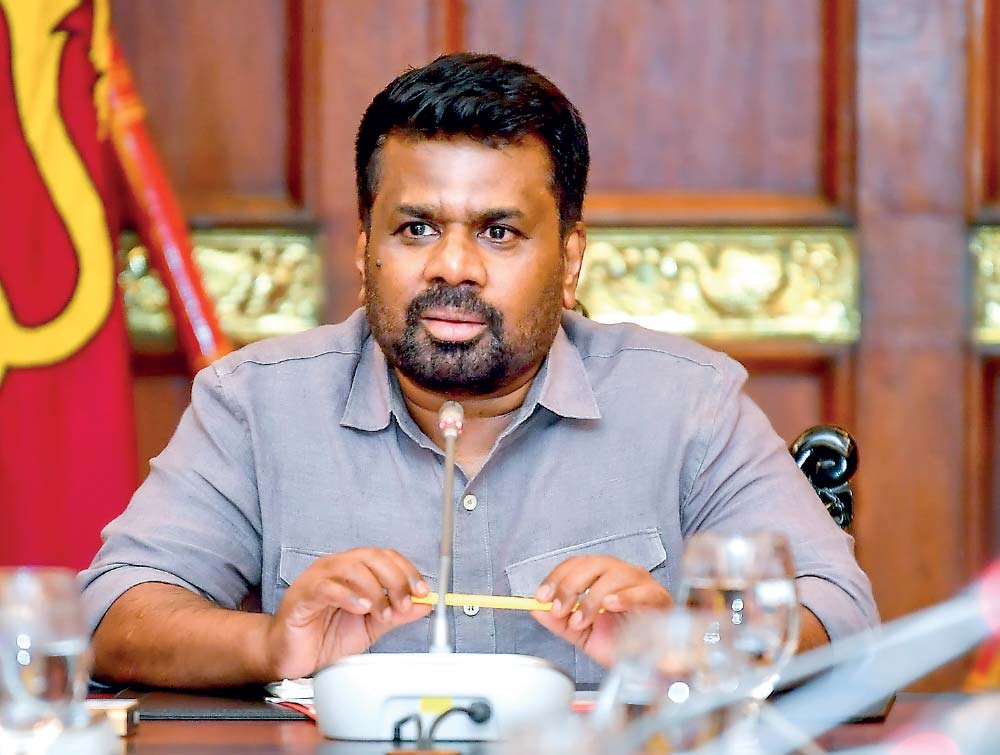
President Anura Kumara Dissanayake
President Anura Kumara Dissanayake has directed officials to complete the proposed Education Reform Policy Framework within one month, underscoring the need for a carefully structured reform process that builds on lessons from previous education policies.
The instruction was issued during a discussion at the Presidential Secretariat on Wednesday on the education policy concept paper presented by the National Education Commission.
During the meeting, National Education Commission Chairman A. Sarath Ananda said the current reform process covers several key pillars, including early childhood education, general education, higher education, vocational education, technological education, digital education, and non-formal education.
Discussions reviewed the evolution of Sri Lanka’s education system, past reform initiatives, and the social changes resulting from those reforms. The President instructed officials to examine previous reform efforts and incorporate key lessons into the formulation of the new policy framework.
Commission members noted that since the establishment of the National Education Commission in 1991, a number of education policies had been developed, with a significant portion of the 1997 policy being implemented at primary education level. They also observed that a general education policy formulated in 2016 was not implemented as intended, while a policy developed in 2023 was not adopted as the national education policy.
Officials further pointed out that previous reform efforts had often been driven by the operational requirements of education-related institutions rather than a comprehensive policy framework designed to guide long-term educational transformation.
Describing the current period as a significant opportunity for reform, President Dissanayake stressed that changes should be implemented without disrupting the continuity of the existing education system. He said reforms should be integrated into the current framework rather than pursued through a parallel structure.
The President acknowledged that developing a new education policy framework would be a major challenge for the Commission and cautioned against viewing either the previous or current education systems as wholly successful or unsuccessful.
He emphasised the importance of identifying both strengths and weaknesses within the existing system, noting that the success of education reforms can only be assessed over the long term through their impact on society.
Discussions also focused on the need to anticipate future social challenges and ensure the new policy framework incorporates the skills and competencies required to develop citizens capable of adapting to a changing society.
Participants highlighted the need for a regulatory framework covering education sectors that currently lack adequate oversight, while also discussing concerns regarding the consequences of insufficient regulation in private education.
The meeting further examined the need for research into university education reforms and the regulation of private universities.
Among those present were Prime Minister Harini Amarasuriya, Deputy Minister of Education and Higher Education Madhura Seneviratne, Deputy Minister of Vocational Education Nalin Hewage, Secretary to the President Nandika Sanath Kumanayake, and Secretary to the Ministry of Education, Higher Education and Vocational Education Nalaka Kaluwewa.



