Monday Sep 28, 2026
Monday Sep 28, 2026
Friday, 14 August 2026 06:03 - - {{hitsCtrl.values.hits}}
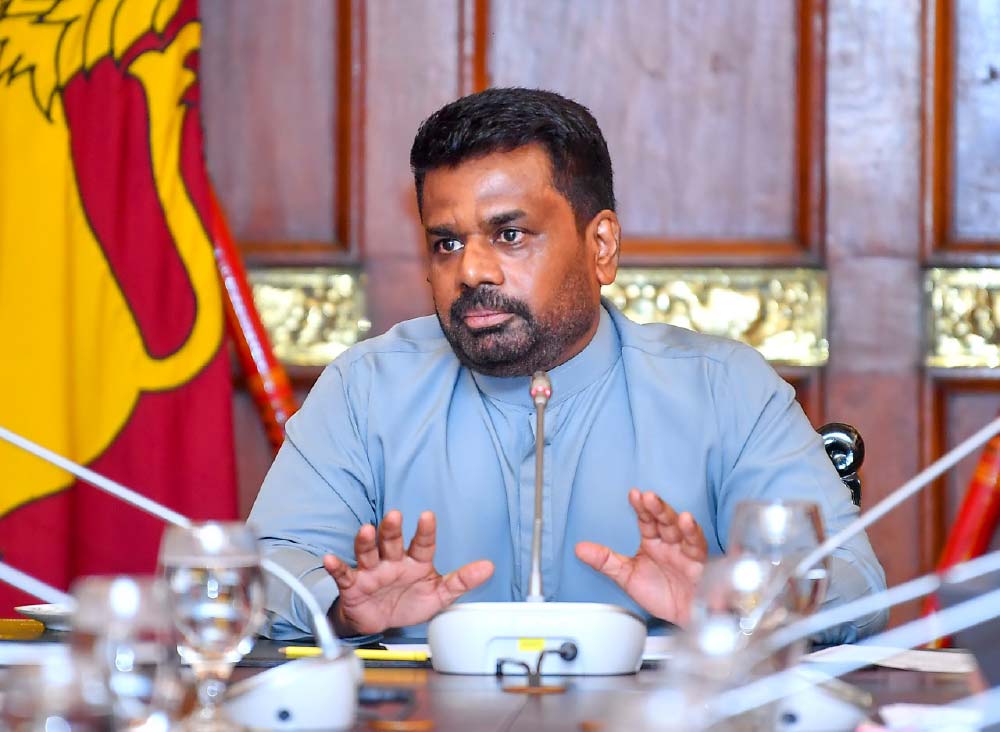
President Anura Kumara Dissanayake
President Anura Kumara Dissanayake mounted a detailed defence of the proposed 22nd Amendment to the Constitution before the Bar Association of Sri Lanka (BASL), arguing that extending the retirement age of Superior Court judges was necessary to retain judicial experience as the Government expands court capacity, and rejecting claims that the move was intended to benefit particular incumbents.
The President’s Office yesterday shared the text of the President’s comments during the meeting with BASL representatives on Wednesday.
Explaining the rationale during discussions with the BASL, the President said the retirement-age change should have been made when the 20th Amendment expanded the Supreme Court from 11 to 17 judges and the Court of Appeal from 12 to 20.
He reasoned that if the six additional Supreme Court positions had been filled from the then 12-member Court of Appeal, only six judges would have remained there. Together with the eight additional Court of Appeal positions created by the expansion from 12 to 20, this would have required 14 new appointments to the appellate court.
President Dissanayake said that was the point at which the retirement-age reform should have been introduced to retain the experience of serving judges while substantially expanding the courts. “However, that did not happen,” he said.
He said the judicial system needed to retain a mix of experience, but argued that selecting particular judges for retention on the basis of their ability or experience would itself raise questions of undue privilege and intervention.
The President said an objective assessment mechanism could be preferable, but maintained that such a mechanism alone would not guarantee judicial independence. His preferred approach was therefore a broader change applying to the judicial system rather than selecting individual judges for extended service.
Responding directly to the BASL’s argument that the extension could amount to a privilege for incumbent judges, President Dissanayake said almost any reform affecting the judiciary could be characterised in that way. He cited the previous increase in the number of Supreme Court and Court of Appeal judges as an example, saying that too could have been interpreted as creating positions for particular individuals.
He said the same argument could be made about judicial salaries, vehicle permits, or appointments and maintained that he had therefore sought to structure the proposed change without selecting particular beneficiaries.
“I regard it as an effort to take the existing state of the judiciary to a new level,” he said, rejecting the contention that it constituted a privilege for particular individuals.
On criticism over why the Amendment was being introduced now, the President said any change in retirement age would inevitably come too late for some judges who had already retired and benefit others approaching retirement. On that reasoning, he said, timing alone could not establish that the measure was designed to favour particular judges.
He also rejected arguments that the reform should be delayed until after 1 December, saying that if the objection disappeared after a particular date, the dispute appeared to concern particular individuals rather than the underlying policy.
“I have no personal interest in any particular individuals,” he said, adding that he did not know many of the judges concerned before becoming President.
President Dissanayake said the Government was not proposing a further increase in the number of Supreme Court judges, but wanted to add four Court of Appeal judges.
He linked that increase to plans to use the constitutional provision allowing the Court of Appeal to sit in the provinces rather than remaining concentrated in Colombo. Additional judges would provide the capacity for such sittings once the required infrastructure was established.
The Government also intends to establish about 11 new High Courts, primarily across 10 districts, and increase the High Court cadre from 110 to 120. The President said High Court numbers had to rise together with the establishment of new courts because, unlike the Superior Courts, High Court judges require specific courts in which to serve.
He rejected suggestions that the retirement-age changes would produce a two-year deadlock in judicial appointments and promotions. While Supreme Court appointments could be affected, he said the additional Court of Appeal judges would be appointed as new sittings were established, High Court appointments would accompany the creation of new courts, and promotions in the lower judiciary would continue.
The Judicial Service Commission is also moving to recruit 50 additional magistrates. President Dissanayake stressed that the relevant selection panels, rather than the Executive, would determine how many applicants met the required standard.
The President separately explained why some existing judicial vacancies had not yet been filled, saying he expected the issue to be resolved within about a month.
He linked the delay to the Easter Sunday case, which involves about 23,000 charges and 3,000 witnesses and is being heard by a three-member High Court bench comprising some of the most senior High Court judges, who would also be among those eligible for appointment to the Court of Appeal.
President Dissanayake said the case was now in its final stage and he had considered the consequences of elevating a judge from the bench before its conclusion, as well as the possible disadvantage to that judge if an appointment were withheld.
He said moving the judge could jeopardise continuity in a case carrying substantial public expectations of justice, while leaving the judge out of consideration could itself be unfair. The vacancies, he insisted, had not been kept open for a preferred candidate or until someone became eligible.
“If I had wanted to, I could have allowed the Easter Sunday case to collapse,” he said, questioning who would restart a trial involving about 23,000 charges and 3,000 witnesses and when victims would then receive justice.
President Dissanayake said the Amendment had to be understood within a wider reform of the justice process, beginning before cases reached court.
He said the Government planned to establish 24 regional offices of the Commission to Investigate Allegations of Bribery or Corruption (CIABOC), which currently has only one office in Colombo, and had approved the recruitment of 373 officers on higher salary scales to strengthen investigative capacity.
The Police has an approved cadre of 102,000 but only around 72,000 serving officers, of whom nearly 4,000 are unable to perform uniformed duties, leaving about 68,000 effectively available. The Government plans to recruit another 10,000 officers and provide additional equipment and technology.
The Attorney General’s Department is also to receive 50 additional officers, while the Government is reviewing promotions and increasing allowances in an effort to stem the departure of skilled and experienced legal officers.
The judicial sector itself has around 1,007 support-staff vacancies. Approval has been granted to recruit about 260 personnel, attracting around 21,000 applications, and the President said the Government intended to fill the remaining vacancies through established recruitment procedures.
Budget provisions are also planned to complete partially constructed court buildings, except projects affected by unresolved contractor disputes, and to provide permanent facilities for courts operating from rented premises. Judicial digitalisation is being advanced, with systems in the Supreme Court and Court of Appeal at the testing stage.
President Dissanayake acknowledged the BASL’s concern that the Amendment could create a damaging perception even if no individual benefit was intended, but maintained that the proposal formed part of reform spanning investigations, prosecutions, judicial capacity, staffing, and infrastructure rather than an isolated extension of judges’ tenure.
He also said his position was “firmly grounded in the Constitution” and that he had no intention of exercising Executive powers beyond those constitutionally granted, adding that he was prepared to accept any risk to his own office arising from pursuing changes he considered necessary.
The President concluded that despite the objections and wider public debate, the Government believed a change to the system was necessary and would proceed on the “principles and policy objectives underlying this reform.”




