Monday Sep 28, 2026
Monday Sep 28, 2026
Tuesday, 5 May 2026 00:02 - - {{hitsCtrl.values.hits}}
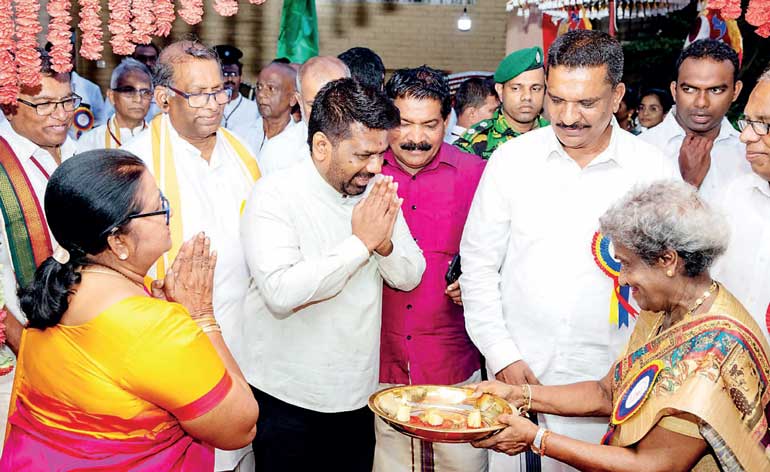
President Anura Kumara Dissanayake on Sunday issued a strong public statement on national reconciliation, declaring that Sri Lanka’s journey towards unity among the Sinhalese, Tamil, and Muslim communities has reached a point of no return and that his Government will not allow racism or extremism to regain space in the country.
Speaking at the annual Kamban Festival held at the Ramakrishna Hall in Wellawatte, the President said Sri Lanka’s future depends on building a society where all communities live together in brotherhood, equality, and dignity, while emphasising that literature, arts and culture have a critical role in healing the wounds of the country’s troubled past.
The President, who attended one of the Tamil community’s most prominent literary and cultural events, was received in accordance with traditional Hindu rituals and was later conferred the Kamban Award in recognition of his efforts to promote national unity and equality.
Strongest commitment yet on national unity
In a speech that combined reflections on Sri Lanka’s ethnic divisions, social values, and education system, President Dissanayake made it clear that the Government sees reconciliation as a national priority.
“We need a country in which all our people—Sinhalese, Tamil, Muslim, Burgher and Malay—can live together in brotherhood,” he stressed.
Acknowledging that reconciliation remains incomplete, Dissanayake stressed that progress already made would not be rolled back. “We have already taken a firm and decisive step towards national unity. I assure you that the steps already taken will not, under any circumstances, be reversed. We will not allow any space for racism or extremism to re-emerge in our country.”
The President reflected on decades of mistrust between communities, saying Sri Lankan society had once become deeply fragmented. “The Sinhalese people in the South viewed the Tamil people in the North with suspicion, hostility, and resentment. Similarly, the Tamil community in the North viewed the Sinhalese community in the same manner,” he added.
He said conflict had brought devastation to both sides. “In war, it is humanity that perishes first. In literature, it is humanity that is first revived.”
The President also made a poignant reference to the destruction of libraries during Sri Lanka’s ethnic conflict, an apparent allusion to the burning of the Jaffna Public Library in 1981. “I still reflect on how a library could be set on fire in the name of an election,” he said.
His remarks were widely seen as an attempt to acknowledge painful historical memories while positioning culture and literature as tools of national healing.
The President also shared a personal recollection involving the late Tamil political leader R. Sampanthan, referencing a conversation that deeply influenced his understanding of minority dignity and citizenship.
“Anura, I am proud to say to the world that I am a Sri Lankan, but I do not wish to live in Sri Lanka as a second-class citizen,” he recalled.
Dissanayake said it is not for politicians to define whether communities feel equal, but for citizens themselves to feel that they belong. “Everyone who is born in this country, contributes to its economy, and belongs to this land must feel a sense of belonging that this is our motherland.”
The President directly criticised the role of politics in perpetuating ethnic divisions, saying racism had often been nurtured by political actors. “The seeds of racism are deeply embedded within politics itself,” he said.
He pledged stronger legal and political action if existing laws prove insufficient. “If existing laws are not sufficient to defeat racism, we will formulate new laws and ensure that racism is decisively defeated,” he said.
A major theme of the speech was the transformative power of literature and culture, particularly the works of Tamil poet Kamban, after whom the festival is named.
The President praised the work of the All Ceylon Kamban Kazhagam, which was founded in Jaffna in 1980 to preserve Tamil literary heritage and guide younger generations through culture and values.
He described Kamban’s reinterpretation of the Ramayana as a literary work that continues to teach values of justice, morality, and humanity.
“In the creation of a new society that places humanity at its forefront, literary festivals hold a highly important place,” he added.
The President also delivered a broader critique of modern society, warning that Sri Lanka’s education system and digital culture are producing children disconnected from empathy and human values.
He described a generation burdened by schools, tuition classes and excessive academic pressure. “Are we raising our children as if they are merely nuts and bolts of a machine?”
He also expressed concern over technology-driven isolation. “Children with mobile phones in their hands have, in many cases, become absorbed into a single application or digital space,” he said.
The President argued that literature, art, and emotional intelligence must become central to child development if society is to recover its moral compass.
Dissanayake said the Government is prepared to support organisations working to strengthen Tamil literature, arts, and cinema in Sri Lanka. “What we need is a strong Tamil literary tradition in Sri Lanka, along with strong poets and filmmakers. A significant revival of Tamil arts and culture in Sri Lanka is essential. If there are any organisations working towards this goal, we, as the Government, will extend our fullest support,” he added.
Among those in attendance were religious leaders, academics, jurists, and political figures, including Fisheries Minister Ramalingam Chandrasekaran, former Malaysian Minister M.S. Aravanan, Indian political leader K. Annamalai, and liver transplant specialist Mohamed Rela.




