Monday Sep 28, 2026
Monday Sep 28, 2026
Wednesday, 29 July 2026 00:07 - - {{hitsCtrl.values.hits}}
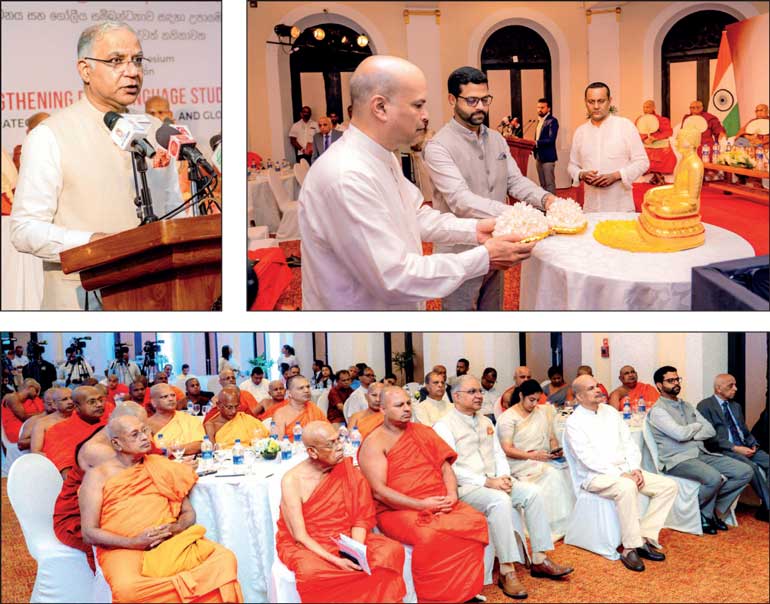
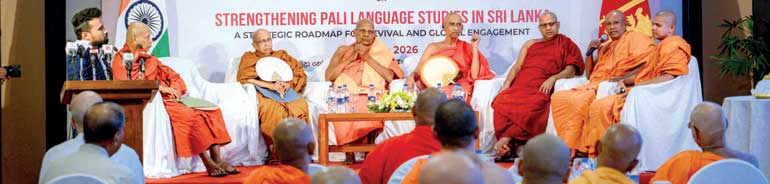
The Pathfinder Foundation, in collaboration with the High Commission of India in Colombo and the Indian Council for Cultural Relations (ICCR), held a symposium on ”Strengthening Pali Language Studies in Sri Lanka” on 24 July in Colombo.
The symposium brought together eminent members of the Maha Sangha, distinguished academics, policymakers, and education specialists to discuss the future of Pali language studies in Sri Lanka and explore practical strategies for preserving and promoting one of South Asia’s most significant classical languages.
The event was held with the blessings and participation of leading members of the Maha Sangha, including Most Venerable Dr. Niyangoda Vijithasiri, Anunayaka Thero of the Malwatta Mahavihara; Most Venerable Dr. Ittapana Dhammalankara Maha Nayaka Thero of the Kotte Sri Kalyani Samagri Dharma Maha Sangha Sabha; Most Venerable Shastrapathi Ganthune Assaji Maha Nayaka Thero of the Amarapura Chulagandhi Chapter; Senior Professor Ven. Kotapitiye Rahula, Anunayaka of the Kotte Sri Kalyani Samagri Dharma Maha Sangha Sabha; Most Venerable Dr. Waleboda Gunasiri Anunayaka Thero of the Sri Lanka Ramanna Nikaya; and Most Venerable Waskaduwe Mahindawansa Thero of the Amarapura Sambuddha Sasanodaya Maha Nikaya.
The symposium also brought together representatives of the three main Nikayas, leading scholars in Pali and Buddhist Studies, Indian High Commissioner Santosh Jha, Deputy High Commissioner Maitrey Kulkarni, Pathfinder Foundation Founder Milinda Moragoda, Swami Vivekananda Cultural Centre Acting Director Roshni Thomson, Urumayake Ulpatha General Secretary R.A.D. Sirisena, university academics, Pirivena educators, and education experts.
Delivering the keynote address, Senior Professor Ven. Medagampitiye Vijithadhamma Thera described Pali as a comprehensive knowledge system that has preserved Sri Lanka’s cultural, philosophical, and spiritual heritage for centuries. He also commended the Government of India’s decision to confer Classical Language status on Pali in 2024.
“Pirivena education remains the centre of Pali knowledge transmission, while universities represent its highest level of academic learning,” Ven. Vijithadhamma Thera said. He observed that several important Pali traditions continue to be preserved within specific monastic lineages in Sri Lanka.
He noted that Pali education is currently divided among schools, Pirivenas, and universities, emphasising the need for closer collaboration among these institutions to strengthen the discipline.
“The decline of the humanities in higher education is largely due to limited employment opportunities. Symposiums such as this are therefore essential to strengthening Pali language studies,” he said.
Drawing attention to international examples, Ven. Vijithadhamma Thera noted that countries such as Thailand and Cambodia conduct national examinations in Pali and suggested that Sri Lanka should consider introducing a similar system. He also called on universities to provide greater recognition to creative scholarly works produced in Pali. Highlighting the opportunities offered by emerging technologies, he said artificial intelligence and digital tools could play a transformative role in preserving the language.
“Palm-leaf manuscripts can be digitised using Optical Character Recognition (OCR) technology and made widely accessible. Pali is a priceless cultural treasure that must be preserved and passed on to future generations,” he said, adding that safeguarding the language requires the collective efforts of the State, schools, the Sangha, information technology professionals, researchers, and the wider academic community.
Addressing the gathering, Indian High Commissioner Santosh Jha said that participating in Buddhist events was much more than a diplomatic responsibility, as it held deep personal significance for him, having been born and raised in Bihar, close to the place where Lord Buddha attained Enlightenment.
He noted that Pali forms the very foundation of Buddhist knowledge and recalled that in October 2024 the Government of India conferred Classical Language status on Pali. Referring to the remarks of Prime Minister Narendra Modi, he said it is humanity’s responsibility to keep the Pali language alive in order to preserve the original teachings of the Buddha.
High Commissioner Jha emphasised that Pali is the language of the earliest Buddhist scriptures, including the Tripitaka, which embodies the timeless message of Dhamma. In a world increasingly affected by conflict, he said, the Buddha’s teachings provide a path towards peace, compassion, and the welfare of all humanity.
He further observed that Sri Lanka continues to play a unique role in preserving Pali through its use in religious rituals, chanting, and Theravada Buddhist traditions.
Recalling earlier initiatives, the High Commissioner noted that Sri Lanka became the first country to organise an international seminar on the significance of Pali’s recognition as a Classical Language soon after India’s decision in October 2024. He added that Prime Minister Modi had personally acknowledged the initiative and appreciated the contributions of Sri Lankan scholars in promoting Pali studies.
Building on that momentum, he said India has continued to support efforts to preserve and promote Pali, including assisting the Pathfinder Foundation in reprinting important classical Pali grammar texts such as Namamala and Balawatharo.
The symposium focused on the current state of Pali education in Sri Lanka, future prospects for its development, innovative approaches to teaching and learning, and stronger collaboration among Pirivenas, universities, research institutions, and international partners.
Participants also discussed ways of strengthening cooperation between Sri Lankan and international Pali scholars and educational institutions while laying the foundation for a sustainable national program to promote the study, teaching, research, preservation, and wider use of the Pali language for future generations.




