Tuesday Sep 15, 2026
Tuesday Sep 15, 2026
Wednesday, 25 March 2026 00:04 - - {{hitsCtrl.values.hits}}
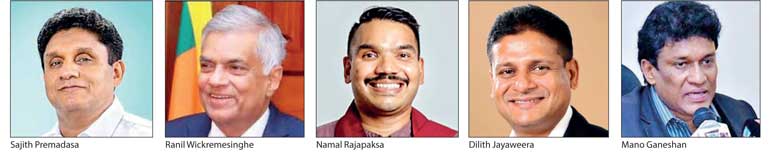
Seventeen party leaders including SJB’s Sajith Premadasa, UNP’s Ranil Wickremesinghe and NPP’s Namal Rajapakse have issued a statement on the grave situation relating to security for lawyers and the public.
The statement had been sent to several international professional organisations including the International Bar Association, Commonwealth Lawyers’ Association, International Commission of Jurists, International Association of Young Lawyers, International Association of Democratic Lawyers, Amnesty International, Human Rights Watch, International Federation for Human Rights, the World Organisation against Torture, Frontline Defenders, Office of the High Commissioner for Human Rights, United Nations Special Rapporteur on Human Rights Defenders.
The statement is as follows.
 We wish to draw your attention to a series of alarming events which have been taking place in our country in the recent past. There is now a recurring pattern of shootings and killings, with the use of sophisticated firearms, with more than 60 lives lost last year and 9 in the New Year up to now.
An incident which occurred in broad daylight on 13 February 2026, in the immediate vicinity of a high-security zone, claimed the lives of Attorney-at-Law Buddhika Mallawarachchi and his wife.
This incident has sent shockwaves through the ranks of the legal profession in our country. The Bar Association of Sri Lanka, resorting to an extraordinary course of action after an interval of 14 years, convened a meeting of the entire membership of the Association, comprising more than 3,500 attorneys-at-law, and unanimously resolved at that meeting that all members of the profession should refrain from engaging in their professional work throughout the country on Monday, 16 February. The result of this decision was that all courts, from the Supreme Court to Magistrates Courts in all parts of the country, were closed on that day, and thousands of cases scheduled for hearing had to be postponed.
Within an hour of this killing, there were statements attributed to the police that the victim of the murder had appeared professionally for a criminal well known for drug trafficking, and that the motive for the killing arose from criminal activity on the part of his clients. In the absence of any investigation at that point, there is no doubt that this was a reckless and irresponsible intervention, calculated to distort the issue, and to diminish in the public mind the gravity of this despicable atrocity.
For a country which has been justifiably proud of the stature and integrity of institutions responsible for the administration of justice, it is singularly disheartening that there is now, to a significant extent, erosion of an environment conducive to the proper functioning of the courts system. Prevailing conditions no longer allow Bench and Bar to fulfil their duties with robust independence, bereft of fear and favour.
This poses a basic challenge to the right of any accused person, enshrined in the Constitution of the country, to be represented by Counsel.
There is clear evidence of pressure brought to bear on the Attorney-General, which has the effect of politicising exercise of the prosecutorial function, with consequent detriment to perceived fairness of the criminal justice process. Due process, natural justice and established traditions are being cynically violated by vicious political attacks which have taken the place of legal submissions in Courts of Law.
Rising public discontent across the spectrum is sought to be suppressed by the provisions of a proposed anti-terrorism law which, in its present form, strikes at the very root of cherished democratic institutions and values in the country, and demonstrably infringes core obligations undertaken by Sri Lanka in international instruments, including the International Covenant on Civil and Political Rights. Directly targeted are media institutions with obvious vulnerability for owners, editors, executive staff, and media personnel at all levels.
The extreme politicisation of the police force, under the leadership of an Inspector-General who has jettisoned even the appearance of detachment and objectivity, militates seriously against professionalism and impartiality in respect of criminal investigations, including the inquiry into the recent killing of a member of the legal profession.
The Government is clearly in breach of its duty to take administrative and, if necessary, legislative measures to give effect to Article 9(4) of the Luxembourg Convention, adopted by the Council of Europe, for the protection of lawyers. The Commonwealth Association on 9 July 2016 emphatically endorsed the Convention by the assertion that “If the lawyer is not protected, then no one is protected.”
These salient features of a vibrant democracy are today under sustained and formidable challenge in our country.
The Minister of Public Security and Parliamentary Affairs, Ananda Wijepala, has failed dismally in his duty to secure the safety of citizens and to forestall the increasingly manifest deterioration of law and order in Sri Lanka.
We would like to alert international professional bodies with regard to the grave threats to the life and safety of professionals in our country, and urge them to make suitable interventions to help us preserve a culture which we have held sacrosanctity over the decades.




