Thursday Oct 15, 2026
Thursday Oct 15, 2026
Wednesday, 8 July 2026 00:02 - - {{hitsCtrl.values.hits}}
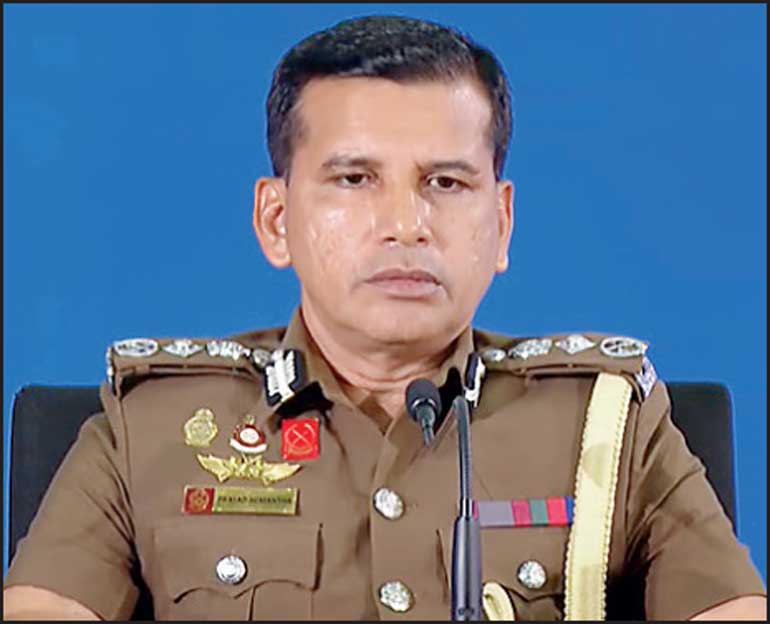
Commissioner General
of Prison
Prasad Hemantha Kumara

Cabinet Spokesman and Minister
Dr. Nalinda Jayatissa
By Charumini de Silva
The Commissioner General of Prisons Prasad Hemantha Kumara yesterday said prison authorities had received no prior intelligence about the recent unrest at Negombo Prison, while defending the actions of prison officers who he said managed to contain the violence despite inmates being under the influence of drugs.
Addressing the weekly post-Cabinet media briefing, Kumara said the unrest began on Sunday after inmates broke into the prison’s medicine storage, consumed medication as intoxicants and became increasingly violent.
He said prison officers responded immediately and were able to prevent more extensive damage. “I personally went to the Negombo prison, used a megaphone to communicate with inmates, who eventually agreed to return to their cells, allowing the situation to be brought under control and meals to be distributed,” he said.
Kumara said on Sunday, around 25 to 50 prison officers were on duty, and assistance was also sought from nearby prisons to help control the situation on Monday. However, the Commissioner General said tensions escalated again on Monday morning, which was a scheduled Court day, when inmates who had consumed the medicine were found to be intoxicated, resulting in further clashes.
Responding to questions on why prison visits had been allowed to continue on Monday despite the previous day’s violence, he said that suspending visits could have aggravated tensions.
“If visits are stopped, inmates become even more aggressive because they look forward to meeting their families and a home cooked meal after the weekend,” he explained.
Kumara said prison officers had risked their lives to restore order, noting that many inmates were in a deranged state due to drug consumption and that female inmates had also been given the drugs.
He said officers’ intervention had prevented the violence from escalating further.
“If the prison officers had not intervened to stop the clashes, I cannot even estimate the extent of the damage that could have occurred,” he said.
According to Kumara, rioting inmates damaged several security installations, including the prison’s CCTV system, body scanners and other detection equipment located at the main entrance.
Rejecting allegations that inmates had been denied treatment for dengue, Kumara said all prisoners received the required medical care from doctors in the usual manner.
Also addressing the media briefing, Cabinet Spokesman and Health Minister Dr. Nalinda Jayatissa said multiple investigations were already underway to determine the circumstances surrounding the incident.
He also dismissed claims circulating that 40 inmates had died of dengue.
“If that were the case, there would have to be bodies,” the Minister said, rejecting the allegation as false.
Dr. Jayatissa said the Government had appointed a three-member independent committee comprising a retired Supreme Court judge, an officer from the Attorney General’s Department and a senior lawyer to investigate the incident.
In parallel, separate investigations are being conducted by Negombo Police, the Colombo Crime Division (CCD), the Criminal Investigation Department (CID) and the Department of Prisons.
“The full truth of the incident will be revealed once all reports are submitted,” he said, stressing the Government’s commitment to ensuring accountability following the prison violence.
The Minister also acknowledged longstanding structural challenges within Sri Lanka’s prison system, saying prisons remain severely overcrowded and understaffed.
He said the Government was working to address these issues through legislative reforms and the construction of additional prison facilities.
Dr. Jayatissa further noted that delays in obtaining reports from the Government Analyst’s Department continued due to staff shortages. Although recruitment efforts were underway, he said the number of applicants remained well below the department’s staffing requirements, contributing to delays in investigations.




