Wednesday Nov 04, 2026
Wednesday Nov 04, 2026
Wednesday, 4 November 2026 00:00 - - {{hitsCtrl.values.hits}}
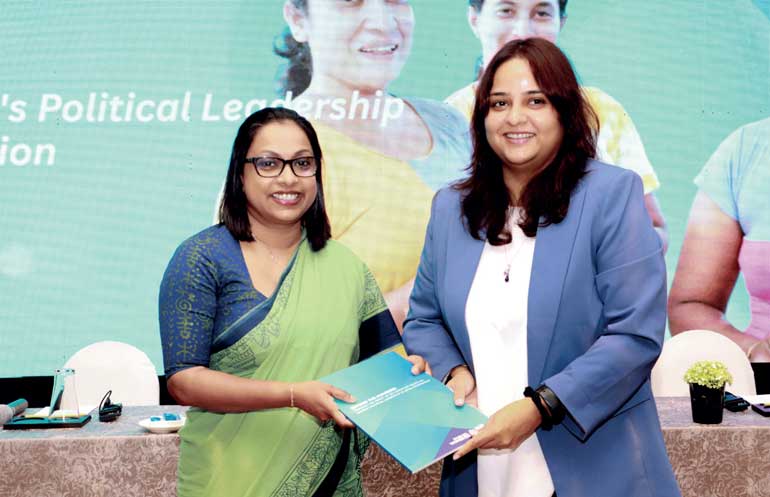
UN Women Head of Office Ramaaya Salgado (right) presents the “Beyond Numbers” report to Mass Media Deputy Minister Dr. Kaushalya Ariyarathne
UN Women yesterday launched a new report “Beyond Numbers” examining the impact and lessons of Sri Lanka’s 25% local government quota, bringing together government representatives, political actors, women leaders, civil society, development partners and the United Nations to discuss the future of women’s political participation and leadership in Sri Lanka.
Launched at a strategic dialogue convened by UN Women Sri Lanka, the report brought together government representatives, political actors, women leaders, civil society, development partners, academia and the United Nations to reflect on the future of women’s political participation and leadership in Sri Lanka.
The report was launched at a strategic dialogue convened by UN Women Sri Lanka, providing a platform to reflect on the gains achieved through the quota, the barriers that continue to limit women’s participation and leadership, and the reforms needed to accelerate progress across local, provincial and national levels.
Sri Lanka has made important gains in women’s political representation over the past several years, including through the introduction of the local government quota and increased representation in Parliament. Yet progress towards equal participation and influence remains uneven. Women continue to face barriers including party gatekeeping, limited access to campaign resources and political networks, unequal opportunities for leadership within party structures, harassment and violence, and persistent social norms that question women’s legitimacy as political leaders.
The report highlights the significance of the 25% quota for women’s seats in local government, which increased women’s representation in local authorities from less than 2% to nearly 23%. Beyond increasing numbers, the quota provides important lessons on what enables women to enter political institutions, the extent to which greater representation translates into influence, and where structural barriers continue to impede women’s leadership and participation.
UN Women Sri Lanka Head of Office Ramaaya Salgado said: “While increasing representation is important, the next challenge is ensuring that representation translates into meaningful participation, influence and leadership. The experiences of women who entered local government through the quota offer valuable insights into what works, what continues to limit women’s political participation, and what reforms are needed to create a more inclusive political landscape.”
Discussions during the dialogue explored the relationship between representation, influence and political leadership; the implications of the quota experience for future reforms at provincial and national levels; and the institutional, political and social changes needed to strengthen pathways for women’s leadership. Participants also examined issues related to nomination processes, campaign financing, leadership progression, safety, accountability and the broader enabling environment for women in politics.
The dialogue further underscored the importance of ensuring that efforts to strengthen political participation are inclusive and responsive to the experiences of women facing multiple and intersecting forms of exclusion, including women from minority communities, women with disabilities, young women, rural women, women affected by conflict, and women outside established political networks.
The event forms part of UN Women’s ongoing support to evidence-based policymaking, inclusive governance and women’s leadership in Sri Lanka. Findings from the report and recommendations emerging from the dialogue will contribute to future policy engagement, advocacy, programming and partnerships aimed at advancing women's political participation and leadership, and ensuring that increased representation translates into meaningful influence and lasting change.
Full report is available at https://bit.ly/women-local-governance




