Tuesday Oct 06, 2026
Tuesday Oct 06, 2026
Thursday, 11 June 2026 00:03 - - {{hitsCtrl.values.hits}}
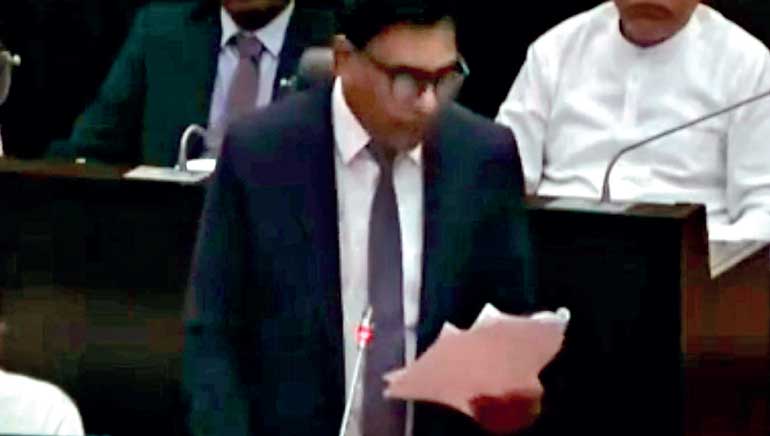
Public Security Minister Ananda Wijepala
Public Security Minister Ananda Wijepala yesterday disclosed what he described as significant new findings in the ongoing investigation into the 2019 Easter Sunday terror attacks, alleging that former State Intelligence Service (SIS) Director and retired Major General Tuan Suresh Sallay conspired to facilitate the suicide bombings that killed hundreds and injured many more.
Addressing the Parliament, he said investigators had uncovered sufficient and credible evidence to reasonably suspect that the former senior intelligence official played a role in creating the conditions that enabled the coordinated attacks of 21 April 2019.
Wijepala claimed that Sallay had not been cooperating with the investigations. “Sallay has not given the password to his phone and laptop, citing memory loss,” he said.
According to the Minister, investigators believe Sallay, who previously served as Director of Military Intelligence and later headed the SIS, was involved in activities that strategically directed Islamic extremists towards carrying out the attacks, which caused extensive loss of life, injuries, property destruction, severe economic damage and long-term harm to inter-religious and inter-ethnic relations in Sri Lanka.
Wijepala disclosed that a key strand of the investigation relates to an alleged covert intelligence-gathering operation conducted three weeks before the bombings. “Investigators claim that four Muslim individuals were deployed under the direction of the suspect to collect sensitive information from Catholic churches in Negombo area, including attendance figures and other details considered critical for planning potential targets and assessing the scale of attacks,” he said.
He said a witness has reportedly identified the photograph of the principal individual involved in that operation from a collection of images maintained by the Criminal Investigation Department (CID) relating to Islamic extremist suspects. Authorities said the individual was an ISIS ideologue who has remained missing since the Easter Sunday attacks.
The Minister also noted that intelligence warnings regarding a possible attack by members of the National Thowheed Jama’ath (NTJ), including its leader Zahran Hashim, had been received before the bombings. “These warnings were allegedly provided by an intelligence informant based in Panadura, who alerted military intelligence authorities about an imminent threat,” he added.
However, Wijepala alleged that the information was ignored within the military intelligence structure, allowing the attacks to proceed. He also claimed that the informant was unlawfully arrested and detained after sharing the warning.
Following his release, the informant was allegedly summoned to a meeting with Sallay at the Galadari Hotel in Colombo, where the matter was discussed and the former intelligence chief is said to have apologised to him.
The Minister said statements made by Mohamed Milar Mohamed Hanseer, also known as Azad Maulana, during a program aired by the British broadcaster Channel 4, had provided additional support for findings suggesting that a deliberate and structured background had been created to facilitate the attacks.
Wijepala said investigators now suspect that Sallay had prior knowledge of the plot and may have actively participated in a conspiracy that not only enabled the attacks, but also obstructed the disclosure of critical information before and after the incident.
The alleged actions, he said, amount to offences under the Prevention of Terrorism Act (PTA) No. 48 of 1979, including providing direct or indirect support to terrorist activity and assisting in concealing those responsible. Investigations have also pointed to deliberate efforts to prevent the exposure of key facts relating to one of the most controversial and sensitive incidents in Sri Lanka’s recent history.
The Minister also sought to address concerns regarding the treatment of the suspect following his arrest. “Sallay had been granted all legal rights available to detainees, including access to legal counsel, communication with family members and formal notification procedures,” he said.
According to Wijepala, investigators escorted the suspect to his residence after the arrest, informed family members of the reasons for his detention and provided an official arrest receipt to his wife. The CID subsequently notified the Human Rights Commission of Sri Lanka (HRCSL) in writing and produced the suspect before the Colombo Judicial Medical Officer.
Detention orders were initially obtained for 72 hours under the PTA and later extended under Section 9 of the Act, permitting detention and interrogation for up to 90 days. The Colombo Fort Magistrate’s Court was informed under case number B 35882/2024, with Sallay named as the third accused in the proceedings.
Authorities also informed both the HRCSL and the suspect’s relatives regarding the detention arrangements. Wijepala said Sallay has been permitted weekly consultations with his lawyer, regular telephone conversations with close family members and in-person family visits during which relatives may provide food, clothing and other personal necessities.
In addition, he said Sallay was being treated for a skin rash around groin area, a hearing problem, a tooth replacement, an MRI scan, and many other medical treatments.
“Under amendments introduced through Act No. 12 of 2022 to the PTA, the Colombo Fort Magistrate has personally visited the CID detention facility on multiple occasions to inspect the suspect’s condition. During those visits, Sallay had not made any complaints regarding torture, inhumane treatment or mistreatment,” Wijepala said, noting that no formal complaints had been lodged against investigators.
The Minister pointed out that his behaviour changed entirely only after a Court order issued on 3 June 2026 imposed overseas travel bans on former President Gotabaya Rajapaksa and two former military officers as part of the ongoing Easter Sunday investigations.
He said inquiries remain ongoing as authorities continue efforts to establish the full extent of the alleged conspiracy behind the Easter Sunday attacks, one of the deadliest terrorist incidents in Sri Lanka’s history.



