Tuesday Oct 06, 2026
Tuesday Oct 06, 2026
Thursday, 25 June 2026 06:48 - - {{hitsCtrl.values.hits}}
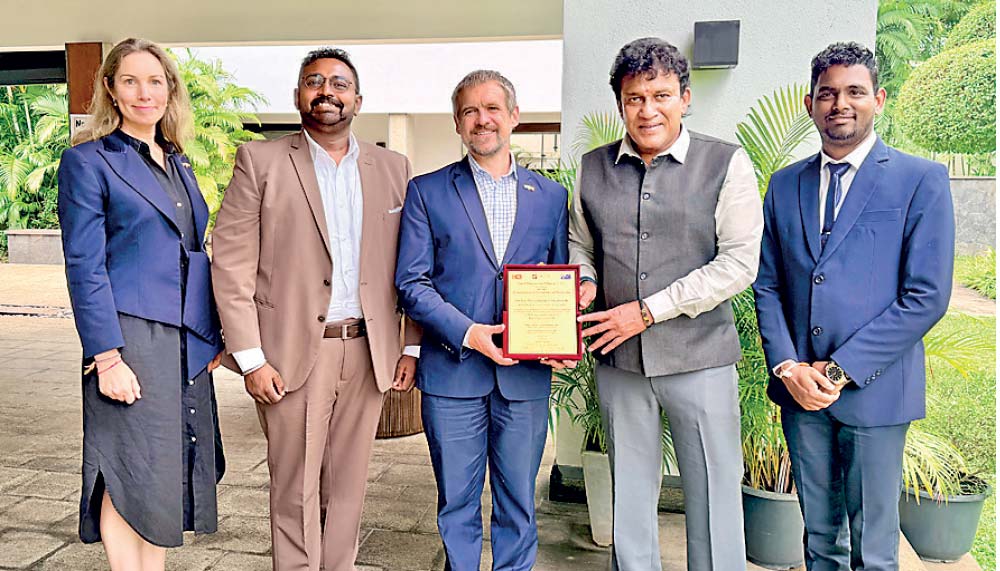
The delegation of the Tamil Progressive Alliance (TPA), led by party Leader MP Mano Ganesan, met with Australian High Commissioner Matthew Duckworth at the Australia House in Colombo last week for a comprehensive discussion on issues affecting the Malaiyaha Tamil community and broader matters relating to national democratic governance and inclusive development.
The TPA delegation comprised MP Ganesan, Vice President – International Affairs and Communications Barath Arullsamy, and Ratnapura Pradeshiya Sabha Vice Chairman Chandrakumar.
Representing the Australian High Commission were High Commissioner Duckworth, Deputy High Commissioner Ruth Baird, and Second Secretary – Political Matthew Lord.
During the meeting, Ganesan emphasised that the Malaiyaha Tamil community must no longer be viewed solely through the lens of its historical origins as an indentured labour force.
“The community has undergone a significant transformation and today constitutes Sri Lanka’s fourth largest ethnic community, numbering approximately 1.5 million people. The aspirations of our people have evolved beyond labour-related concerns and now encompass equal citizenship, land ownership, education, economic empowerment, and meaningful participation in national development,” he said.
The delegation briefed the High Commissioner on the longstanding land rights challenges faced by estate communities. It was highlighted that despite contributing significantly to Sri Lanka’s economy for over two centuries, thousands of plantation families continue to live without secure land tenure.
Ganesan also pointed out that while Sri Lankan law provides mechanisms for land allocation to landless citizens, many plantation families remain excluded from these benefits. The TPA reiterated that access to land ownership is fundamental to ensuring dignity, social mobility, housing security, and long-term economic development for the community.
The discussion also focused extensively on disaster-affected families in the Central and Uva Provinces, particularly in the districts of Nuwara Eliya, Kandy, and Badulla. The delegation highlighted that many families displaced by landslides and earth movements continue to live in temporary accommodation, with relatives, or in vulnerable locations despite the passage of several months.
Ganesan expressed appreciation to the Government of Australia for its financial assistance towards strengthening the National Building Research Organisation (NBRO), particularly initiatives relating to digital mapping and technological modernisation. The delegation noted that delays in NBRO clearance processes have often become a major obstacle in identifying and releasing suitable lands for housing and resettlement projects.
He conveyed the community’s gratitude for Australia’s support, noting that improved technical capacity within the NBRO would contribute modernisation towards accelerating solutions for affected families.
The meeting also included an exchange of views on democratic governance, reconciliation, minority inclusion, and constitutional reform. The delegation observed that several commitments made by the current National People’s Power (NPP) Government, including reforms relating to democratic institutions and minority concerns, remain unfulfilled and stressed the importance of ensuring that governance reforms proceed alongside economic recovery efforts.
The delegation further briefed the High Commissioner on the proposed National Tamil Community Council (NTCC), a non-territorial representative mechanism intended to provide structured policy input and parliamentary engagement for communities dispersed across multiple regions of the country.
Both parties reaffirmed the importance of continued engagement and dialogue on issues affecting vulnerable communities and inclusive national development.



