Thursday Oct 15, 2026
Thursday Oct 15, 2026
Monday, 16 February 2026 02:55 - - {{hitsCtrl.values.hits}}
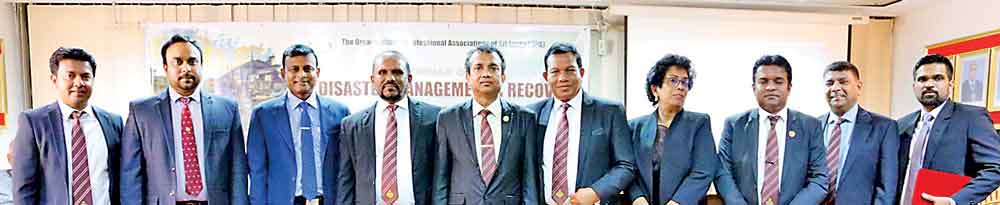
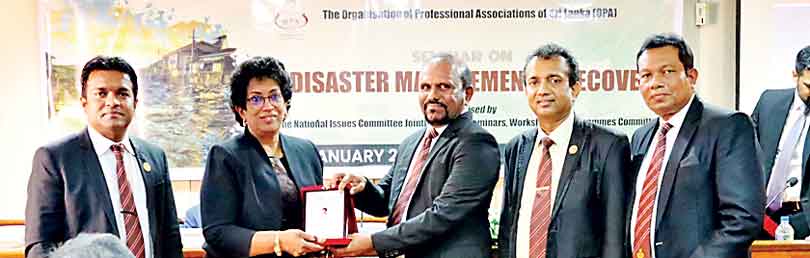
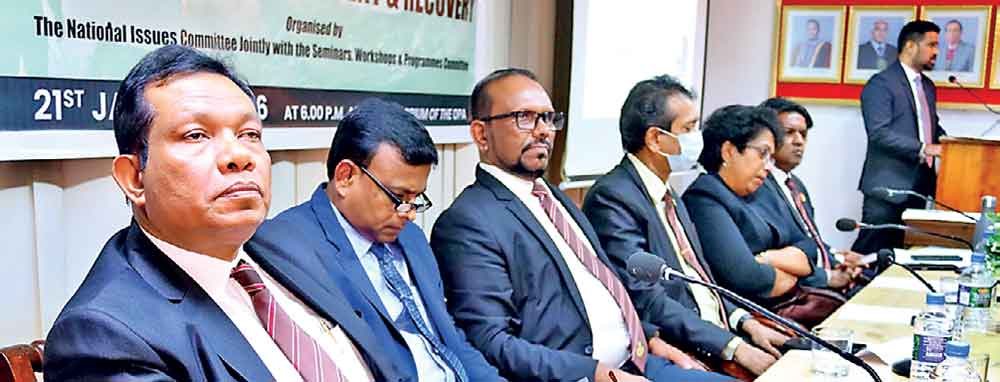
In the aftermath of Cyclone Ditwah, we must “build back better” to ensure an equitable recovery and a more resilient, sustainable future for all Sri Lankans. This was highlighted at a seminar on “Disaster Management and Recovery,” jointly organised by the National Issues Committee and the Seminars, Workshops, and Programs Committee of the OPA on 21 January at the OPA auditorium. The event began with introductory remarks by OPA Vice President Bhanu Wijayaratne who is also the Chairman of the National Issues Committee.
The guest speakers included Loughborough University, UK Professor of Disaster Risks and Climate Resilience Professor Dilanthi Amaratunga, Essential Services Commissioner General Prabath Chandrakeerthi, Disaster Management Centre Director of Preparedness Chathura Liyanaarchchige and National Building Research Organisation Director of the Human Settlements, Planning, and Training Division Chinthaka Rathnasiri.
Prabath Chandrakeerthi provided an overview of the extent of damage, current status, and recovery plan. He noted that, based on NBRO assessments, 8 hospitals need to be relocated to safer locations, while three major hospitals must be restored. A minimum of 18 months would be required to repair damaged roads, bridges and railway tracks. Although electricity, water, and telecommunication services have largely been restored, permanent repair work is still ongoing. He stated that 429 safety centres continue to operate, providing shelter to families displaced by the destruction of over 6,000 houses. Recovery initiatives for the plantation, livestock, and fisheries sectors were also outlined.
Chathura Liyanaarchchige pointed out the importance of science and technology in disaster management. He highlighted the need to enhance impact-based forecasting and early warning systems, strengthen scientific approaches to risk reduction, promote research in resilient infrastructure, improve early warning communication, build institutional capacity, utilise artificial intelligence and machine learning, introduce decision support systems, enhance disaster mitigation and adaptation, strengthen search and rescue capacities, and conduct regular disaster preparedness and simulation exercises.
Chinthaka Rathnasiri described the efforts of the National Building Research Institute in landslide disaster risk management. These initiatives included landslide hazard and risk identification, risk communication, landslide early warning system, mitigation of high-risk landslides, landslide risk assessment for development projects, research and development, capacity building and technical services for resilience. He also provided examples of the NBRI’s work in landslide-prone districts.
Professor Dilanthi Amaratunga argued that that the focus should transition from immediate emergency response to long-term national stability by integrating physical rebuilding with social recovery. She declared that the devastation of Cyclone Ditwah has highlighted that Sri Lanka’s
current infrastructure was “built for a different century”. Long term reconstruction must include restoring economic Independence, resolving the shelter crisis, preventing climate-sensitive diseases and correcting social vulnerabilities by ensuring that marginalised groups are benefited through inclusive reconstruction.
Prof. Amaratunga highlighted the importance of pre-disaster recovery to enhance resilience rather than rebuilding existing risks. This includes ensuring risk assessments to understand the locational vulnerability of relocation sites, arrangement of finance through insurance or other instruments, and building the capacity of critical stakeholders on safe (re)construction sites. She observed that, although strict regulations are there in case of buildings and houses, a faulty system, administrative bottlenecks and malpractices have created many loopholes and avenues to bypass the system, necessitating a paradigm shift to fix the system. She called upon the government, private sector, academia, civil society and other partners and stakeholders to seize this opportunity to take concrete actions to build a more resilient future for all communities across Sri Lanka.
The presentations were followed by a vibrant question and answer session moderated by Bhanu Wijayaratne. The seminar was attended by OPA President Jayantha Gallehewa, office bearers and members of the OPA.