Wednesday Oct 07, 2026
Wednesday Oct 07, 2026
Tuesday, 17 February 2026 04:57 - - {{hitsCtrl.values.hits}}
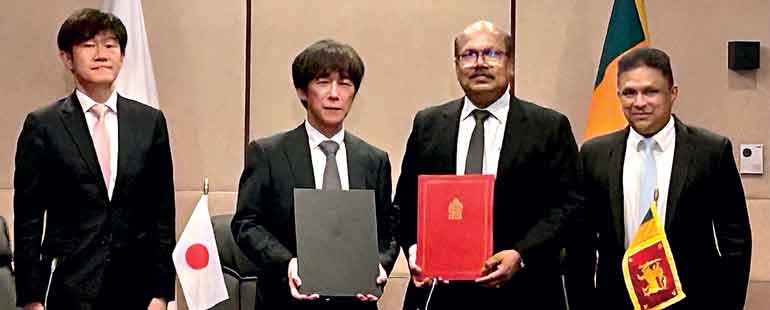
The Inter-Governmental Economic Policy Dialogue between Japan and Sri Lanka reconvened for the first time in 10 years yesterday in Colombo.
The Dialogue was co-chaired by Japanese Economy, Trade and Industry Ministry (METI) International Affairs Vice Minister Takehiko Matsuo and Sri Lankan Trade Secretary K.A. Vimalenthirarajah.
A large business delegation composed of around 40 business leaders, led by Japan-Sri Lanka Business Co-operation Committee Chairman and Itochu Corporation Chief Administration Officer Fumihiko Kobayashi, also participated in the Dialogue.
Based on the ‘Japan-Sri Lanka Joint Statement’ issued during the official visit of President Anura Kumara Dissanayake to Japan in September last year, the Dialogue was resumed with the objective of jointly exploring opportunities to enhance Sri Lanka’s industrial development and economic growth.
Prior to the Dialogue, a new Memorandum of Cooperation (MOC) on this Dialogue was signed by representatives of both sides.
Vice Minister Matsuo set out three key priorities for further strengthening bilateral relations between Japan and Sri Lanka.
First, he highlighted the economic development potential of Sri Lanka, particularly through the ‘Conceptual Roadmap on Building an Export-Oriented Industrial Corridor,’ which was announced as a proposal by the METI and the Japan External Trade Organisation (JETRO) during President Dissanayake’s visit. In this context, he noted the importance of promoting intra-regional trade by leveraging the vast South Asian market, as well as facilitating Sri Lanka’s integration into global supply chains.
Second, he stressed the importance of enhancing preparedness and response capabilities in times of crisis. He noted that strengthening financial resilience requires reducing overreliance on tourism, remittances from migrant workers, and tea exports, and advancing economic diversification.
Third, he emphasised the need to promote positive success stories. In order to attract investment and encourage market entry into Sri Lanka, it is essential to further improve the business environment by addressing challenges faced by Japanese companies operating in the country.
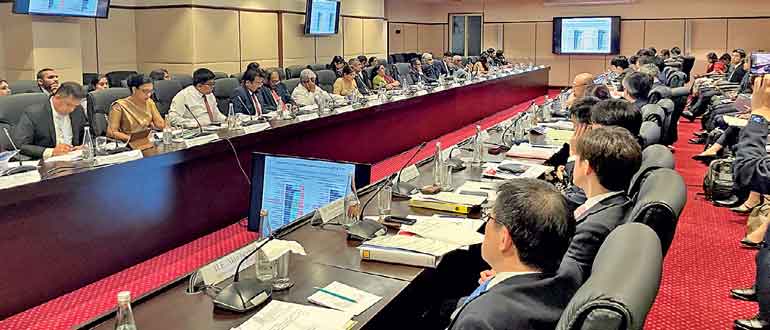
Referring to the importance of addressing concrete issues Japanese companies operating in Sri Lanka are facing, Japanese Ambassador Akio Isomata expressed appreciation for the cooperation of the Board of Investment (BOI) and other relevant agencies of the Government of Sri Lanka in establishing the Japan-Sri Lanka Committee on Business Environment last August, and for having been convening working-level meetings since then.
The Japanese Ambassador noted the three fundamental elements of a sound business environment, namely, “transparency,” “predictability,” and “non-discriminatory treatment (level playing field).”
He also asked for an early realisation and effective implementation of a single window system for investment approval procedures to facilitate future investment.
He also said that Japan would like to see, as a way forward to invite investors to Sri Lanka, an economic development strategy including policies on the diversification of export products and markets that will lead the country to a sustainable growth.
The Japanese Ambassador further said that Japan would also like to see sector-wise industrial promotion roadmaps in a clear-cut manner, so that foreign investors can understand potential investment opportunities in Sri Lanka.
Representing the Japanese Foreign Affairs Ministry, Southwest Asia Division Director Masakatsu Murotani affirmed commitment to addressing the challenges identified during the Dialogue.
Kobayashi underscored the importance of further integrating Japanese companies into the global market, including Sri Lanka, and of expanding their global supply chains in light of the contraction of Japan’s domestic market.
Referring to the presentations delivered by Dole Asia Holdings Ltd., and Mitsui & Co. Ltd., at the Dialogue, he further emphasised the need to address the challenges currently faced by Japanese companies in order to generate mutual benefits for both Japan and Sri Lanka.
During the Dialogue, both sides exchanged views on the advancement of future business cooperation between Japan and Sri Lanka, as well as on the challenges that must be addressed to further strengthen bilateral economic ties.



