Thursday Oct 15, 2026
Thursday Oct 15, 2026
Tuesday, 5 May 2026 00:03 - - {{hitsCtrl.values.hits}}
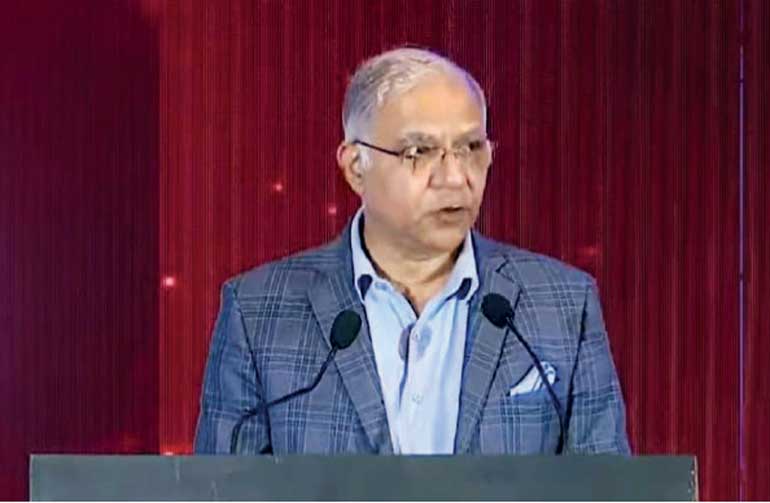
Indian High Commissioner
Santosh Jha
India has called for a bold reset in its economic and strategic engagement with Sri Lanka, with Indian High Commissioner Santosh Jha urging both countries to move beyond symbolism and accelerate long-discussed agreements on trade, connectivity, energy, and digital integration.
Delivering a keynote address at the Global Innovation and Leadership Summit in Colombo on Saturday, organised by Z Media and WION, Jha described the India-Sri Lanka relationship as one rooted in centuries of shared history rather than conventional diplomacy.
“This is not simply a bilateral relationship. It is a civilisational bond,” Jha said, recalling Indian Prime Minister Narendra Modi’s description of India and Sri Lanka as “civilisational twins” during his April 2025 visit.
He said ties between the two nations predate treaties, trade agreements, and formal diplomatic structures, citing shared religious, cultural, and historical linkages ranging from the Ramayana tradition to the transmission of Theravada Buddhist texts and the region’s ancient architectural influences.
“These are not coincidences of geography. These are the signatures of a shared civilisation,” he said.
Positioning India-Sri Lanka relations against an increasingly fragmented global order, Jha said the world was entering a period marked by weaponised supply chains, geopolitical competition, economic uncertainty, and weakening confidence in global institutions.
“When the world is uncertain, you turn to those you trust. And trust, real trust, is built over centuries, not decades. India and Sri Lanka have that in plenty,” he said.
Jha said this depth of trust gives the bilateral relationship resilience that transactional partnerships often lack, especially during political or economic shocks.
He also highlighted India’s role as Sri Lanka’s largest trading partner, largest source of tourists, and one of its leading foreign investors.
The High Commissioner said Indian-linked investments in Sri Lanka accounted for 50% of total foreign direct investment (FDI) inflows last year, including investments routed through third countries.
Referring to the India-Sri Lanka Free Trade Agreement (FTA), Jha noted that the agreement had delivered stronger relative gains for Sri Lanka.
“More than 65% of Sri Lankan exports use FTA benefits, whereas only 5% of Indian exports use the same,” he said.
He also pointed out that Sri Lanka has maintained a trade surplus with India for over a decade when only FTA-enabled trade is considered, while India has emerged as Sri Lanka’s second-largest export destination.
Despite this, he warned that both countries have spent too long discussing an upgrade to the agreement without meaningful progress.
“We have spent too long talking about it; sometimes renaming it; but not actually moving with purpose and required political will to forge a new framework,” Jha said.
“I say this not to assign blame — but to note that every year of delay is a year of opportunity lost.”
One of the strongest themes of his address was physical connectivity between the two neighbours, particularly across the Palk Strait.
Jha noted that while Colombo and Chennai are separated by roughly 300 kilometres by sea, the distance between Rameswaram and Talaimannar is just 30 kilometres. “And yet, there is no direct road. No railway. No ferry service that runs at scale. No energy grid connection. No pipeline. It is, frankly, an anomaly. The time for wavering is over,” he said.
Jha argued that a permanent land link, whether by bridge or tunnel, would fundamentally reshape the economic geography of the region and help Sri Lanka realise its ambitions of becoming a regional hub.
The High Commissioner also pushed for deeper cooperation in energy infrastructure, including a submarine electricity interconnection, petroleum pipeline arrangements, and the development of tank farm infrastructure.
He said such projects would enhance Sri Lanka’s energy security and price stability at a time of heightened volatility in global energy markets.
Drawing comparisons with India’s regional power cooperation with Nepal, Bhutan, and Bangladesh, Jha said similar arrangements could unlock long-term strategic benefits for Sri Lanka.
On digital cooperation, he pointed to India’s digital public infrastructure, including platforms such as UPI and Aadhaar, saying these could serve as models for Sri Lanka’s own digital transformation.
“The opportunity to collaborate, to share platforms, to build joint capabilities, to create a seamless digital corridor between our two economies is right in front of us,” he said.
Jha also referenced India’s support during Sri Lanka’s 2022 economic crisis, including fuel, food, medicine, and credit support, as well as assistance during Cyclone Ditwah and recent energy-related disruptions linked to West Asia.
He said India’s post-Ditwah support amounted to $ 450 million and emphasised that India’s development partnership with Sri Lanka has remained people-centric.
He highlighted projects such as the Indian Housing Project, which he said has provided homes to around 55,000 families, alongside investments in railways, bridges, schools, hospitals, scholarships, and training programs.
“A Sri Lanka that is economically strong, socially cohesive, and regionally connected is unambiguously in India’s interest,” he said.
In his closing remarks, Jha rejected perceptions of an unequal relationship between the two countries, insisting the partnership should be viewed as one between equals.
“This is not a partnership of big and small; there is no big brother here but two civilisational twins,” he said.
He urged businesses, policymakers, and the media in both countries to act decisively to convert historic goodwill into tangible economic outcomes.
“The world is changing fast. The window of opportunity does not stay open forever. India and Sri Lanka have everything they need to build something extraordinary together. All we need now is to start building,” he said.




