Tuesday Oct 06, 2026
Tuesday Oct 06, 2026
Saturday, 25 April 2026 01:20 - - {{hitsCtrl.values.hits}}
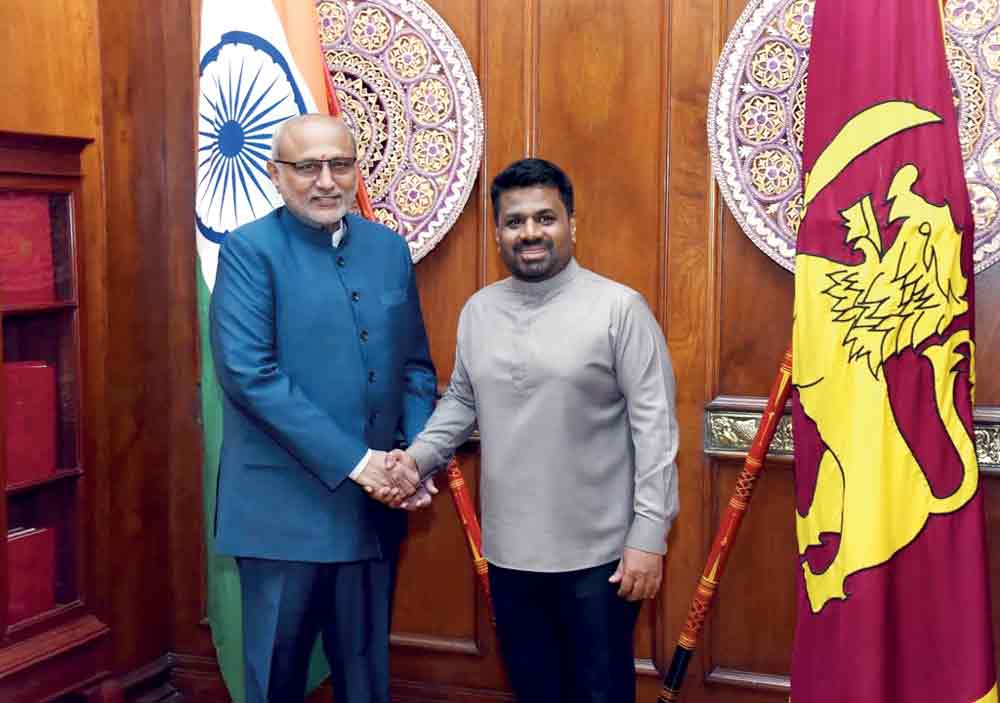
India Vice President C.P. Radhakrishnan (left) with President Anura Kumara Dissanayake
India Vice President C.P. Radhakrishnan visited Sri Lanka from 19 to 20 April 2026. He was accompanied by Prof. S.P. Singh Baghel, Minister of State in the Ministry of Fisheries, Animal Husbandry and Dairying and the Ministry of Panchayati Raj, and Members of Parliament Dr. K. Laxman and Dr. Medha Vishram Kulkarni. This was the first-ever bilateral visit of the Vice President of India to Sri Lanka. Earlier, in October 2000, Krishan Kant, the then Vice President of India, had visited Sri Lanka for the State funeral of former Prime Minister Sirimavo Bandaranaike.
On 19 April, the Vice President called on President Anura Kumara Dissanayake at the Presidential Secretariat in Colombo. The two leaders reviewed ongoing bilateral initiatives, including the progress of various development cooperation projects being undertaken by India in Sri Lanka.
They noted the resumption of train services following restoration work on the Northern Railway Line, which had suffered extensive damage during Cyclone Ditwah in November–December 2025.
The restoration work was carried out under a $ 5 million grant from the Government of India. Both sides also noted the completion of three Bailey bridges, restoring critical road connectivity following the devastation caused by Cyclone Ditwah. These Bailey bridges, completed alongside the visit, were constructed by the Indian Army as part of India’s $ 450 million assistance package for reconstruction and rehabilitation. The Vice President also welcomed Sri Lanka’s decision to join the India-led International Big Cat Alliance.
Prime Minister Dr. Harini Amarasuriya hosted a luncheon in honour of the Vice President. The two leaders discussed the deep civilisational bonds between India and Sri Lanka and the vibrant people-to-people connections that sustain these ties.
The Vice President and the Prime Minister, who is also the Education Minister, noted the enhancement of support under the Ceylon Estate Workers Education Trust scholarship scheme. The number of scholarships has been increased from 350 to 700, and the monthly stipend has been increased to Rs. 2,500 for A-Level students and Rs. 7,500 for those pursuing higher education, benefiting the children of estate workers.
Radhakrishnan also interacted with leaders of Indian Origin Tamil and Sri Lankan Tamil political parties, in addition to meeting Opposition Leader Sajith Premadasa in Colombo on 19 April.
He addressed around 1,000 members of the Indian diaspora at a community reception at the New Kathiresan Hall in Colombo. At the event, Radhakrishnan announced the extension of Overseas Citizen of India card eligibility to include fifth- and sixth-generation Indian Origin Tamils in Sri Lanka, expanding from the previous limit of four generations.
He also announced the simplification of the OCI process by recognising certificates issued by the Sri Lankan Government as proof of origin. OCI cards will now be issued based on such documentation, including Certificates of Registration issued by the Sri Lankan Government, India-Sri Lanka passports, or registration records maintained at the High Commission of India in Colombo and the Assistant High Commission of India in Kandy.
This was a long-standing request of the Indian diaspora in Sri Lanka and will benefit Indian Origin Tamils, especially estate workers. The Vice President also virtually inaugurated and handed over the final set of 145 houses to beneficiaries, marking the completion of Phase III of the Indian Housing Project, under which 4,000 houses have been constructed for plantation estate workers.
The Indian Housing Project, with an overall commitment of around INR 1,835 crores (Rs. 62.75 billion, approx.), is a flagship grant assistance project in Sri Lanka and is the largest overseas project undertaken by the Government of India. As part of the initiative, 50,000 houses have already been completed, and work on another 10,000 houses is underway.
The Vice President also paid his respects at the Kathiresan Temple and the Gangaramaya Temple, where the Holy Relics of Lord Buddha from Devnimori in Gujarat were on display in February 2026.
On 20 April, the Radhakrishnan visited houses constructed under the Indian Housing Project at the Liddlesdale Estate in Ragala, in the Nuwara Eliya district. He interacted with families of beneficiaries and visited the village, where 166 houses have been constructed under Phase III.
In Nuwara Eliya, he also visited the Seetha Amman Temple, a key location associated with the Ramayana, where Mata Sita is believed to have been held captive by Ravana in Ashok Vatika.
In addition to the announcements on OCI eligibility, completion of Phase III of the Indian Housing Project, resumption of train services on the restored Northern Railway Line, installation of three Bailey bridges and expansion of the CEWET scholarship scheme, Sri Lanka’s decision to join the India-led International Big Cat Alliance was also noted.
The following MoUs were exchanged during the visit: An MoU covering the first set of six priority projects under the Multi-Sectoral Grant Assistance programme for the Eastern Province, and an MoU for the construction of a four-storey medical ward complex at the District General Hospital in Mullaitivu.
The Indian High Commission in a statement said Sri Lanka remains a key partner in India’s ‘Neighbourhood First’ policy and Vision MAHASAGAR. This first-ever bilateral visit of the Indian Vice President to Sri Lanka follows recent high-level engagements between the two countries and is expected to further reinforce the longstanding people-to-people ties between India and Sri Lanka.



