Saturday Sep 26, 2026
Saturday Sep 26, 2026
Saturday, 26 September 2026 00:00 - - {{hitsCtrl.values.hits}}
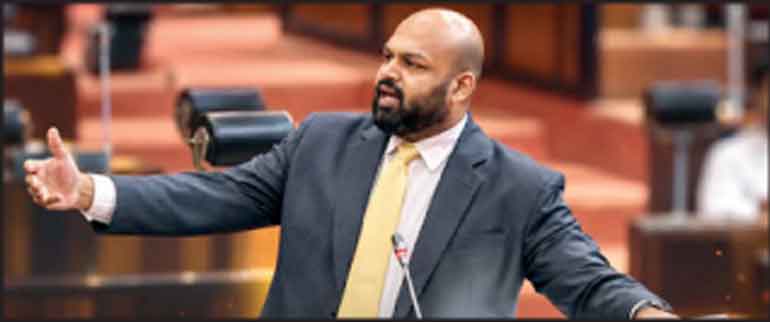
ITAK MP Shanakiyan Rasamanickam
The Ilankai Tamil Arasu Kachchi (ITAK) yesterday voted against the 22nd Amendment to the Constitution and the Judicature (Amendment) Bill, after Parliamentary Group Leader Shanakiyan Rasamanickam questioned the timing of the extension of judicial tenure and whether the changes would ease the court delays faced by ordinary citizens.
Speaking during the debate on the two pieces of legislation, Rasamanickam said the party’s stand was based on principle and acknowledged that its votes would not defeat the amendments, given the Government’s majority.
He said several Supreme Court judges had been allowed to retire under the existing provisions before the amendments were introduced during a further period of judicial succession. The amendments would raise the retirement age of judges from 65 to 67.
“We are not supporting one judge or opposing another judge. Our question is why these amendments were not introduced before the earlier retirements, and why they have been brought at this particular time,” Rasamanickam said, calling on the Government to explain its reasoning to the country.
He argued that the amendments did not target the main source of judicial delay. Of more than 1.1 million cases pending in Sri Lanka’s judicial system, around 800,000 are before Magistrates’ Courts and around 260,000 before District Courts, the courts ordinary citizens most frequently approach.
“If a judge can hear five cases a day, keeping the same judge for another two years does not suddenly enable that judge to hear ten cases a day,” he said, calling instead for more judges, more courts, better infrastructure and better case management.
The amendments also raise the maximum number of Court of Appeal judges to 24 from 19. Rasamanickam said the Court of Appeal required adequate judges, but that the overwhelming backlog lay in the lower courts.
He noted that the National People’s Power (NPP) had come to power promising to abolish the Executive Presidency, and that Foreign Minister Vijitha Herath had, while in the Opposition, moved a Private Member’s proposal seeking its abolition. The Government had instead prioritised extending judges’ retirement ages, he said.
Rasamanickam said ITAK would have been prepared to support genuine and comprehensive judicial reform had changes to the number of judges, retirement ages and the structure of the judiciary been brought as part of a new Constitution.
Citing past clashes between the Executive and the Judiciary, including those involving President J.R. Jayewardene and Chief Justice Neville Samarakoon, President Chandrika Kumaratunga and Chief Justice Sarath N. Silva, and President Mahinda Rajapaksa’s administration and Chief Justice Shirani Bandaranayake, he said judges had historically acted independently, and cautioned that no Government should assume appointments made during its term would yield favourable rulings.
He said he was not suggesting President Anura Kumara Dissanayake would misuse the provisions, but warned that the Constitution was not written for one President or one Government, and that a future Government could seek to lower the retirement age again.
“If the rules governing judicial tenure begin changing according to the Government of the day, it could have serious consequences for the independence of the judiciary,” he said.
Rasamanickam pointed to ITAK’s past stands on principle, including its leaders’ opposition, led by A. Amirthalingam, to the move to strip former Prime Minister Sirimavo Bandaranaike of her civic rights, and the late R. Sampanthan’s Supreme Court challenge to the unconstitutional dissolution of Parliament in 2018.
“For ITAK, principles are more important than temporary political advantage. We will vote according to principle and walk out of Parliament with our heads held high,” he said.




