Sunday Sep 13, 2026
Sunday Sep 13, 2026
Thursday, 11 June 2026 00:00 - - {{hitsCtrl.values.hits}}
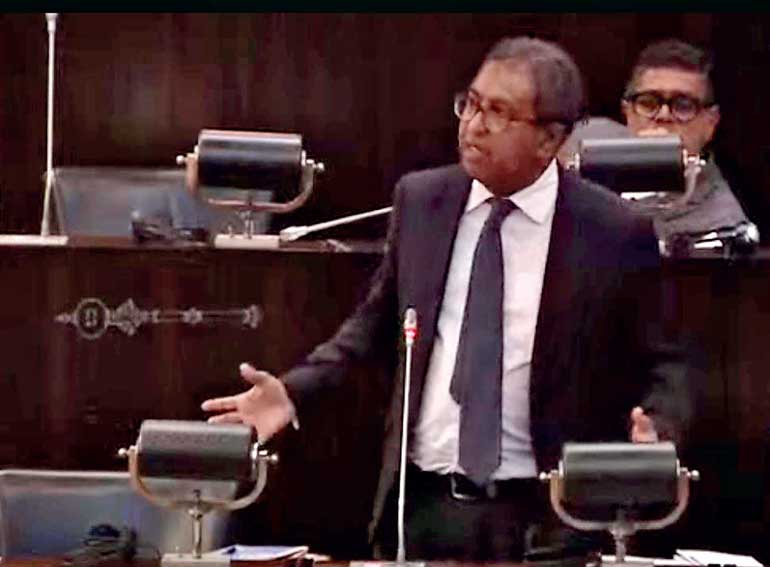
SJB MP Dr. Harsha de Silva
Main Opposition party, Samagi Jana Balawegaya (SJB) MP Dr. Harsha de Silva yesterday questioned the rationale behind the Central Bank of Sri Lanka’s (CBSL) latest regulations requiring exporters to convert residual foreign currency earnings into Sri Lankan rupees, warning that the measure risks undermining investor confidence and business freedom.
Speaking in Parliament, he likened the regulation to the “forced foreign exchange conversion” measures imposed during Sri Lanka’s economic crisis between 2022 and 2024.
“I want to ask the Government whether we have declared a crisis in this country?” he asked, arguing that forced conversion regulation was originally introduced as an emergency measure during the country’s foreign exchange crisis.
“This means if you have some export revenue, and keep aside for your debt payments and your raw materials, and whatever you have, you’re forced to convert it into Sri Lankan rupees,” he claimed.
The CBSL Gazette issued on Tuesday noted that exporters are required to convert any remaining foreign currency earnings into rupees by the 10th day of the month following receipt after meeting specified foreign currency obligations.
He argued that such measures restrict economic freedom and create uncertainty for businesses seeking to manage their finances and foreign exchange exposure.
“If you don’t have economic freedom, investors are jittery,” he asserted, maintaining that investors prefer to make business decisions based on market conditions and commercial considerations rather than directives imposed by authorities.
The MP described the regulation as “draconian” and “anti-business friendly,” warning that policy interventions of this nature could discourage investment and weaken confidence in the economy.
While acknowledging that the measure may have provided short-term support to the rupee by increasing the supply of foreign exchange in the domestic market, Dr. de Silva questioned the sustainability of such an approach.
He said the exchange rate had strengthened temporarily to Rs. 330 yesterday following the implementation of the CBSL regulation, as exporters converted foreign currency holdings into rupees, but cautioned against relying on administrative measures to manage market conditions.
According to him, if authorities believe such restrictions are necessary, they should clearly communicate whether they are temporary and specify a timeframe for their removal.
“If you are implementing crisis-time regulations, then you also must make a statement in Parliament that this is temporary, in three months we will remove it, or something like that,” he said.
The SJB MP stressed that building confidence among investors and businesses should remain a key policy objective, noting that predictable and market-friendly policies are essential to sustaining economic recovery.
“What you need to do is build confidence in the market. To build confidence in the market, bringing in these draconian-type regulations won’t do,” Dr. de Silva added.




