Wednesday Oct 07, 2026
Wednesday Oct 07, 2026
Thursday, 5 March 2026 03:52 - - {{hitsCtrl.values.hits}}
By Amira Cader
Greenpeace South Asia has called for stronger global climate accountability and a comprehensive national framework to address climate-related loss and damage following the release of its latest issue brief examining the devastating impacts of Cyclone Ditwah in Sri Lanka.
The report, titled “Cyclone Ditwah’s Loss and Damage: A Case for Climate Accountability,” was launched at the Sri Lanka Press Institute on Tuesday, highlighting the economic, social and environmental consequences of one of the island’s most destructive climate disasters.
The report outlines several policy recommendations to strengthen Sri Lanka’s disaster response and climate resilience.
Among them is the establishment of a national Loss and Damage framework that recognises both economic and non-economic losses, including psychological trauma, cultural loss and community displacement.
The report also calls for the creation of an independent Loss and Damage committee with decision-making authority, as well as greater community participation and women’s leadership in disaster recovery planning.
The report further urges the Government to advocate internationally for the Polluter Pays principle, holding major carbon-emitting countries and fossil fuel corporations accountable for financing climate-related loss and damage.
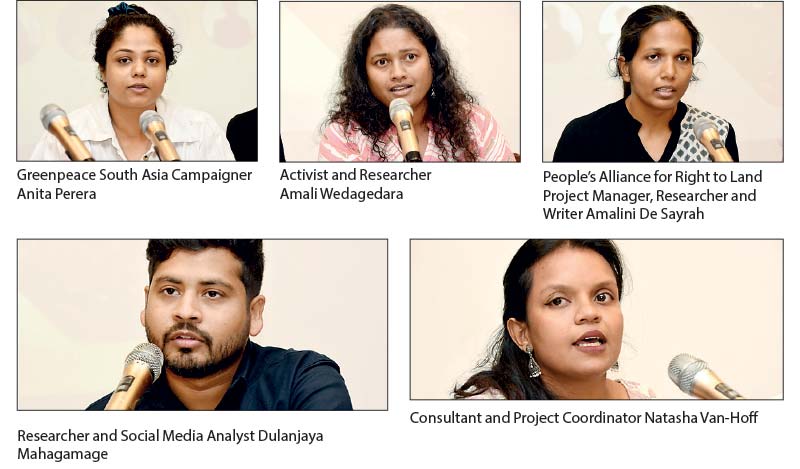
Moderated by Consultant and Project Coordinator Natasha Van-Hoff, the discussion brought together experts examining the disaster from global, economic, social and environmental perspectives.
Greenpeace South Asia Campaigner Anita Perera said Cyclone Ditwah revealed the deeper human cost of climate disasters, much of which remains overlooked in conventional disaster assessments.
“Many losses communities experience cannot be captured through traditional economic indicators. Families unable to recover the bodies of loved ones, children losing access to education and communities losing cultural heritage represent profound non-economic losses,” she said.
Scientific evidence cited in the issue brief suggests that human-driven climate change intensified the rainfall associated with Cyclone Ditwah, with studies indicating the extreme rainfall was between 28% and 160% more intense than it would have been without global warming.
The disaster caused more than 600 deaths, while over 2.3 million people were affected by flooding, landslides, displacement and disruption to essential services.
Infrastructure including roads, bridges, railways and utilities suffered extensive damage, slowing relief and recovery efforts. Over 114,000 homes were partially or completely damaged, while agriculture and fisheries were severely affected, threatening rural livelihoods and food security.
According to the World Bank, the total economic damage caused by Cyclone Ditwah is estimated at approximately $ 4.1 billion.
Activist and Researcher Amali Wedagedara specialising in agrarian debt and development noted that disasters often deepen financial vulnerability among rural communities.
“When climate disasters strike agrarian communities, they exacerbate existing debt burdens and undermine already fragile livelihoods,” she said.
Wedagedara also noted that scaling up community-based mental health services, providing long-term support for affected communities and ensuring grant-based climate financing does not create additional debt.
People’s Alliance for Right to Land (PARL) Project Manager, Researcher and Writer Amalini De Sayrah emphasised the long-term impact of displacement and land insecurity following disasters.
She noted that the loss of homes, land and community spaces often results in prolonged recovery challenges and social instability for vulnerable communities.
De Sayrah stressed that infrastructure development, including road construction, should not be carried out solely by the Road Development Authority (RDA) but should also involve consultation with communities at the grassroots level to better understand the risks and lessons that need to be learned to prevent future disasters.
Researcher and Social Media Analyst Dulanjaya Mahagamage highlighted the environmental consequences of Cyclone Ditwah and the importance of strengthening post-disaster management.
“The impact of Cyclone Ditwah on ecosystems reminds us that disaster recovery cannot focus only on infrastructure. Protecting biodiversity and restoring natural systems must be central to how we rebuild.”
Mahagamage also noted the important role civil society organisations and local communities can play in supporting biodiversity protection and ensuring more sustainable post-disaster responses.
Greenpeace also calls for climate-related debt relief and restructuring to help vulnerable countries recover from disasters without worsening existing financial burdens.
Despite contributing less than 0.1% of global greenhouse gas emissions, Sri Lanka continues to face severe climate impacts, raising questions of global climate justice.
Cyclone Ditwah illustrates how countries least responsible for climate change are often the ones suffering its most severe consequences. As extreme weather events intensify, the panel warned that the need for stronger global climate accountability and meaningful support for affected communities is becoming increasingly urgent.
The discussion stressed the importance of addressing gaps in disaster response, strengthening resilience and ensuring that vulnerable communities are better protected in the face of future climate crises.
– Pix by Shehan Gunasekera



