Wednesday Oct 07, 2026
Wednesday Oct 07, 2026
Saturday, 21 March 2026 00:00 - - {{hitsCtrl.values.hits}}
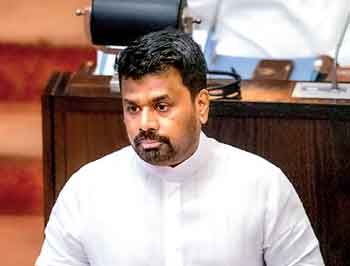 |
| President Anura Kumara Dissanayake |
President Anura Kumara Dissanayake yesterday told Parliament that Sri Lanka had rejected simultaneous requests from Iran and the US seeking military access, in order to safeguard the country’s long-standing policy of neutrality amid the escalating Middle East conflict.
The President said that when Iran sought permission for three naval vessels to make a goodwill visit to Sri Lanka, a request from the US followed on the very same day, seeking approval for two naval fighter aircraft to land at Mattala Rajapaksa International Airport (MRIA).
Dissanayake stressed that Sri Lanka has consistently maintained a neutral foreign policy and would not abandon it under any pressure.
“The dignity of the nation, the pursuit of justice and international recognition can only be safeguarded by firmly protecting our neutrality,” he said.
He acknowledged that certain Members of Parliament and sections of public opinion had accused the Government of favouring one side or delaying its response, but dismissed such claims as completely false.
Explaining the sequence of events, the President said Sri Lanka first received Iran’s request on 26 February, seeking approval for three naval vessels to call at Sri Lankan ports between 9-13 March as part of a cooperation tour. Authorities had begun examining the request and reviewing the approval process.
Later that same afternoon, a separate request was received from the US, seeking permission for two naval fighter aircraft belonging to the US Navy, stationed near Djibouti, to land at MRIA.
“At that point, we had two documents on our table. One from Iran requesting entry for naval vessels on 9-13 March, and another from the US requesting permission for two naval fighter aircraft to land at Mattala,” he said.
With signs of escalating military tensions already emerging internationally, the Government decided to deny permission to both sides in order to preserve Sri Lanka’s neutrality. “That is neutrality,” he said.
Responding to criticism over the refusal to allow the Iranian vessels, Dissanayake questioned what the consequences would have been if approval had been granted. “Such a move would have undermined Sri Lanka’s neutral stance, either by appearing to align with one party or by compelling the country to extend similar access to the other,” he pointed out.
He cautioned that granting permission could have drawn a distant conflict closer to Sri Lanka, potentially involving both MRIA and the Port of Colombo.
“We will not do that,” the President said, reiterating that Sri Lanka would not compromise its neutral position under any circumstances.



