Thursday Oct 15, 2026
Thursday Oct 15, 2026
Friday, 3 April 2026 00:00 - - {{hitsCtrl.values.hits}}
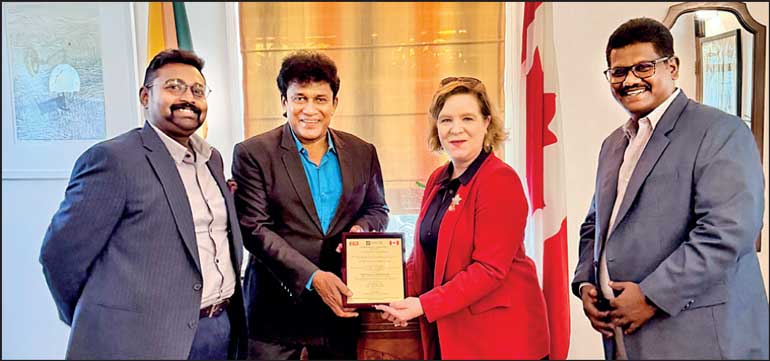
Sri Lanka’s plantation economy, long regarded as a backbone of the country’s export sector, is now facing a deeper structural test, as recent engagements between the Tamil Progressive Alliance (TPA) and the Canadian High Commission bring renewed attention to land rights, economic reform, and inclusive development.
At a meeting held at Canada House with Isabelle Martin, TPA Leader Mano Ganesan underscored a critical contradiction at the heart of Sri Lanka’s economy: while the tea sector continues to generate direct foreign exchange earnings, the communities sustaining it remain among the most economically vulnerable.
The meeting was attended by TPA Leader MP Mano Ganesan, Democratic Front General Secretary Paraneetharan, and Vice President – International Affairs and Communications Barath Arullsamy.
Sri Lanka’s tea exports generate approximately $ 1.2–1.3 billion annually, making it one of the country’s top foreign exchange earners. In contrast, apparel exports, valued at over $ 5 billion, depend heavily on imported raw materials, meaning a significant portion of earnings flows back out of the country. Tea, by comparison, remains a largely domestic value chain, positioning plantation communities as central stakeholders in national economic stability.
Yet, despite this contribution, structural disparities persist.
Recent disaster data following the Ditwah crisis reveals the scale of vulnerability. While plantation communities constitute less than 1% of the affected population, they accounted for approximately 11% of disaster-related deaths and 28% of missing persons. More broadly, over 158,000 individuals were displaced nationwide, with thousands still lacking permanent housing solutions nearly four months after the disaster.
“What we are witnessing is not a resource failure, but a political failure,” MP Ganesan noted, pointing out that despite policy announcements, no meaningful progress has been made in land allocation or permanent resettlement.
The TPA has consistently argued that the issue is no longer one of wages or labour conditions, but of structural inclusion.
“The Malaiyaha Tamil community is no longer a labour identity. It is a distinct and dignified ethnic community whose future is tied to land, education, and economic mobility,” Ganesan stated during the discussions.
This framing marks a significant shift in political discourse, moving away from traditional plantation wage debates toward broader questions of ownership, human capital development, and long-term integration into the national economy.
The critique also extends to the ideological positioning of the current Government. While historically rooted in Marxist and class-based political theory, the present administration, according to TPA, has not translated these principles into tangible improvements for plantation workers.
“If this were truly a class-driven framework, the working class would be at the centre of economic upliftment. Instead, what we see is stagnation,” MP Ganesan remarked, highlighting the widening gap between ideological claims and policy outcomes.
Against this backdrop, Canada’s role has emerged as a significant reference point.
Canada’s development engagement in Sri Lanka, spanning humanitarian assistance, governance, and inclusive development, has been acknowledged as both consistent and principled. Bilateral trade between the two countries reached approximately $ 540 million in 2025, with Sri Lanka maintaining a strong trade surplus.
More importantly, Canada’s internal model of governance has been highlighted as a potential framework for adaptation.
“Diversity is not a weakness, it is a strength. Canada has demonstrated this to the world,” Ganesan noted, emphasising that inclusive policy frameworks and institutional recognition of diversity can strengthen national cohesion rather than weaken it.
Drawing from this, the TPA has proposed the establishment of a Non-Territorial Community Council (NTCC), aimed at providing a structured, cross-provincial institutional mechanism to address land, housing, education, and socio-economic development challenges faced by the Indian Origin Malayaha community.
The proposal seeks to move beyond fragmented interventions and introduce a coordinated governance model that reflects the dispersed nature of the community.
At the centre of the discussion remains the issue of land.
Despite legal provisions that allow for land redistribution and resettlement, progress has remained limited nearly four months after the disaster. The TPA maintains that this reflects a lack of political will rather than institutional capacity, reinforcing the urgency of structural reform.
The delegation also stressed that international assistance to Sri Lanka must be more targeted, ensuring that support reaches the most underserved communities, particularly those sustaining key economic sectors. As Sri Lanka navigates its post-crisis recovery, the plantation sector presents both a challenge and an opportunity.
Barath Arullsamy highlighted that a significant concentration of disaster-affected plantation families was in the Kandy District, underscoring urgent gaps in recovery. He also referenced the recent visit of Canadian MP Juanita Nathan, noting her willingness to support affected communities, and called for Canada to take a more direct role, including through Government and diaspora partnerships, in assisting the Malaiyaha Tamil community.
Without structural reform, the country risks maintaining a system where one of its most valuable export sectors continues to operate on outdated socio-economic foundations. With reform, however, the sector could transition into a modern, inclusive, and productivity-driven component of the national economy.
The engagement with Canada signals a potential shift in direction, from humanitarian support toward longer-term structural partnership. Whether that shift translates into tangible outcomes will ultimately depend on the Government’s political will, MP Ganesan concluded.




