Thursday Oct 22, 2026
Thursday Oct 22, 2026
Saturday, 5 September 2026 00:00 - - {{hitsCtrl.values.hits}}
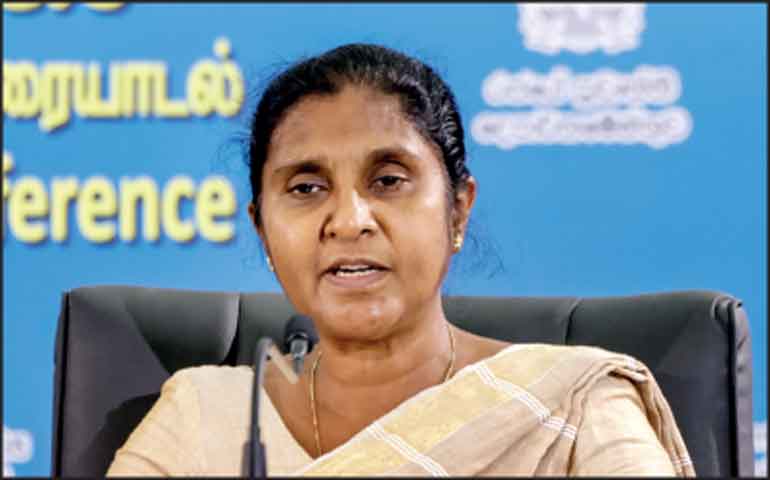
Department of Agriculture Additional Director General (Development)
G.G.V. Shyamali
Department of Agriculture Additional Director General (Development) G.G.V. Shyamali yesterday urged farmers to complete sowing by mid-October, as the country braces for a wet start and a dry finish to the upcoming cultivation season.
“We suggest farmers to begin land preparation immediately, taking advantage of late September rains, and to complete sowing between 15 October and 25 October,” she said, addressing a media briefing organised by the Government Information Department.
She explained that sowing within this window ensures crops are roughly a month old before intense November downpours arrive, reducing the risk of flood damage. “It would also allow 3.5-month paddy varieties to be harvested by late January, just before the dry spell sets in,” she said.
Shyamali also advised farmers to opt for short-duration rice varieties rather than long-duration ones. “Choose seed varieties that can be harvested quickly,” she added.
The advisory comes as Sri Lanka targets around 830,000 hectares for paddy cultivation in the 2026/27 Maha season, with meteorological forecasts pointing to above-average rainfall in October and November driven by prevailing El Niño conditions and a positive Indian Ocean Dipole.
According to the World Meteorological Organisation’s Global Producing Centres, there is an “exceptionally high likelihood, nearly 100%” that El Niño conditions will persist through to February 2027. Rainfall is expected to drop sharply from January, as temperatures rise, setting the stage for the anticipated dry spell early next year.
She stressed that strict water discipline this season would be critical to ensuring a successful Yala season in 2027.
“To conserve water, we urge the farmers to avoid long-duration paddy varieties in favour of shorter cycles better suited to the shifting rainfall pattern. It also recommended wider adoption of Alternate Wetting and Drying (AWD), an irrigation method introduced by the Rice Research and Development Institute in Batalagoda, which can save around three full irrigation turns over a season,” she pointed out.
Shyamali reiterated that conserving water now is essential to safeguarding against the anticipated dry conditions of the 2027 Yala season.




