Thursday Oct 15, 2026
Thursday Oct 15, 2026
Tuesday, 25 August 2026 06:15 - - {{hitsCtrl.values.hits}}
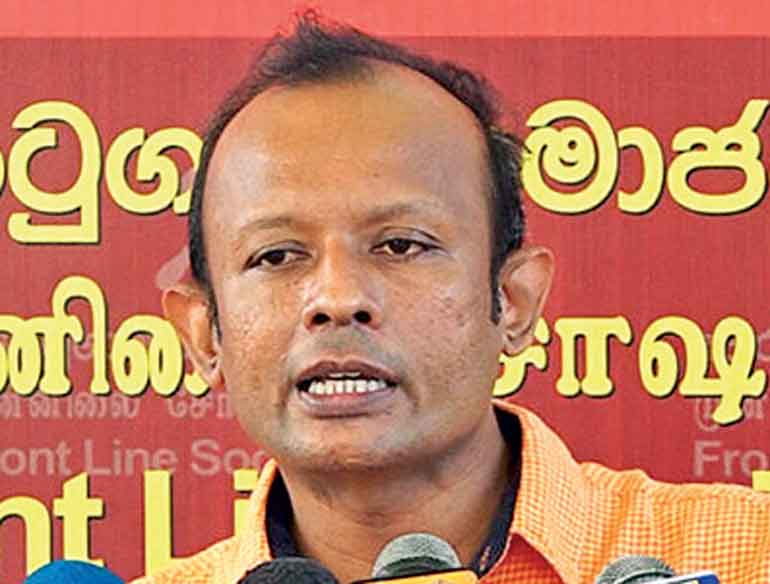
FSP Education Secretary Pubudu Jayagoda
By Shanika Sriyananda
The proposed 22nd Amendment to the Constitution is aimed not at reducing judicial delays or strengthening the judiciary, but at removing obstacles to the Government’s planned neo-liberal economic program, the Frontline Socialist Party (FSP) claimed.
FSP Education Secretary Pubudu Jayagoda, speaking to journalists at a seminar yesterday, rejected the reasons given by the Government for proposing an extension of the retirement age of Supreme Court and Court of Appeal judges.
He said the Government had cited several reasons for the move, including reducing case backlogs, strengthening the fight against corruption and retaining the experience of senior judges.
“These are false reasons,” Jayagoda said, stating that corruption and fraud cases were primarily dealt with by the High Courts and Magistrates’ Courts and that extending the retirement age of superior court judges would not resolve delays in those courts.
He said that if reducing the backlog was the priority, the Government should increase the capacity of Magistrates’ Courts, District Courts and High Courts, where, he claimed, about 99% of pending cases were concentrated.
Jayagoda also questioned why the Government was moving quickly on the constitutional amendment when several other measures it had identified to improve the justice system could be implemented through ordinary legislation, including amendments to the Judicial Service Act.
He alleged that the amendment was instead aimed at creating the conditions necessary to implement the Government’s broader economic program and to restrict resistance to policies that could face opposition from workers, farmers and other groups.
He cited the proposed Single Labour Law, which he claimed would weaken labour rights won through decades of struggle, as well as proposed changes allowing private business interests greater involvement in the management of the Employees’ Provident Fund.
According to Jayagoda, the Government would need greater control over legal and political opposition to implement such measures.
He also criticised plans that were being prepared to replace farmers’ cooperatives with farmer companies, restructure the Paddy Marketing Board and introduce changes to the fisheries sector.
He alleged that proposed fisheries reforms could eventually allow multinational companies to gain access to parts of the country’s marine resources, while farmers and fishermen could challenge such measures through the courts and protests.
Jayagoda further criticised proposed legislation relating to higher education quality assurance and accreditation, claiming it could legitimise what he described as ‘degree shops’, and revealed the Government’s plans to close around 3,000 schools.
He said the NPP Government’s broader agenda included the privatisation of hospital and laboratory services, the restructuring or sale of State institutions, new restrictive legislation and changes to the cooperative sector.
“The list is long,” Jayagoda said, claiming that previous governments had faced obstacles when attempting to implement unpopular policies because citizens and organisations had used democratic and legal mechanisms to challenge them.
“The Government is preparing to clear the road before embarking on its neo-liberal path,” Jayagoda said, describing the proposed 22nd Amendment as a “Shramadana that clears the road to hell.”
He urged the public to oppose the amendment, which he described as part of a ‘reactionary program’, and to defend democratic and constitutional rights.
Speaking to journalists at a seminar on Wijerama Mawatha in Colombo on Sunday (23), Jayagoda rejected the Government’s stated reasons for extending the retirement age of Supreme Court and Court of Appeal judges.
He said claims that the move was intended to prevent case delays, improve the prosecution of corruption or retain the expertise of senior judges were not convincing.
“Fraud and corruption cases are heard in the High Courts and Magistrates’ Courts. The retirement age of Supreme Court judges does not affect this,” Jayagoda said, arguing that most of the backlog of cases was in lower courts.
He said the capacity of Magistrates’ Courts, District Courts and High Courts should instead be strengthened if the Government’s objective was to reduce delays.
Jayagoda also questioned the urgency behind the proposed constitutional amendment when, according to him, many of the other measures cited by the Government could be implemented without constitutional changes.
He alleged that the real purpose of the amendment was to create greater room for the Government to implement what he described as a “neo-liberal” economic agenda and to limit legal and political resistance to those measures.
Among the policies he criticised were a proposed Single Labour Law, changes to the management of the Employees’ Provident Fund, restructuring of farmer cooperatives, changes to the Paddy Marketing Board and proposed fisheries reforms.
Jayagoda claimed these measures could trigger legal challenges and protests by workers, farmers and fishermen, making greater control over State institutions advantageous to the Government.
He also alleged that the Government was preparing legislation on quality assurance and accreditation in higher education, while accusing it of planning to close around 3,000 schools. He further cited proposed changes affecting hospitals, laboratory services, State institutions and cooperatives.
“These are the measures that require the Government to sharpen its teeth and claws to control the legal actions and protests taken by workers against these new laws,” he said.
Jayagoda accused the National People’s Power (NPP) Government of following a path similar to previous governments in pursuing policies that, he said, would undermine public interests.
He argued that constitutional provisions and judicial remedies had historically provided avenues for citizens and organisations to challenge government action, including through fundamental rights petitions and challenges to draft legislation.
“If the Government is to go on the neo-liberal road, it will have to clear the road first,” Jayagoda said.
Describing the proposed 22nd Amendment as a “Shramadana that clears the road to hell,” he urged the public not to support what he called a reactionary program and instead defend democratic rights.




