Sunday Sep 27, 2026
Sunday Sep 27, 2026
Wednesday, 5 August 2026 03:47 - - {{hitsCtrl.values.hits}}
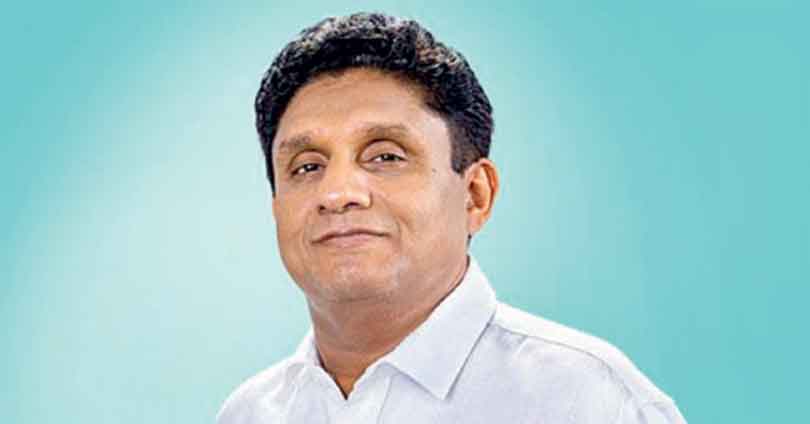
Opposition Leader Sajith Premadasa
Opposition Leader Sajith Premadasa yesterday intensified criticism of the Government’s proposed extension of superior court judges’ retirement age, arguing it risks undermining judicial independence and urging the administration to justify the constitutional amendment with evidence that it would address Sri Lanka’s mounting court backlog rather than weaken institutional safeguards.
Premadasa told Parliament that the Government has proposed extending the retirement age of Supreme Court judges with the stated objective of improving the efficiency of the judicial system, but that the proposal has drawn opposition from the Bar Association of Sri Lanka (BASL) and several other organisations in the legal sector.
He noted that a 2023 report prepared for the Ministry of Justice with technical assistance from the Asian Development Bank (ADB) had identified different priorities, and said he was seeking clarification from the Government on its policy and intended course of action.
Premadasa made these remarks in Parliament yesterday.
He said that if extending judges’ retirement age formed part of a broader judicial reform agenda aimed at improving efficiency, the Government should also present the remaining reforms together with a clear implementation timeline. He further questioned why, despite a backlog of around 1.1 million cases requiring a comprehensive feasibility study to improve judicial efficiency, the Government had not relied on or commissioned studies such as the 506-page 2023 report.
Premadasa called on the Government to table official data showing how much of the reported backlog of 1.1 million cases was attributable to the shortage of judges, and how much resulted from delays within court administration, the Government Analyst’s Department, the Attorney General’s Department or other institutions.
He also requested an update on the implementation of the recommendations contained in the judicial reform report prepared in 2023 for the Justice Ministr with ADB technical assistance, noting that the report prioritised systemic reforms.
Premadasa said he wished to know whether adequate consultations had been held with the BASL, the Law Commission, the Attorney General’s Department and the Judicial Service Commission before proposing the amendments.
He said even judges had reportedly rejected the proposal unanimously by a vote of 65-0, arguing that discussions should therefore take place. He added that several international legal organisations had also expressed strong opposition, questioning both the timing and circumstances surrounding the proposed reforms. According to those organisations, he said, the proposal poses a serious threat to judicial independence.
Premadasa called on the Government to present any studies demonstrating that extending judges’ retirement age, without first filling existing vacancies in the Supreme Court and lower courts, would reduce delays in the administration of justice.
He also requested an analysis explaining how extending judges’ retirement age would expedite the hearing of cases, together with the key performance indicators the Government intended to use to measure the success of judicial reforms and the improvements expected from the proposed extension.
Premadasa said the Government should disclose the date on which the proposed constitutional amendments were submitted to the Legal Draftsman, the date they received the Attorney General’s approval, the date they would be published in the Gazette and the date they would be presented to Parliament for First Reading.
Premadasa said a 2022 Supreme Court determination by Justices Buwaneka Aluvihare, Murdu Fernando and Janak de Silva had held that the retirement age of Supreme Court and Court of Appeal judges is entrenched in the Constitution.
He said the determination further stated that any constitutional amendment directly or indirectly affecting the retirement age or tenure of serving judges would interfere with judicial independence and constitute an infringement of Article 3 of the Constitution, thereby requiring approval at a referendum.
The judgement said: “Unlike public officers and others holding office under the Constitution, the retirement age of the judges of the Supreme Court and Court of Appeal are specified in the Constitution. Any Constitutional amendment to the retirement age or the period of office impacting on incumbent judges, whether directly or indirectly, will impinge on the independence of the judiciary and violative of Article 3 which requires a Referendum”.
Premadasa said the Samagi Jana Balawegaya had proposed inviting the BASL to Parliament to brief Members of Parliament on the issue and urged that the necessary arrangements be made.
Referring to remarks by the BASL President, he said the Mahanayake Theras of the three Nikayas had also written to the President expressing opposition to the proposal and requested that the letter be tabled in Parliament.
He urged the Government to undertake a more comprehensive and informed review before proceeding with the amendments and appealed to it not to amend the Constitution solely in relation to the Judiciary after having come to power promising to introduce a new Constitution that would abolish the Executive Presidency.




