Thursday Oct 15, 2026
Thursday Oct 15, 2026
Monday, 9 March 2026 06:26 - - {{hitsCtrl.values.hits}}
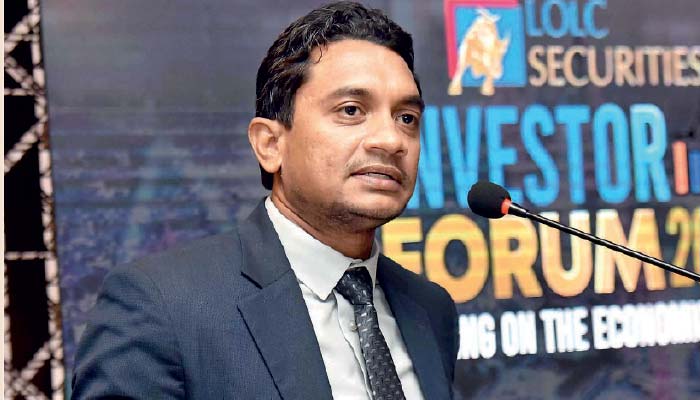
Industry and Entrepreneurship Development Deputy Minister Chathuranga Abeysinghe - Pic by Upul Abayasekara
By Charumini de Silva
Industry and Entrepreneurship Development Deputy Minister Chathuranga Abeysinghe said Sri Lanka is entering a more predictable economic phase with stronger fiscal discipline, stable macroeconomic indicators and structural reforms, whilst calling for a major shift towards capital markets to support industrial growth.
Speaking at the LOLC Securities Forum last Friday, he said the Government aims to bring around 100 new companies to the stock market within the next two to three years as part of efforts to strengthen the role of capital markets in financing industrial expansion.
Abeysinghe said the improving macroeconomic outlook provides a predictable environment for investors, with fiscal policy, inflation and interest rates becoming increasingly stable.
“We have a predictable macroeconomic environment and strong growth sectors emerging. Now investors must focus on real assets and opportunities,” he said, encouraging businesses to list on the stock market and use instruments such as debentures and bonds to raise capital.
Abeysinghe urged investors and market participants to focus on fundamentals and avoid spreading misinformation about the economy.
“There is so much false information circulating. As stockbrokers and analysts you have a responsibility to share accurate information with the public,” he said, calling on private companies to explore the capital market as a long-term financing source.
He pointed out that the limited use of capital markets has been a major constraint on Sri Lanka’s industrial expansion. “One of the greatest barriers for industrialisation in Sri Lanka is not the lack of capital, but the lack of knowledge about capital,” Abeysinghe said.
He noted that most local industries rely heavily on bank borrowing rather than equity financing. As a result, many companies carry balance sheets dominated by debt, which leaves them vulnerable during economic downturns.
Abeysinghe said that expanding the capital market is critical to building globally competitive companies capable of taking Sri Lankan brands overseas.
“Our plan is to drive about 100 new institutions into the stock market within the next two to three years. That is how the country would grow and how we would build global companies,” he said.
He noted that the recent performance of the stock market reflects stronger fundamentals, with listed companies across sectors such as finance, tourism and agriculture showing tangible growth.
The Deputy Minister also outlined the factors behind Sri Lanka’s 2022 economic collapse, saying the country’s biggest structural problem was a persistent fiscal deficit rather than corruption alone. He noted that tax revenue as a share of gross domestic product had fallen sharply from around 20% in 1990 to about 8.5% by 2019, forcing successive governments to rely heavily on borrowing.
He said fiscal discipline introduced under the International Monetary Fund (IMF) program has helped stabilise public finances through stronger revenue collection and rationalised expenditure.
“We now have fiscal discipline enacted. The Government is collecting revenues more methodically and ensuring a primary surplus,” he said.
Abeysinghe said Sri Lanka’s external sector is also strengthening with rising export earnings, tourism recovery, higher remittances and increased foreign investment inflows.
He noted that exports reached about $ 17.2 billion last year, while remittances have exceeded $ 8.1 billion. Foreign direct investment has also crossed $ 1.2 billion through the Board of Investment of Sri Lanka, with total inflows expected to exceed $ 2 billion annually going forward.
He also said debt servicing obligations are also expected to remain manageable over the coming years.
“Last year we serviced about $ 3.9 billion in debt. This year it will be around $ 2.7 billion, and going forward it will remain below $ 3.5 billion until 2032,” he said.
The Deputy Minister said the Government is targeting economic growth of around 5%, supported by expansion in export industries, tourism, electronics manufacturing, technology services and value-added agriculture.
He also highlighted a wide range of structural reforms underway, including a new national trade and tariff policy, investment reforms, a proposed Public-Private Partnership (PPP) framework, and amendments to legislation governing investments and the Colombo Port City.
Sri Lanka is also undergoing a major digital transformation of government services, he said, aimed at reducing bureaucracy and improving transparency.
“Every transaction in Government is going to be digital. Each service will move online so that people have fewer touch points with officials,” Abeysinghe said.
He acknowledged that reform implementation has been slow at times due to the need to amend outdated legislation and systems.
“Some Ordinances and Acts we are changing go back to the 1890s. For example, to register a business you had to submit more than 15 documents. Now we are simplifying it so you can prove your address and get business registration within two days,” he said.
Abeysinghe said Sri Lanka’s strategic neutrality in international relations and expanding trade partnerships could help position the country as a regional hub for trade, investment and financial services in the coming years. “At this point we don’t see any risk that Sri Lanka will fail financially if we continue on the current trajectory,” he said.
However, he cautioned that global uncertainties linked to geopolitical tensions could create short-term turbulence, including potential impacts on tourism and global investment flows.
“These are global issues and we may see some turbulence in the first quarter. But we expect things to stabilise later in the year,” he said.
He added that the Government has sufficient financial buffers and contingency plans to manage potential risks, including energy security and fuel supplies already secured for the coming months.
Abeysinghe reiterated that the Government’s broader goal is to drive sustainable economic growth while reducing poverty and strengthening governance through long-term structural reforms.




