Tuesday Sep 22, 2026
Tuesday Sep 22, 2026
Tuesday, 22 September 2026 06:03 - - {{hitsCtrl.values.hits}}

Academy of Contemporary China and World Studies Vice President Fan Daqi, Chinese Ambassador Wei Huaxiang, Mass Media Deputy Minister Kaushalya Ariyarathne, University of Colombo Prof. Tissa Ravinda Perera, University of Kelaniya Head of Department of Mass Communication Prof Manoj Jinadasa
By Shanika Sriyananda
Sri Lanka and China have agreed on an action plan to take media cooperation into a broader and more practical phase, with greater emphasis on joint reporting, content sharing, professional exchanges to encourage young journalists and the use of new technologies, including artificial intelligence.
The China-Sri Lanka Media Cooperation Action Plan was launched at the China-Sri Lanka Media Cooperation and Exchange Seminar 2026 held in Colombo, recently.
The Action Plan aims to deepen media ties through stronger institutional cooperation, joint reporting and content sharing, professional and young journalist exchanges, and greater collaboration among media organisations, universities and think tanks.
It also places emphasis on AI and digital technologies, including AI-assisted translation, digital content production, data journalism and visualisation, while encouraging both countries to expand their participation in Global South and international media cooperation and establish a continuing mechanism to review progress and develop new areas of partnership and deepen people-to-people understanding between Sri Lanka and China.
Meanwhile, the importance of strengthening people-to-people connection through a close media network between China and Sri Lanka to explore new forms of cooperation for a shared future was extensively discussed at the seminar with the participation of academics, senior experts on international relations and media professionals.
China-Sri Lanka Media Cooperation and Exchange Seminar 2026 was hosted by the Academy of Contemporary China and World Studies and the Sri Lanka Rupavahini Corporation, and organised by the Yunnan International Communication Centre for South and Southeast Asia and the Association for Sri Lanka–China Social and Cultural Cooperation.
Health and Mass Media Deputy Minister Kaushalya Ariyarathne in her opening remarks said stronger media cooperation between Sri Lanka and China should go beyond the exchange of news and programs to deepen people-to-people understanding.
She said journalists and media organisations had an important role in helping audiences to understand each other’s societies, experiences and development journeys. “Media is no longer simply a means of transmitting information. It has become a powerful instrument for building understanding between societies and strengthening people-to-people relations,” she said.
Ariyarathne, reflecting on her recent visit to China as part of a workshop for Sri Lankan parliamentarians, said that it had given her valuable insights into the country’s experience in governance, economic development, infrastructure modernisation, technological innovation and green development.
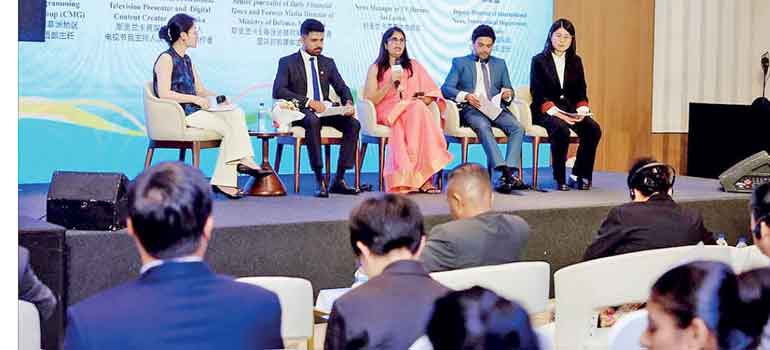
Panel discussion
She said the program, which included visits to Beijing, Shenzhen and Guangdong, also provided an opportunity to engage with Chinese institutions and better understand the country’s development experience.
“I found these exchanges particularly valuable in understanding how knowledge, technology and effective communication can contribute to national development,” she said.
Emphasising that the trust as the foundation for a meaningful communication, she also highlighted professional exchanges, joint reporting and content production as practical ways to strengthen the relationship between the two countries.
“Such cooperation could create a more sustainable platform for dialogue while building relations based on trust, mutual respect and shared interests. We can help our peoples’ understanding not only what is happening between our two countries, but also why our cooperation matters for our shared future,” Deputy Minister Ariyarathne said.
Highlighting the long history of China–Sri Lanka relations, referring to the ancient Silk Road and the Rubber-Rice Pact as important chapters in the relationship, Chinese Ambassador Wei Huaxiang said that the coming years will include major diplomatic anniversaries, providing an opportunity to build on the historical relationship.
“Next year, we will celebrate the 70th anniversary of the establishment of diplomatic ties between China and Sri Lanka, and the 75th anniversary of the signing of the Rubber-Rice Pact. China-Sri Lanka relations will face a historic opportunity to build on the past achievements and chart the future,” he said
According to Ambassador Wei, this has created a more important scenario than ever for the Chinese and Sri Lankan media to serve as a bridge for telling new stories of sincere mutual assistance, everlasting friendship, and win-win cooperation toward a shared future between China and Sri Lanka.
He said that it would help to carry forward China-Sri Lanka friendship and enhance people-to-people exchanges.
“In the global media landscape, the voices of developing countries remain relatively weak. The media of China and Sri Lanka have a responsibility to deepen cooperation and strengthen coordination in international communication,” he said.
Ambassador Wei stressed the importance of both nations speaking with a common voice on issues such as climate change, poverty reduction and development, and global governance, while effectively countering misinformation and misleading narratives.
Academy of Contemporary China and World Studies Vice President Fan Daqi said that China–Sri Lanka friendship had deep historical roots and has evolved through generations, from the voyages of Zheng He and historic agreements to contemporary projects such as Colombo Port City and Hambantota Port.
Fan described media professionals as the current generation entrusted with telling the story of this long relationship.
Explaining the need for upholding open cooperation, he said that Chinese and Sri Lankan media should focus on the broader picture of bilateral relations and report truthfully, objectively and comprehensively on cooperation, including projects under the Belt and Road Initiative.
“Such reporting can improve mutual understanding and contribute to sustained bilateral cooperation,” he said, adding that the state-to-state relations are strengthened by understanding and connections between ordinary people.
Shared Asian philosophy
“Artificial intelligence, big data and social media are transforming journalism and international communication. Chinese and Sri Lankan media can exchange knowledge on new technologies, platforms and business models while creating closer cooperation among young journalists, editors and media organisations,” he said.
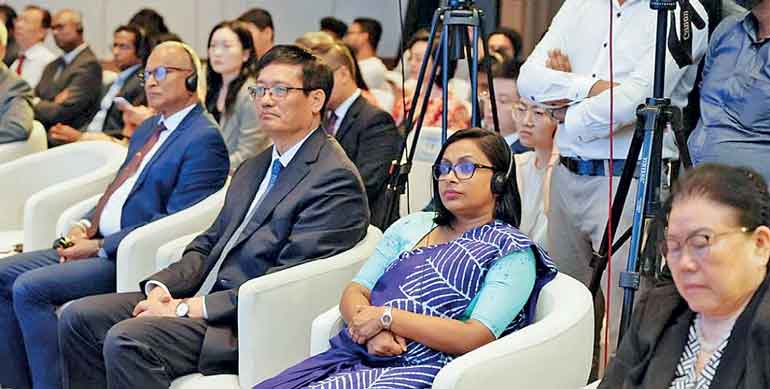
Drawing on the two countries’ shared Asian philosophical traditions, University of Kelaniya Head of Department of Mass Communication Prof. Manoj Jinadasa said China-Sri Lanka media cooperation should go beyond the exchange of technology and information.
He also said that both countries have much to learn from each other, particularly as rapid technological change and digital networks reshape how people receive and understand information.
Prof. Jinadasa stressed that China’s technological and economic advances could offer useful lessons for Sri Lanka’s media sector, while Sri Lanka could contribute by bringing its own communication traditions and philosophical perspectives into the partnership.
“When we talk about how the media can share between China and Sri Lanka as a cooperating model—exchanging, understanding and learning—we have to think of our own philosophies to sustain our audience,” he opined.
Calling for a model of cooperation based on exchange, understanding and mutual learning, rather than one-way communication, he also emphasised the need of the media in both countries placing people and human values at the centre of their work in an increasingly algorithm-driven environment.
“Greater digital connectivity should be matched by stronger human connectivity, with media cooperation helping audiences understand one another and strengthening people-to-people relations. We are all connected by digital connectivity, though we are not connected with humanity. We have to reconnect our human values to the media,” Prof. Jinadasa explained.
University of Colombo Prof. Tissa Ravinda Perera delivering the keynote address said that China’s engagement with Sri Lanka and the region had become an important part of contemporary regional cooperation, particularly through infrastructure development and connectivity under the Belt and Road Initiative.
Accurate information on development
“The media has a key responsibility to ensure that such development cooperation is communicated responsibly. Citizens need accurate information about the objectives, opportunities, challenges, social implications and long-term significance of major projects,” he said, adding that media organisations should help audiences understand development beyond political slogans or isolated headlines.
He emphasised that the media could explain how infrastructure projects connect with national economic strategies, regional trade, investment, employment, technology and the everyday lives of communities.
According to Prof. Perera, the future of China–Sri Lanka relations will depend not only on infrastructure and investment but also on trust, understanding, knowledge and human connection.
“International reporting should therefore be based on verified information, reliable sources and professional journalistic standards. The media should provide sufficient context when reporting on complex economic, political and development issues. Inaccurate or incomplete reporting can create confusion and undermine public trust,” he noted.
Academy of Contemporary China and World Studies Senior Research Fellow Dr. Chen Wenling focused on China’s modernisation and its cooperation with developing countries while highlighting China’s transformation from a relatively poor country at the time of its founding in 1949 into the world’s second-largest economy.
She attributed this transformation to the leadership of the Communist Party of China and the sustained efforts of successive generations of Chinese people, leaders and entrepreneurs.
Explaining China’s modernisation process involving a very large population looking at common prosperity including cultural development, ecological protection and development.
“China’s development experience should be understood in the context of each country’s own circumstances,” Dr. Chen said, mentioning China's involvement in development cooperation through the Belt and Road Initiative and other projects in countries including Sri Lanka.
Promoting city-to-city relations
At the panel discussion on Deepening media ties between China and Sri Lanka through people-to people connectivity, International News of China Daily Deputy Director Shao Xinying emphasised that journalists in China and Sri Lanka have much in common and that media cooperation can strengthen mutual trust.
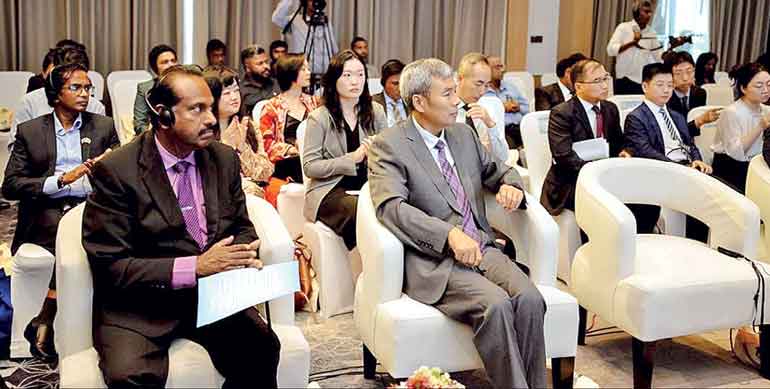
Proposing to looking at bilateral relations through history, individuals, cities, regional cooperation and technology Shao said that historical stories could make the long relationship between the two countries more meaningful to younger generations and referred to the travels of the Chinese monk Faxian, the voyages of Zheng He and the historical links between the two civilisations.
Shao, highlighting the importance of telling contemporary human stories, gave the example of a young Sri Lankan who learned Mandarin through an exchange program in China and later found employment at Port City Colombo.
“His experience illustrated how exchanges between the two countries can directly affect individual lives,” she said while proposing to use city-to-city relationships to tell stories of people-to-people connections.
“Regional media networks could provide another platform. Cooperation between Chinese and Sri Lankan media could be strengthened to leverage Asian regional media networks and jointly amplify the voice of the Global South,” Shao noted.




