Tuesday Oct 06, 2026
Tuesday Oct 06, 2026
Wednesday, 24 June 2026 00:00 - - {{hitsCtrl.values.hits}}
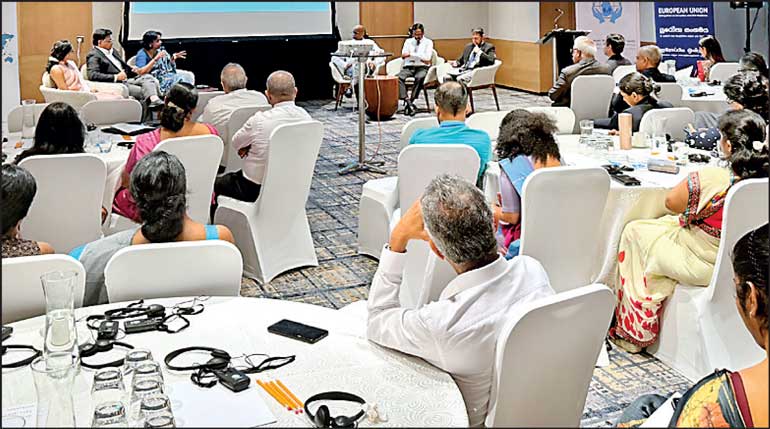
From left: HRCSLSocio-Economic Rights Sub-Committee Member Niyanthini Kadirgamar, UN Global Compact Network Sri Lanka Executive Director Rathika de Silva, HRCSL Business and Human Rights Sub-Committee Member Bhavani Fonseka, HRCSL Commissioner Prof. T. Thanaraj, Commissioner Nimal Punchihewa, and Max Planck Foundation for International Peace and the Rule of Law Legal Consultant Sanjit Dias, who moderated the trilingual panel discussion
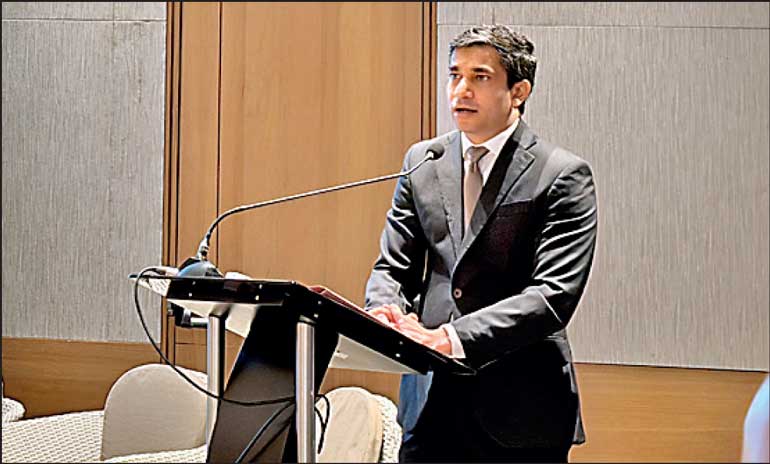
HRCSL Commissioner and Business and Human Rights Sub-Committee Chair Dr. Gehan Gunatilleke introducing the HRCSL General Guidelines and Recommendations on Business and Human Rights
Sri Lanka’s first National Guidelines on Business and Human Rights were launched last week by the Human Rights Commission of Sri Lanka (HRCSL) with co-funding support provided by the European Union and supported by the Max Planck Foundation for International Peace and the Rule of Law (MPF) in Germany and Centre for a Smart Future (CSF) in Sri Lanka.
These guidelines mark an important step towards strengthening responsible business conduct and integrating human rights considerations into business practices across the country.
Centre for a Smart Future Director and HRCSL Sub-Committee on Business and Human Rights member Iromi Perera said: “The question before us is how we can build on this foundation and ensure that the values reflected in these guidelines become an accepted operating norm within the private sector, rather than a source of contention or conflict.”
She further highlighted that the guidelines represent the beginning of an important journey and reflect a collective commitment by diverse stakeholders to address issues at the intersection of business and human rights.
The launch forms part of the broader Just Business: Promoting the Adoption of Business and Human Rights in Sri Lanka and the Maldives project, through which MPF and CSF have been supporting the HRCSL’s efforts to strengthen awareness, dialogue, and institutional capacity on business and human rights.
Representatives of the Max Planck Foundation noted that the guidelines were the result of a collaborative process driven by the HRCSL and supported through international partnership: “these guidelines are a starting point rather than an endpoint. Their real value will be measured by the conversations, practices, and partnerships they continue to inspire long after the project itself has concluded.”
The launch also featured a panel discussion reflecting on the guidelines and Sri Lanka’s broader business and human rights agenda. Panellists from the HRCSL, civil society, the private sector, and international organisations discussed opportunities to strengthen responsible business practices, promote meaningful stakeholder engagement, and support the implementation of the guidelines across sectors.
As global expectations around environmental, social, and governance standards continue to evolve, the guidelines are expected to serve as a valuable resource for the private sector, businesses, State-owned enterprises, policymakers, regulators, and civil society organisations seeking to advance sustainable and rights-respecting economic development in Sri Lanka. The Guidelines are available in Sinhala, Tamil and English languages and can be downloaded from the HRCSL website - https://www.hrcsl.lk/documentation/guidelines-and-directives/



