Saturday Oct 17, 2026
Saturday Oct 17, 2026
Thursday, 4 June 2026 00:02 - - {{hitsCtrl.values.hits}}
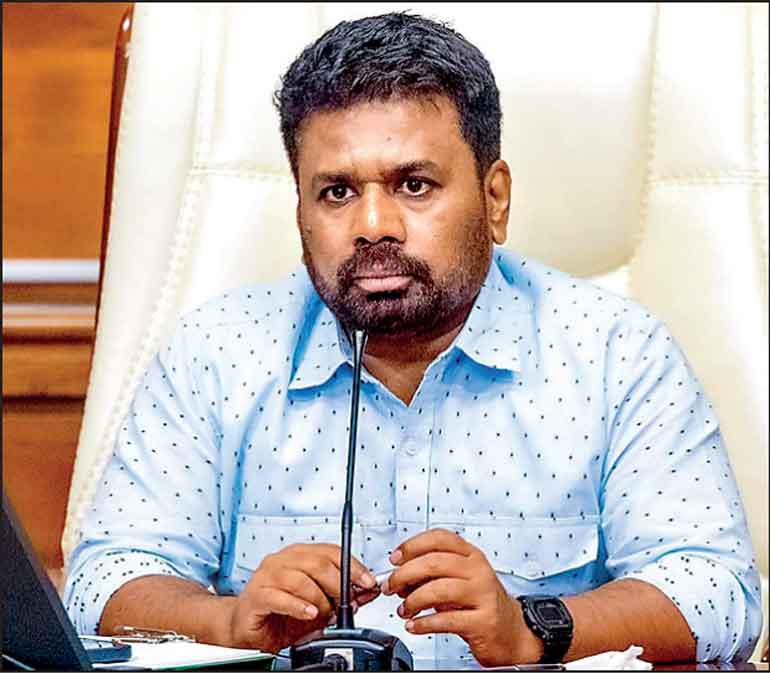
President Anura Kumara Dissanayake
The Bar Association of Sri Lanka (BASL) yesterday expressed serious concern over reports that the Government is considering a constitutional amendment to raise the retirement age of Supreme Court and Court of Appeal judges, arguing that the proposal is unnecessary, risks eroding public confidence in the judiciary, and could be perceived as interference with judicial independence.
In a letter to President Anura Kumara Dissanayake, the BASL said:
“The BASL notes with grave concern reports in the public domain that the Government is considering the introduction of an amendment to the Constitution to increase the age of retirement of Judges of the Court of Appeal and the Supreme Court.
“It is the considered view of the BASL that the age of retirement of the judges of the Court of Appeal and the Supreme Court, which has stood at 63 years and 65 years, respectively, from the promulgation of the 1978 Constitution, should not be changed arbitrarily and that such a change is neither necessary nor desirable.
“To do so will result in the loss of public confidence in the integrity of the legal system and of the Government’s commitment to preserve and protect the rule of law and the independence of the judiciary. Members of the public are likely to question the motives of the Government in bringing in a Constitutional amendment solely for this purpose.
“Your Excellency is no doubt aware that the cadre of the judges of the Court of Appeal was increased from 12 to 20 judges (including the President of the Court of Appeal) and that of the Supreme Court from 11 to 17 judges (including the Chief Justice) by the 20th Amendment to the Constitution certified on 29 October 2020. With such enhancement, workwise, there cannot be a real requirement to extend the retirement ages of these judges.
“Your Excellency is aware that altering the retirement age of judges of the apex courts would have to be done through a Constitutional amendment. For many years, Sri Lanka’s Constitution has been subject to ad hoc amendments, sometimes in order to cater to the political needs of the government in power and often contrary to the interests of the rule of law, the independence of the judiciary, and the judiciary.
“Extending the retirement age of the sitting judges of these Courts at this point of time is likely to be viewed by the public as a blatant attempt to interfere with the judiciary. We believe that to go ahead with such an ad hoc move will also be an affront to the Honourable Judges of those Courts.
“If the Government goes ahead with such a move it will set a dangerous precedent for future governments too to introduce ad hoc amendments to the Constitution in respect of the functions of the judiciary.
“The independence of the judiciary and the public confidence reposed in it are indispensable pillars of the rule of law and the democratic framework of our Republic. In that regard, it is of paramount importance that the judiciary must not only remain independent in fact, but must also be seen by the public to be wholly independent, impartial, and free from even the slightest perception of influence, favour, accommodation, or impropriety.
“The BASL is therefore constrained, in the discharge of its duty to uphold and safeguard the rule of law and the independence of the judiciary, to respectfully express its serious concern regarding any such proposed amendment, which is neither in the interests of the judiciary nor of the people.
“In the circumstances, the BASL respectfully urges Your Excellency not to proceed with any proposed constitutional amendment seeking to increase the retirement age of the members of the judiciary, including Judges of the Court of Appeal and the Supreme Court.
“We remain confident that Your Excellency will give due consideration to the importance of preserving and protecting the independence, integrity, dignity, and public confidence in the Judiciary, which is essential to the maintenance of the Rule of Law and democratic governance in Sri Lanka.”




