Thursday Oct 15, 2026
Thursday Oct 15, 2026
Monday, 13 July 2026 03:03 - - {{hitsCtrl.values.hits}}
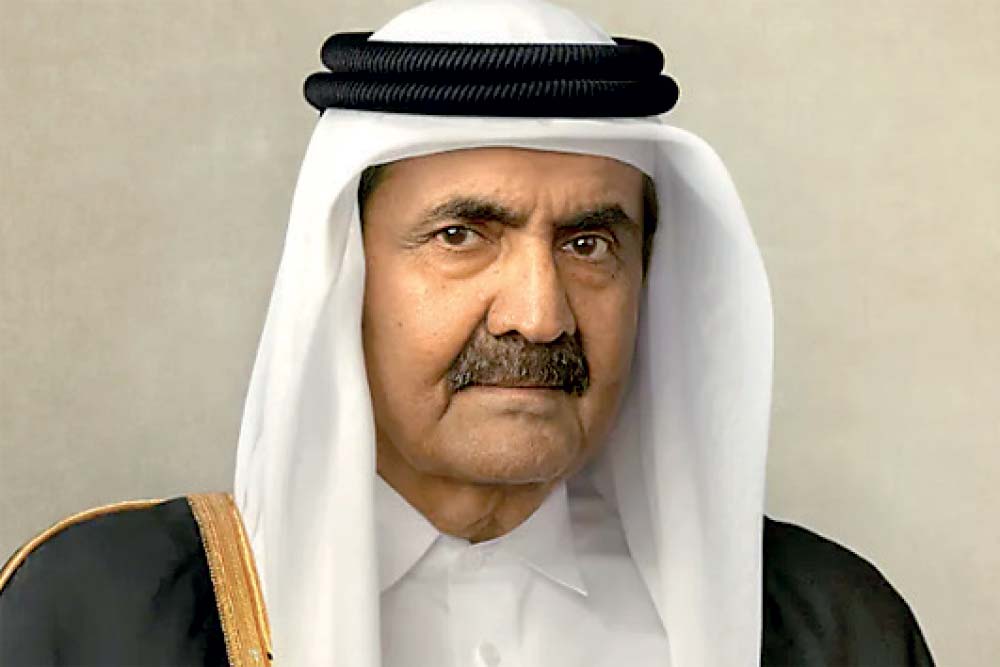
Sheikh Hamad bin Khalifa Al Thani
Sheikh Hamad bin Khalifa Al Thani, the former emir of Qatar who transformed the small Gulf state into one of the world’s wealthiest and most influential nations, has died. He was 74.
A charismatic figure with a friendly demeanour, the father emir assumed the reins of power in 1995. Regarded as the architect of modern Qatar, he embarked on leading development and reform plans and education programmes using his country’s vast natural gas wealth to push an ambitious agenda of political, economic and social reforms.
During his reign, Qatar’s gross domestic product (GDP) increased more than 24-fold, while production from the North Field turned the country into the world’s largest exporter of liquefied natural gas (LNG) by 2006. In record time, the small nation’s LNG production capacity reached 77 million tonnes per annum, according to government figures.
His tenure also saw the establishment of the Qatar Foundation, the launch of the Al Jazeera news channel in 1996, the promulgation of Qatar’s first permanent constitution in 2004 and the introduction of municipal elections in which women were granted the right to vote and stand as candidates. Under his leadership, the Gulf nation secured the right to host the 2022 FIFA World Cup, the first time an Arab country had done so.
Born in Doha in January 1952, Sheikh Hamad graduated from the British Royal Military Academy at Sandhurst before becoming commander of Qatar’s armed forces. He became heir apparent and defence minister in 1977, assumed power as emir on June 27, 1995, and handed over leadership to his heir apparent, Sheikh Tamim bin Hamad Al Thani, on June 25, 2013.
The peaceful, voluntary transfer of leadership was rare in the region.
“The future lies ahead of you, the children of this homeland, as you usher into a new era where young leadership hoists the banner,” Sheikh Hamad said as he announced his abdication and the carefully crafted transition to Sheikh Tamim, who was then 33.
Sheikh Hamad had wide-ranging visions for Qatar’s role as a diplomatic broker. Over the years, its mediation was brought to bear on the conflict in Sudan’s Darfur region, Lebanese factional feuding and the rift between the Palestinian groups Hamas and Fatah.
Before Sheikh Hamad’s abdication, Qatar formally opened an office for the Taliban at the request of the United States, which set the stage for talks between Washington and the Afghan group that ultimately led to NATO and the US’s chaotic withdrawal from Afghanistan in 2021.
During his rule, Qatar was among the few countries to side with the popular uprisings that became known as the Arab Spring.




