Saturday Oct 17, 2026
Saturday Oct 17, 2026
Saturday, 18 July 2026 04:13 - - {{hitsCtrl.values.hits}}
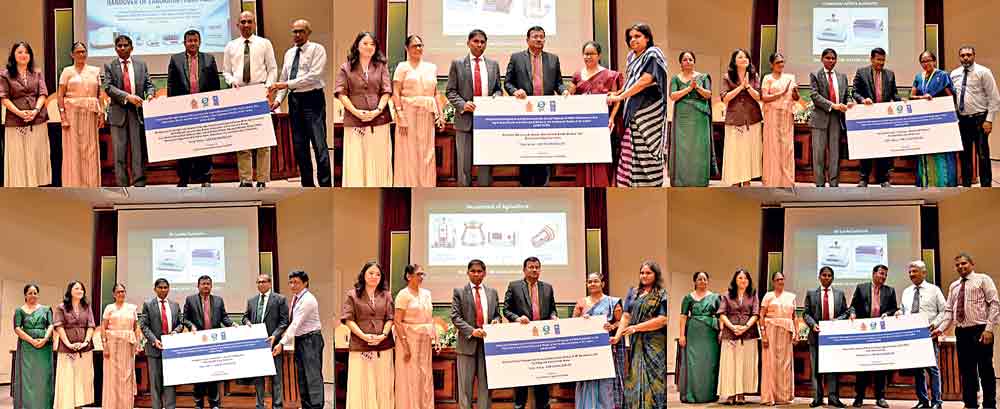
The equipment was officially handed over to six beneficiary institutions: the Central Environmental Authority, University of Sabaragamuwa Sri Lanka, Department of Agriculture, Sri Lanka Customs, Consumer Affairs Authority and Government Analyst’s Department
 Six key institutions receive advanced analytical equipment to enhance Sri Lanka’s ability to detect, regulate, and manage hazardous chemicals and pollutants under Rs. 204 m Environment Ministry and UNDP initiative
The Environment Ministry together with the United Nations Development Programme (UNDP) in Sri Lanka, officially handed over advanced laboratory equipment valued at approximately Rs. 204 million (est. $ 663,000) to key national institutions recently.
This was under the Global Environment Facility (GEF)-funded project, Integrated Management and Environmentally Sound Disposal of Persistent Organic Pollutants (POPs) Pesticides in the Agricultural Sector and Mercury and Waste in the Healthcare Sector in Sri Lanka.
The ceremony brought together senior government officials, technical institutions, development partners, and stakeholders.
The equipment was officially handed over to six beneficiary institutions: the Central Environmental Authority, University of Sabaragamuwa Sri Lanka, Department of Agriculture, Sri Lanka Customs, Consumer Affairs Authority and Government Analyst’s Department. The handover was accompanied by the signing of Memoranda of Understanding (MoUs) and a presentation on mechanisms to ensure the long-term technical and financial sustainability of the equipment.
The state-of-the-art analytical instruments, laboratory support equipment, consumables, and chemicals will significantly strengthen Sri Lanka’s ability to detect, analyse, monitor, and regulate hazardous substances, including mercury, Persistent Organic Pollutants (POPs), and other chemicals of concern. The investment is expected to enhance regulatory oversight across the lifecycle of chemicals, from import and border control to market surveillance, environmental monitoring, and scientific research.
Environment Deputy Minister Anton Jayakody underscored the national significance of the initiative. ‘’With the update of the National Environmental Act, Sri Lanka is committed to ensuring the environmentally sound management of hazardous chemicals and waste. The equipment handed over will strengthen the scientific and regulatory capabilities of institutions that play a critical role in protecting public health, and preserving our natural environment. This investment will deliver lasting benefits for the country and reinforce our journey towards a greener and more resilient future.”
Environment Secretary K.R. Uduwawala emphasised the importance of strengthening institutional capacities to safeguard human health and the environment. ‘‘Sri Lanka is a Party to the Basel, Rotterdam, Stockholm, and Minamata Conventions. As the National Focal Point for the Basel, Stockholm, and Minamata Conventions, the Ministry of Environment has a responsibility to ensure that the country fulfills its obligations under these multilateral environmental agreements and our foremost obligation is to safeguard human health and the environment from the adverse impacts of hazardous chemicals and wastes’’
UNDP Sri Lanka Officer in Charge Marina Ten said: “This handover is about far more than the delivery of equipment. It is about empowering national institutions with the tools, knowledge, and systems required to protect communities and ecosystems from the harmful impacts of hazardous chemicals. Through this partnership with the Ministry of Environment and the support of the Global Environment Facility, we are helping Sri Lanka strengthen its capacity to meet global environmental commitments while advancing sustainable development priorities.”
The project is being implemented by the Ministry of Environment under the National Implementation Modality, with technical support from UNDP Sri Lanka and funding from the Global Environment Facility (GEF). With a total budget of $5.04 million, the project seeks to strengthen Sri Lanka’s chemicals and waste management framework, enhance institutional capacities, establish a centralised chemicals database, promote green procurement and financing mechanisms, and support compliance with the Stockholm Convention on Persistent Organic Pollutants and the Minamata Convention on Mercury.
The equipment procurement was undertaken through a transparent and competitive international bidding process and is complemented by a sustainability mechanism that promotes shared use of equipment, cross-agency collaboration, and long-term maintenance arrangements. These measures are expected to maximise the value of the investment and ensure its continued contribution to national environmental management efforts.
As Sri Lanka continues to address emerging environmental challenges, the strengthened laboratory infrastructure will play a vital role in supporting research, enforcement, monitoring, and policymaking to protect both people and the environment from the risks posed by hazardous chemicals and waste.




