Sunday Oct 04, 2026
Sunday Oct 04, 2026
Friday, 26 June 2026 04:46 - - {{hitsCtrl.values.hits}}
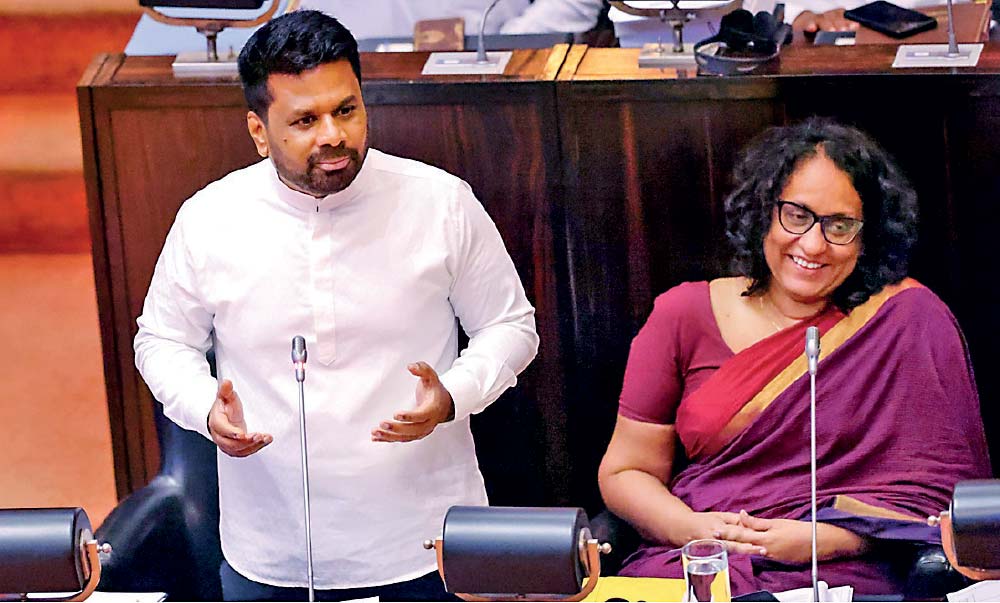
President Anura Kumara Dissanayake yesterday pledged to repeal the long-controversial Prevention of Terrorism Act (PTA) before the end of the year, while simultaneously unveiling plans for a new legal framework aimed specifically at combatting organised crime, in what could mark one of the most significant overhauls of Sri Lanka’s security and civil liberties architecture in decades.
Addressing Parliament during the adjournment debate on Combatting the Drug Menace, Dissanayake sought to draw a sharp distinction between the PTA, which has long been criticised by rights groups for its sweeping powers, and a proposed Organised Crime Act, which he said would contain narrowly defined provisions focused solely on criminal networks.
“For many years, people struggled to secure the repeal of the PTA. I am pleased to state that this Act will be repealed within this year,” the President declared, adding that final discussions had already concluded and that the Government would move swiftly to abolish it.
The announcement represents one of the strongest commitments yet by the National People’s Power (NPP) administration on a reform that successive governments had promised but failed to deliver.
Dissanayake argued that the PTA’s greatest flaw was its broad and ambiguous definitions, which enabled governments to use the law far beyond its original purpose.
“Under the PTA, terrorism could be interpreted in many different ways,” he said. “One could potentially bring charges under the Act based on wide-ranging interpretations.”
In contrast, he said the new organised crime legislation would contain precise definitions that prevent the misuse of State power against political opponents, critics, and dissenters.
“The broad and ambiguous provisions that existed under the PTA made it possible to target individuals simply because they disagreed with those in power. We are determined to eliminate such possibilities,” he said.
He also said the Government intends to effectively replace the current Online Safety Act with a substantially revised framework.
Dissanayake recalled that his party had opposed the legislation when it was introduced and criticised the previous administration’s approach to lawmaking.
“We have no intention of implementing the Online Safety Act in its present form,” he said, revealing that the Cabinet had already approved the drafting of a replacement Bill last week. “These were laws that had the potential to undermine the rights of the people and we are committed to abolishing or reforming them,” he added.
Positioning his administration as markedly different from its predecessors, the President highlighted the deliberate policy of restraint in handling public protests.
“Numerous protests have taken place across the country, yet no single water cannon has been used against the public during our period in office. Tear gas has not been deployed against ordinary citizens either,” he said, noting that the only recent use of tear gas occurred during unrest inside Matara Prison.
The President pointed out that democracy required not only freedom of expression and the right to protest but also responsible conduct by political actors, institutions, and the media.
In a veiled criticism of recent protest actions, Dissanayake said demonstrations should target institutions rather than private residences.
“Any protest may be carried out in front of the Finance Ministry or in front of Parliament—that is democratic. But going to an official’s home is an act of incivility,” he said.
The President also used the debate to reject allegations that vacancies in Sri Lanka’s higher Courts were being deliberately left unfilled to influence judicial outcomes.
Referring to concerns raised over appointments to superior Courts, he said he had sought clarification directly from the Chief Justice and had been informed that the delays stemmed largely from broader structural shortages across the judicial system.
“I noticed some claims suggesting that these vacancies are being deliberately kept open as a form of leverage to influence judicial decisions. Nothing could be more insulting to our judges,” he said.
Dissanayake stressed that the Government had “absolutely no desire to control the judiciary,” nor any intention of controlling the media or suppressing dissent.
While promising tougher laws against criminal syndicates, the President sought to reassure critics that civil liberties would not be sacrificed in the process.
“We are committed not only to democracy but also to upholding human rights and human dignity,” he said, presenting the repeal of the PTA, reforms to online regulation, and the crackdown on organised crime as pillars of a wider effort to reshape the State and restore public trust.



