Saturday Oct 17, 2026
Saturday Oct 17, 2026
Wednesday, 19 August 2026 05:04 - - {{hitsCtrl.values.hits}}
By Safna Malik
The Asian Development Bank (ADB) and the Government of Sri Lanka have launched the Sri Lanka Upper Watershed Ecological Restoration Program (SUWERP) to safeguard and restore the country’s central highlands.
The initiative follows Cabinet approval in June 2026 to set up the Upper Watershed Management Authority (UWMA) following severe forest damage caused by Cyclone Ditwah. To support this framework, the Government is restructuring existing state bodies while introducing the Climate Action and Nature Positive Investment (CANOPI) Fund to secure long-term capital for restoration.
As part of these ongoing efforts, ADB hosted a knowledge sharing session titled Investing in Sri Lanka’s Upper Watersheds: Unlocking Natural Capital for a Resilient Future under its Serendipity Knowledge Program (SKOP) series. The event brought together Government officials, policy experts, and research partners to discuss practical implementation pathways.
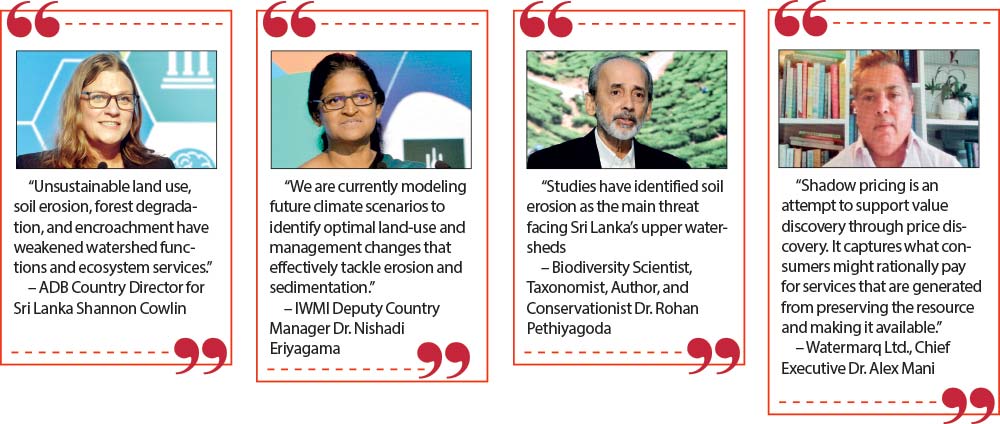
Speaking at the event, ADB Country Director for Sri Lanka Shannon Cowlin emphasised that upper watersheds serve as vital economic assets supporting national development. However, she cautioned that unsustainable land use, soil erosion, forest degradation, and encroachment continue to weaken watershed performance, escalating risks of flooding and landslides, accelerating reservoir sedimentation, reducing agricultural yield, and straining downstream infrastructure.
Cowlin noted that policy discussion has shifted from building basic awareness toward identifying practical investment pathways. To guide implementation, ADB commissioned two studies: a hydrological assessment by the International Water Management Institute (IWMI) focused on water security, and an economic valuation study examining the financial value of ecosystem services. She added that proposed mechanisms such as the UWMA and the CANOPI Fund will require broad consultation, strong stakeholder ownership, and safeguards to ensure local communities, farmers, and plantation workers share in the economic benefits.
Delivering the keynote address, Biodiversity Scientist, Taxonomist, Author, and Conservationist Dr. Rohan Pethiyagoda identified soil erosion as the main threat facing Sri Lanka’s upper watersheds, warning that massive volumes of topsoil wash into the sea every year. He stressed that soil erosion and landslides must be treated as separate issues. While landslides occur naturally in mountain environments, human activity and poor land management have greatly accelerated overall damage.
Pethiyagoda rejected claims that the tea industry alone is to blame for highland deterioration. Properly managed tea lands help prevent soil loss through drainage systems, ground cover, and the dense canopy formed by tea bushes. Poor land management and unsuitable crops like vegetables cause far more damage, alongside decades of failure by successive governments to manage state-owned lands properly.
On governance, Pethiyagoda called for Regional Plantation Companies (RPCs) to be brought in as partners to the UWMA rather than treated as entities to be regulated. The 20 RPCs already possess the workforce, infrastructure, management capacity, and decades of highland experience needed for restoration. He also urged the Government to involve non-Government scientists and conservation experts, noting that existing legal provisions under the Fauna and Flora Protection Ordinance already allow outside experts to contribute.
Pethiyagoda highlighted Sri Lanka’s 103 river basins as an opportunity to reconnect fragmented ecosystems. Protecting vegetation zones on either side of waterways can create biological corridors linking the highlands to the lowlands. However, he cautioned against relying on tree planting drives in degraded highlands, describing afforestation in these regions as mostly ineffective due to aggressive invasive plant species taking over clearings and fire-damaged sites.
Turning to the CANOPI Fund and the UWMA, he warned that both could fail like many existing state bodies unless clear performance targets are set from the beginning. Sri Lanka currently operates 27 authorities, most of which fall short due to Treasury interference, zero-risk mandates, and poor legal drafting. He urged lawmakers to draft legislation for the new authority with care to ensure it achieves its purpose.
Looking overseas, he pointed to Costa Rica’s payment-for-ecosystem-services model, which taxes resource-dependent sectors to fund environmental protection and nature tourism. A similar system in Sri Lanka, applying a 1 per cent levy on energy and water sectors, could generate around Rs 23 billion annually. Reinvesting Rs 9 billion of that total could employ 10,000 workers at Rs 75,000 a month to carry out watershed restoration, combining environmental protection with rural employment.
Hydrological assessment findings
IWMI Deputy Country Manager Dr. Nishadi Eriyagama presented a hydrological assessment conducted under SUWERP aimed at identifying practical land management solutions to curb soil erosion and build watershed resilience. The study was carried out in two main phases. The first phase assessed the Upper Mahaweli watershed and identified the 729-square-kilometre Uma Oya catchment near Rantambe Reservoir as the most vulnerable zone. In the second phase, IWMI gathered baseline data on local water flow, soil erosion, and water quality to model climate impacts and design practical solutions.
She mentioned the Soil and Water Assessment Tool (SWAT) has been deployed to map water flow across 38 sub-basins, alongside the InVEST Sediment Delivery Ratio model to track soil movement based on slope, plant cover, and drainage paths. The models showed that steep, bare lands shed sediment directly into waterways, while flatter, vegetated slopes filter and retain soil.
Water flows and erosion patterns
The Uma Oya basin releases an average of 514.5 million cubic metres of water into the Rantambe Reservoir each year. River flow peaks in December during the northeast monsoon, bringing heavy rainfall that drives major soil erosion, while the lowest water levels occur during the dry season from June to August.
Agricultural areas, including tea plantations and vegetable plots, generate the largest volume of soil entering the river network, averaging 1.2 tons per hectare annually. However, unmanaged bare land and landslide zones suffer the highest individual rates of topsoil loss, with spatial mapping pinpointing the central region between Welimada and Nuwara Eliya as the main erosion hotspot.
Water quality assessment and pesticide contamination
Water testing across 21 locations revealed safe drinking limits were breached at 13 sites, with overall water degradation concentrated in the middle section of the basin. High concentrations of aluminium and iron drove these elevated risk levels, though most other parametres met standard health guidelines.
Dr. Eriyagama noted that chemical testing confirmed widespread pesticide contamination in agricultural zones. Sampling in the central basin revealed six locations containing more than five distinct varieties of pesticides, reflecting the heavy intensity of commercial farming in the surrounding area.
She highlighted that field observations confirmed a stark contrast between land management practices, as well-managed agricultural plots with soil conservation measures release minimal sediment into streams, whereas poorly managed lands discharge massive loads of topsoil into local rivers. She added that IWMI is currently completing the study’s final phase, modelling future climate scenarios to guide targeted land-use changes.
Economic valuation of watershed services
Joining the session virtually, Watermarq Ltd., Chief Executive Dr. Alex Mani introduced ongoing research valuing water and upper watershed ecosystem services. He outlined the economic impact of upstream land degradation on downstream industries, showing which commercial sectors depend on healthy ecosystems and which face direct financial risk from deterioration.
The economic analysis focuses on upstream soil loss directly affecting Rantambe Reservoir and its downstream multi-purpose hydroelectric facilities, which supply power to the national grid. Studies demonstrate that sustainable land management practices can reduce sediment loads by three to five times, aligning Watermarq’s economic model with IWMI’s catchment research.
Shadow pricing and payments for ecosystem services
Mani outlined three analytical components. First, water is valued as natural capital. Standard markets price only extraction and distribution, ignoring ecosystem benefits. Second, shadow pricing estimates what downstream consumers would rationally pay for watershed protection. This captures water’s true economic value. Third, payments for ecosystem services (PES) link financial rewards directly to verified land management actions through thorough monitoring.
The model addresses two critical questions. Upstream, it identifies the minimum payment required for land users to adopt sustainable management practices. This figure varies by location, participant, and specific intervention. Downstream, it determines the maximum amount beneficiaries would rationally pay to safeguard operations. Whilst the current study focuses on hydroelectric facilities, the framework can expand to cover other sectors such as tourism.
Valuation methods and financial assessment
The study uses four cross-checked valuation techniques. First, it assesses how water volume, quality, and silt levels directly affect energy generation. Second, it calculates replacement costs if natural services fail: dredging reservoirs, treating water, or relying on higher-cost and higher-emission energy sources. Third, an avoided cost function quantifies financial losses prevented by healthy land management, including lost revenue from reduced water flow and faster asset devaluation caused by sediment buildup. Fourth, benefit transfer compares regional findings with global watershed data from places like Costa Rica to strengthen valuation confidence.
An initial report has been set up with the framework logic and early findings. The research team will focus on gathering field data over coming months to calibrate findings before submitting a final report with full financial quantifications to the ADB. What emerged across the presentations went beyond a standard environmental progress report, signalling a structural shift in Sri Lanka’s policy approach to central highland restoration.
The event concluded with an extended panel discussion titled From Natural Capital to Investment – Financing Sri Lanka’s Upper Watershed Restoration that examined practical funding structures, risk-sharing mechanisms, and institutional pathways required to secure long-term capital for restoration efforts. Rather than remaining limited to identifying ecological damage, the discussion centred on establishing economic values and funding mechanisms for sustainable land management.
- Pic by Lasantha Kumara




