Saturday Sep 26, 2026
Saturday Sep 26, 2026
Monday, 29 December 2025 05:39 - - {{hitsCtrl.values.hits}}
By Sarasi Wijeratne
The Government and its humanitarian partners will coordinate on a $ 35 million Humanitarian Priorities Plan (HPP) for victims of Cyclone Ditwah.
So far, the Government has received $ 20 million of funds, most of which have been channelled through the UN by its development partners. Nearly 1.2 million people are in need of humanitarian assistance in the aftermath of the cyclone.
The humanitarian response will address short-, medium-, and long-term needs in housing, livelihoods, food security, nutrition, water and sanitation, and education.
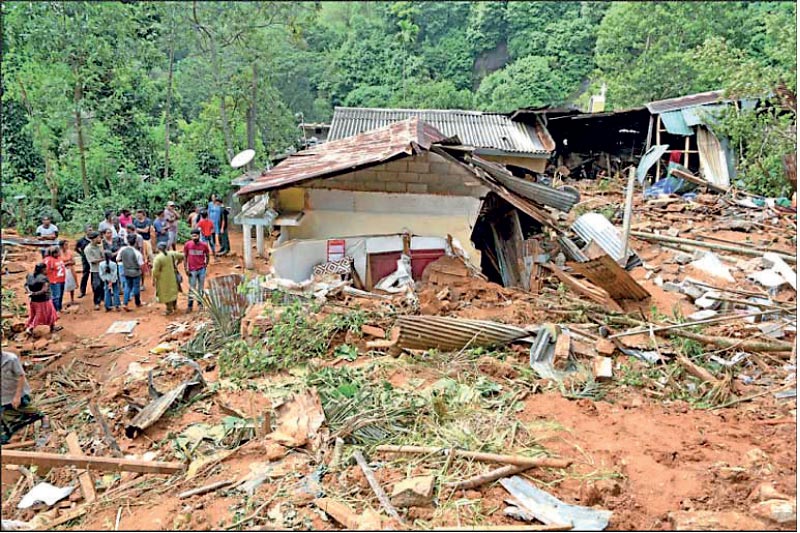
The Government reported 643 casualties and 183 people still missing in the latest situation report of 19 December, which was released by the UN Resident Coordinator’s office in Sri Lanka. More than 66,000 people are still residing in safety centres in the wake of the cyclone, which was unprecedented in Sri Lanka’s weather annals. The cyclone affected communities in all districts, with the Central, Western, and North Western Provinces hit the most.
Cyclone Ditwah displaced nearly 233 thousand families at its peak and fully or partially damaged more than 100,000 houses. Although these families have started returning to their communities, they are living in partially damaged or makeshift houses, which put them in danger of exposure to weather and health risks. According to the report, damage to water supply and sanitation systems in several affected areas is limiting access to safe drinking water and adequate sanitation, increasing public health risks, particularly in displacement settings. An estimated 109 health facilities and infrastructure require repairs on water and sanitation amenities to become functional.
Households depending on subsistence farming, fisheries, daily wage labour, and small businesses are reportedly seeing severe disruptions to their livelihoods. The report notes how the loss of crops, livestock, fishing gear, and other small productive assets have disproportionately affected poorer households with limited coping capacity and little access to compensation.
The destruction of several early stages of the Maha season’s crops is threatening production and future harvests, which are life-giving for many households, particularly low income and small-scale farmers. According to estimates, more than 106,000 hectares of paddy have been damaged in the Maha season, which typically supplies over 70% of the country’s annual rice production. While a narrow window of up to three months currently exists to replant and recover 25-30% of lost production, delayed or missed planting could have a cascading effect on the availability of local food and trigger income losses going into the next year.
More than 5.5 lakhs of children whose education has been disrupted because schools and pre-schools have been damaged by flooding, landslides, and severe winds will need stationery, uniforms, and other essential learning material. Among them are 900 special needs children who will need adapted learning materials.
Meanwhile, the report states approximately 1,185 schools and 2,720 pre-schools urgently require essential teaching and learning equipment, furniture, and minor repairs to enable safe reopening. “Schools that are severely damaged or destroyed may remain non-functional in the near term, necessitating temporary learning spaces to ensure continuity of learning,” the report adds.
At least 1,200 of the most affected schools require a resumption of the school meal program to reduce the high risk of malnutrition among school-aged children.
The report highlights existential protection concerns among displaced communities, particularly for women and girls, as overcrowded shelters, disrupted services, and prolonged displacement heighten risks of gender-based violence, exploitation, and psychosocial distress.
While time and access constraints to affected areas are impacting field assessments to capture the full extent of the damage accurately, sectoral peculiarities pose further challenges.
For instance, overcrowded safety centres, severe damage to transport networks and markets, and extensive losses to crops, livestock, and fisheries are making it difficult to ensure food security because of resulting disruptions to food supply chains and limited household access to essentials, recovery which requires significant resources and time.
At the same time, the lack of breastfeeding corners in safety centres, insufficient nutritional screening and interventions, and a lack of complementary feeding support have been identified as gaps and constraints to nutritional adequacy.
In the case of access to healthcare, the report flags constraints for the full restoration of essential health services due to damaged or inundated facilities and disruptions to power, water, and infection prevention and control. Other factors contributing to it are the need for staff working both in affected health institutions and welfare centres to be supported, and limited availability of referral pathways for mental health and psychosocial support.
Similarly, limitations to providing required quantities of water, inadequate sanitation facilities at safety centres, insufficient equipment and chemicals to clean wells, and the lack of technical staff are impacting the provision of water and sanitation to required levels.
Among the difficulties protection services are faced with are limited funding which prevents sector partners reaching more safety centres and communities with protection needs, a breakdown of referral pathways for specialised services, inadequacies in safety centre management, and insufficient privacy and safeguarding in these locations, especially for women and children.
The loss of livelihoods, rising costs, and service disruptions could exacerbate the vulnerabilities of those already living in poverty. While 23% of the population was already living in poverty, another 10% risk falling below the poverty line during crises.
The overall coordination for the Ditwah response is led by the Government through its national and sub-national networks, with support from the UN, humanitarian partners, international organisations, national civil society organisations, and the private sector.
The development partners that have contributed to the HPP are Australia, Canada, the EU, Japan, New Zealand, Norway, the Republic of Korea, Switzerland, the UK, and the US. The Gates Foundation, the German National Committee for UNICEF, and the US National Committee for UNICEF have been the other contributors.
The Government requested funds of $ 35.3 million for the HPP and has received $ 20.7 million to date.




