Thursday Oct 15, 2026
Thursday Oct 15, 2026
Monday, 11 May 2026 00:06 - - {{hitsCtrl.values.hits}}
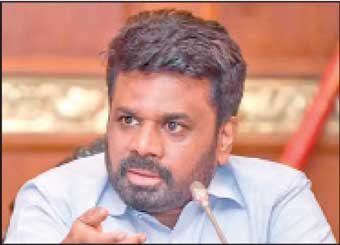 |
| President and Finance Minister Anura Kumara Dissanayake |
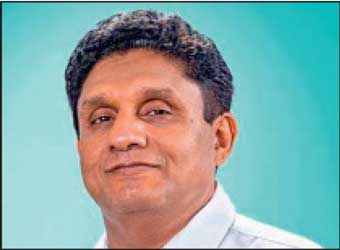 |
| Opposition Leader Sajith Premadasa |
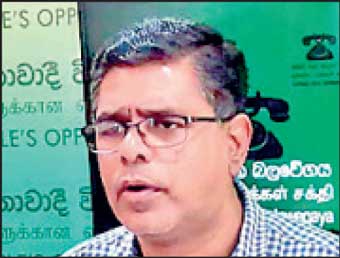 |
| SJB MP Mujibur Rahman |
Opposition MPs last week intensified pressure on President and Finance Minister Anura Kumara Dissanayake over the $ 2.5 million Treasury phishing scandal, accusing the Government of politicising key State institutions and weakening institutional safeguards within the Finance Ministry through inexperienced political appointments and partisan placements.
The attacks came during the Second Reading debate on the proposed Rescue and Rehabilitation Insolvency Bill, where several Opposition MPs used the debate to raise fresh concerns over what they described as institutional failures exposed by the Treasury cyber fraud.
Samagi Jana Balawegaya (SJB) MP Mujibur Rahman questioned why President Dissanayake had yet to make a formal public statement regarding the fraud involving fraudulent payments made from the Finance Ministry, which remains directly under the President in his capacity as Finance Minister.
Rahman accused the Government of initially refusing the Opposition’s request for a Parliamentary debate on the matter and only relenting after Opposition MPs protested inside the Chamber last week.
“The Government refused the Opposition’s request for a debate. They only relented when Opposition MPs rose from their seats in protest. What are they trying to hide?” he asked.
He said the fraudulent payments had taken place in 10 tranches between November 2025 and January 2026, but the Criminal Investigation Department (CID) had only been informed in March while Parliament and the public remained unaware until details emerged publicly.
“Why the secrecy? Where is the Finance Minister, the President? The $ 2.5 million may be an insignificant sum to the Government but it is still taxpayers’ funds. What concerns us most is the breakdown in processes, checks and balances, and accountability that this fraud has exposed,” Rahman said.
Rahman also questioned the handling of the death of a suspended Treasury official linked to the investigation, claiming there were unresolved concerns surrounding the circumstances of the death.
He criticised the appointment of a Government-appointed medical committee to examine the matter, arguing that such inquiries should fall within the purview of judicial and investigative authorities.
The SJB MP further alleged that the Government had weakened institutional capacity by appointing politically aligned individuals to senior State positions despite lacking the necessary administrative experience.
According to Rahman, the appointment of a former MP as Treasury Secretary marked an unprecedented politicisation of the Finance Ministry, traditionally overseen by senior Sri Lanka Administrative Service (SLAS) officials with extensive experience in public finance and administration.
“The crime is unprecedented. But so is the appointment of a political activist as Treasury Secretary, a role traditionally held by highly qualified and experienced SLAS officials who understand the complex State machinery,” he said.
Opposition Leader Sajith Premadasa also accused the Government of transforming the public service into an extension of the Janatha Vimukthi Peramuna’s (JVP) political apparatus through appointments of party loyalists across key State institutions, including Divisional Secretariats and financially sensitive Government agencies.
He said this undermined institutional capacity and integrity. “This is what the lost payments at the Treasury has exposed,” Premadasa pointed.
“We now learn that some of the payments did not have supporting invoices; if these were verified, the payments would not have been made. Also, several payments could have been flagged during the year-end reconciliations; that, too, has not happened,” he alleged.
The previous day, Committee on Public Finance (CoPF) Chairman Dr. Harsha de Silva raised separate concerns regarding the internal processes and institutional arrangements within the Finance Ministry exposed during closed-door CoPF discussions into the Treasury fraud.
Dr. de Silva said the Committee had identified serious weaknesses in accountability, operational clarity, and delegation of authority within the Ministry.
Dr. de Silva said explanations that the payments occurred during the transition of Government debt management functions from the Central Bank of Sri Lanka (CBSL) to the Treasury pointed to deeper structural weaknesses. “It is as if the system was being run without the necessary experience,” he said.
Contrasting the situation with traditional administrative practice, Dr. de Silva said senior Finance Ministry positions had historically been held by experienced SLAS officials rising through established institutional structures.
He alleged that, instead, key vacancies had been filled in an ad hoc manner through delegations from the Planning Service, resulting in insufficient institutional expertise within critical departments.
Dr. de Silva further alleged that the heads of the External Resources Department and Public Debt Management Office lacked the required expertise to manage complex debt operations.
“If the Treasury Secretary and the department heads do not have the required experience and skills, it is not surprising that processes fall apart,” he said.




