Monday Sep 28, 2026
Monday Sep 28, 2026
Wednesday, 5 August 2026 05:35 - - {{hitsCtrl.values.hits}}
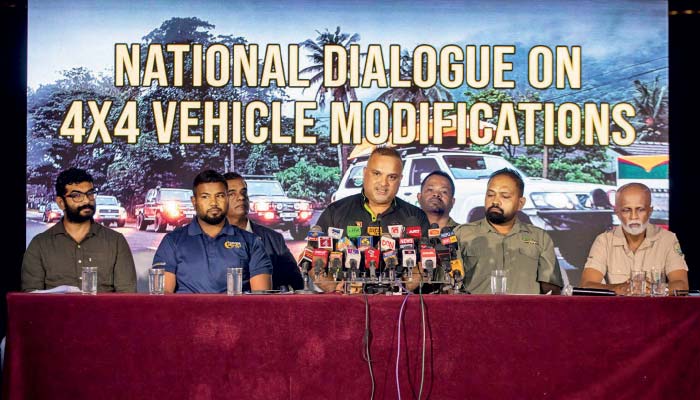 The members of Sri Lanka’s 4x4 community have urged the Government to engage constructively on the new regulations concerning vehicle modifications, stressing the need for a balanced regulatory framework that safeguards public safety and at the same time acknowledges the legitimate operational role of professionally modified four-wheel-drive vehicles.
For many years members of Sri Lanka’s 4x4 community have made important voluntary contributions to disaster relief, humanitarian aid, environmental conservation, the tourism industry, motorsport, and community service. Four-wheel-drive vehicles that are properly equipped have on several occasions proved to be essential in emergencies since they are able to get to places which conventional vehicles cannot and have allowed relief operations to proceed when time was of the essence.
After the 2004 Indian Ocean Tsunami and in the case of many floods, landslides, and other natural disasters, owners of volunteer 4x4 vehicles have worked together with government Institutions, humanitarian organisations, and local communities to deliver emergency supplies, evacuate people who had been affected, assist in search and rescue missions, and ensure access to remote areas. The capability of these vehicles to cope with tough terrain has allowed for timely aid to be given in some of the nation’s most difficult situations.
The Ironman 4x4 Emergency Response Team Sri Lanka is one of the organisations involved in these initiatives and has taken an active part in emergency response operations in conjunction with a large number of independent 4x4 volunteers throughout the country. The members of this organisation have obtained accredited emergency response training via courses organised by the Asian Pacific Alliance for Disaster Management (A-PAD), which is supported by the Government of Japan, as well as through I-CERT Emergency Response Training, the Sri Lanka Life Saving certification, first aid and CPR training provided by the Sri Lanka Red Cross, and special vehicle recovery and off-road rescue programmes. Because of their qualifications and the fact that they have properly equipped vehicles, the volunteers are able to help communities in a safe and professional manner during emergencies.
The role of Sri Lanka’s modified 4x4 community goes well beyond that of providing disaster relief. The members often offer help with community emergency assistance, the recovery of vehicles during floods and when they break down, humanitarian and charitable activities, environmental conservation projects, the transport of medical supplies, and the organisation of public events in remote or difficult terrain. Professionally modified four-wheel-drive vehicles also play a vital part in Sri Lanka’s motorsport industry by giving recovery services, safety assistance, access to the tracks, and vehicle extraction during off-road competitions.
The responsible operation of 4x4 vehicles also brings benefits to the tourism sector, since properly modified vehicles ensure safe access to eco-tourism destinations, nature trails, camping sites, wildlife reserves and other remote attractions. These activities help to promote rural tourism and support local businesses as well as Sri Lanka’s expanding adventure tourism industry.
The 4x4 community also has a significant social role since it promotes responsible outdoor recreation amongst young people. Getting involved in organised 4x4 activities fosters discipline, teamwork, leadership, technical knowledge, awareness of the environment, and a spirit of volunteering. This kind of positive engagement gives young people useful recreational opportunities which can help them avoid harmful influences such as drug abuse, at the same time encouraging responsible citizenship and greater participation in the community.
The 4x4 community entirely backs the Government’s obligation to enhance road safety, make sure that vehicles comply with the relevant standards, and control any unsafe or unauthorised modifications to vehicles. At the same time, members have raised worries that the new regulations might inadvertently have an impact on professionally modified four-wheel-drive vehicles which are used for disaster response, humanitarian operations, tourism, motorsport, and community service.
The alterations presently being considered such as recovery gear, suspension improvements, winches, snorkels, protective fittings, and other functional parts were intended to enhance the vehicle’s capability and safety when operating in tough environments rather than for cosmetic reasons. The community holds that there must be a clear difference between unsafe modifications and professionally fitted equipment which is intended for genuine operational use.
This press conference was held in order to have a respectful and constructive discussion with the appropriate Government departments, namely the Department of Motor Traffic (DMT/RMV), with a view to finding practical solutions which acknowledge the important public service carried out by responsible 4x4 owners without at the same time compromising safe standards. The community suggests that clear technical guidelines should be drawn up for modifications that are acceptable, that an inspection and certification procedure should be put in place for modified vehicles, and that a regulatory framework should be established which distinguishes between functional safety equipment and unsafe or non-compliant modifications.
The 4x4 community in Sri Lanka is not asking for an exemption from the law; instead, it is calling for a fair, practical and evidence-based method of regulation which takes into account both road safety and the needs of vehicles that operate in emergencies, help promote tourism and motorsport, and assist in community development.
The community will continue to work closely with the Government, technical experts, engineers, law enforcement authorities, the various motorsport organisations, tourism stakeholders and emergency response agencies in order to establish up-to-date regulations which safeguard public safety while at the same time retaining the valuable contributions of Sri Lanka’s responsible 4x4 community.




