Thursday Mar 12, 2026
Thursday Mar 12, 2026
Wednesday, 24 December 2025 00:04 - - {{hitsCtrl.values.hits}}
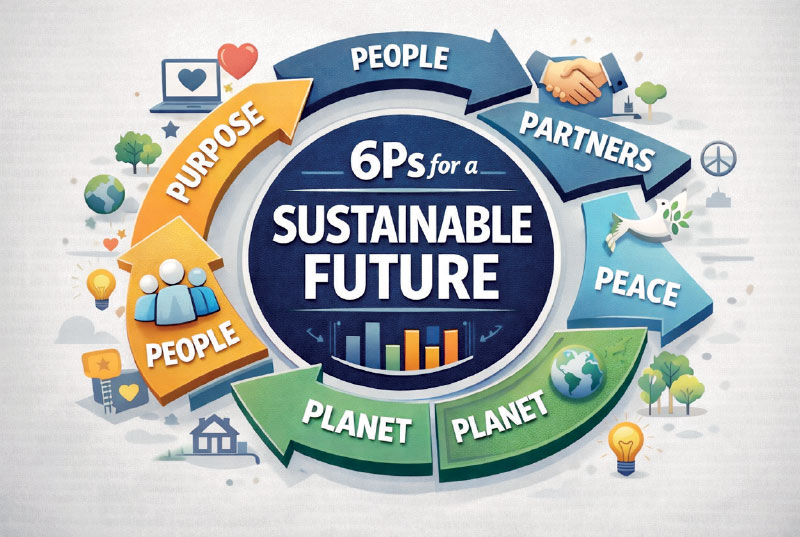
The 6Ps lift marketing out of its narrow commercial lane and place it in a broader human, social and planetary context
 For decades, marketers thrived on the use of 4Ps – Product, Price, Place, Promotion – to conduct their Tactical Marketing Planning.
Now we have to ask whether the 4P marketing mix is a sufficient starting framework for strategic marketing planning. Or is an expanding 6P marketing mix a better way to conduct Strategic Marketing Planning?
A brief history of the 4Ps paradigm
In 1960, Professor Jerry McCarthy published Basic Marketing in which he introduced the 4P marketing framework. Jerry had studied marketing under Professor Richard Clewett at Northwestern University. Clewett taught students that marketing consists of making decisions on product, price, promotion and distribution. Clewett held that the heart of marketing laid in distribution, the setting up of channels of distribution. Jerry decided to replace “distribution” with “place” so that marketers could use the more convenient toolset of the 4Ps. Marketers were especially competent in “place” marketing.
I chose to use the 4P framework in writing my marketing textbooks. I went further and applied the 4P framework not only to commercial organisations but to all organisations – such as colleges, museums, government agencies, etc. All organisations seek marketing results. I called this “broadening marketing”.
More recently, I recognised the need to add a few more marketing tools to the 4Ps. Marketers needed to add service and brand to their product thinking. What good is a product if it doesn’t include good service? What good is the product if it doesn’t exhibit a strong brand? Then I added one more tool to price, namely Incentives. Altogether, I added 3 more marketing tools. Unfortunately, these three new tools did not begin with the letter P.
 More recently, I recognised the need to add a few more marketing tools to the 4Ps. Marketers needed to add service and brand to their product thinking. What good is a product if it doesn’t include good service? What good is the product if it doesn’t exhibit a strong brand? Then I added one more tool to price, namely Incentives. Altogether, I added 3 more marketing tools. Unfortunately, these three new tools did not begin with the letter P
|
Marketing guru Philip Kotler autographs a book authored by him
|
The need for a new 6P framework for strategic marketing
The father of modern management Peter Drucker said that every business must ask this question: What is the purpose of my business? The easy answer to this question is to say “profits”. Is that really the only reason to start a business? Is “selling more stuff” the essence of purpose? Does “profits” sound like a lifting purpose for the company’s employees? Are employees happy that their job is to produce profit for the company’s stakeholders?
I began to think about a Strategic Marketing Planning process that would be founded on a sequence of 6Ps.
The 6Ps lift marketing out of its narrow commercial lane and place it in a broader human, social, and planetary context. In an age of climate anxiety, social fragmentation, inflation, AI, and hyper-competition, marketing must serve a higher order of purpose.
Let’s look at each of the 6Ps in turn.
1. Purpose
Every organisation, brand, or person needs to have a purpose. This is more than a mission statement framed in a boardroom. Purpose answers why we exist beyond profit. Brands with a strong purpose, brands such as Nike, Unilever, Walmart, Amazon and others will grow. Purpose is not just a decorative slogan but a strategic engine. Purpose aligns and motivates employees, attracts customers who share values, and gives the organisation a moral north star. A strong purpose will help organisations meet Gen Z’s demand for authenticity. If the “why” of a business is weak, the rest of the marketing plan is just transactional.
2. People
A market is a set of people. Marketers aim to create value for a defined set of buyers. Marketers try to provide an acceptable solution that satisfies a well-defined customer need or want.
In the process, the marketer must also satisfy the needs of employees. Imagine a hotel trying to satisfy its guests. That hotel should also try to satisfy the hotel’s employees. The hotel’s guests will be affected by the quality of the restaurant’s staff, the room cleaning service, and other groups of employees. The hotel’s success will depend on how well the hotel trains and motivates its employees. In such fields as hotels, banks, colleges, and hospitals, all employees must live the role of brand ambassadors.
3. Partnerships
Every organisation must form partnerships with human groups to accomplish its purpose. Partnerships usually include suppliers, distributors, universities, NGOs, and technology platforms.
Successful partnerships begin with a win–win mindset. With it, partnerships become engines of innovation, market access, and even social impact.
This new 6Ps model represents an effort to humanise marketing. Where the original 4Ps marketing mix helped marketers do tactical marketing, the 6Ps help organisations do strategic marketing where the aim is to be responsible, relevant, and fit to serving the future
4. Peace
People are productive when they work in a peaceful atmosphere. Peace operates at multiple levels:
Organisations need to create trust, reassurance, and long-term relationships. A peaceful world is good for business—and businesses have a role in creating that peace through ethical communication, fair treatment, and social responsibility.
5. Planet
Businesses often fail to account for the environmental externalities of their value creation process. This means that pollution, carbon, waste, and resource depletion are treated as “someone else’s problem”.
Organisations must design for sustainability—responsible sourcing, circularity, reduced packaging, greener logistics. Consumers must become mindful of what they consume and how they consume it. Marketing must stop glorifying endless consumption and start educating, nudging, and offering sustainable alternatives.
Market planning that ignores the planet will lose relevance, regulation will catch up, and younger consumers will move away. A healthy planet is now part of the value proposition.
6. Prosperity
Real prosperity is only possible after the first five Ps are in place. If the organisation has a clear purpose, cares for its people, builds genuine partnerships, contributes to peace, and protects the planet, then the prosperity that comes is healthier, more distributed, and more resilient.
In such a system, shareholders remain important—but not the most important, and not the only voice. Employees, customers, communities, the environment and the planet all become stakeholders. Prosperity becomes a collective outcome, not an individual extraction.
Real prosperity is only possible after the first five Ps are in place. If the organisation has a clear purpose, cares for its people, builds genuine partnerships, contributes to peace, and protects the planet, then the prosperity that comes is healthier, more distributed, and more resilient
Why this 6Ps framework matters now
This new 6Ps model represents an effort to humanise marketing. Where the original 4Ps marketing mix helped marketers do tactical marketing, the 6Ps help organisations do strategic marketing where the aim is to be responsible, relevant, and fit to serving the future. The 6P approach moves marketing:
This framework is not just for Western multinationals. It is for developing markets, family businesses, public sector institutions, education providers—any entity that wants to grow without harming people or the planet.
Message to marketers: Do well, but do good first.
Thanks also goes to Denzil Indrajith Perera of Sri Lanka for our discussion of the 6Ps.