Saturday Jul 25, 2026
Saturday Jul 25, 2026
Thursday, 26 February 2026 00:03 - - {{hitsCtrl.values.hits}}
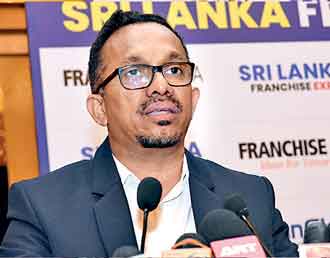
Industry and Entrepreneurship Development Minister Sunil Handunneththi
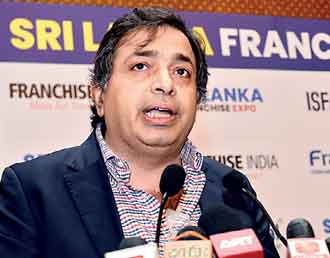
Indian Small Business & Franchise Association Chairman Gaurav Marya
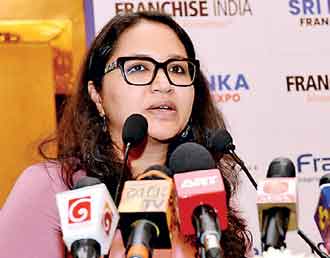
Indian High Commission Economic and Commercial Wing Head and Counsellor Devika Lal
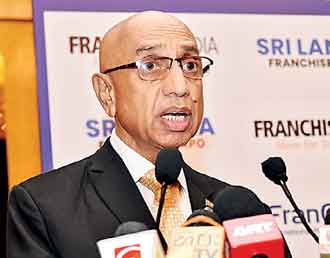
Federation of Chambers of Commerce and Industry of Sri Lanka President Keerthi Gunawardane
By Divya Thotawatte
Drawing significant international interest, Sri Lanka Franchise Expo 2026 kicked off with more than a dozen global brands exploring market entry while local brands signed agreements to expand overseas.
A key highlight at the event was the signing of the agreement between FranGlobal, the international arm of Franchise India Group, and Fat Crab, Don Stanley Holdings’ seafood restaurant, to expand the brand into India. The partnership is set to establish up to 25 outlets by 2028 before expanding further into Southeast Asia and the Middle East.
Speaking at the event, Industry and Entrepreneurship Development Minister Sunil Handunneththi underscored the significance of franchising for the country’s economic growth.
“We appreciate FranGlobal bringing together brands, investors and industry leaders from Sri Lanka and India, especially at a time when our nation is strengthening its entrepreneurship and industrial development. Franchising is not merely a business model; it’s a powerful vehicle for economic growth, innovation, employment generation, and SME development, including knowledge exchange and technology transfer.”
Six major business bodies: Indo-Lanka Chamber of Commerce, Ceylon National Chamber of Industries, International Chamber of Commerce Sri Lanka, Colombo Chamber of Commerce, Federation of Chambers of Commerce and Industry of Sri Lanka, and Indian Small Business & Franchise Association, supported the initiative. Signalling institutional consensus on franchising’s economic multiplier potential.
Indian High Commission Economic and Commercial Wing Head and Counsellor Devika Lal noted India remained Sri Lanka’s largest trading partner and a major source of foreign direct investment (FDI) for the country.
Explaining that the SME sector formed the backbone of both economies, creating livelihoods, generating employment, and driving growth, she added, “This is an excellent time for bilateral investment, and events like the Franchise Expo are crucial in connecting our business communities and strengthening commercial cooperation between our two nations.”
International brands presented at the expo spanned across food and beverage, fitness, professional services. The brands included Stellarossa, EasyGym, Coffeeshop Company, Action Coach, U Clean, Blenz Coffee, Tea Avenue, Impasti Pizza, Burgertory, Figaro’s Pizza, Barcelos, Yogurt Factory, and Orane International, representing sectors experiencing accelerated growth in Sri Lanka’s urban centers.
Franchise India Group Chairman Gaurav Marya said that Sri Lanka’s appeal was not only in recovery metrics, but in the profile of its entrepreneurs. He noted that many potential franchisees now approached investments with clear expansion plans and capital discipline. He said this combination was “relatively rare in emerging markets.”
The expo follows April 2025’s Global Franchise Forum, which established initial dialogue between international brands and Sri Lankan stakeholders. The progression from exploratory discussions to concrete partnership negotiations within ten months suggests momentum that extends beyond event-driven interest.
In a brief interview following the event, Franchise India Group Chairman Gaurav Marya spoke to Daily FT, sharing his vision for scaling both global and Sri Lankan brands, along with the policy changes he said were necessary for the sector’s growth.
Q: What is the main objective of organising the franchise expo?
A: FranGlobal Sri Lanka has only three objectives. One is to democratise entrepreneurship in Sri Lanka through knowledge and networking, which this forum is all about. The second objective is to take Sri Lankan brands overseas. We have already announced three partnerships this year: Tea Avenue, Kelly Felder, and now Fat Crab. The third is to invite a lot of global brands that don’t know this market well. That would eventually bring investment to Sri Lanka.
Q: You announced your partnership with Tea Avenue last year. How is that progressing?
A: We are finalising locations in Bangalore and Hyderabad. By the middle of this year, we should have live locations. Kelly Felder will also open its first store in India within two months. I see India as the natural market for many Sri Lankan brands because of its favourable FTA deals, logistics, and the overlap of society.
Q: How competitive are Sri Lankan brands internationally?
A: In manufacturing and agro-produce, Sri Lanka is very competitive, not just with India but globally, including with China. What we lack in Sri Lanka is building the whole brand story outside. Which needs effort. Once we have two or three success stories internationally, then others will follow.
Q: What support do you provide entrepreneurs after the expo?
A: We first work on discovering the right opportunity because not every opportunity is right for everyone. Then we help them navigate legal, commercial negotiations, financing and incubation.
We handle structuring of the deal and work with them to scale. That way, we help the end-to-end process.
Q: Where do you see the sector in five years?
A: Over the next 3 to 5 years, I plan to introduce 100 global brands into the market and take 25 Sri Lankan brands overseas. I also want to see at least 10,000 franchises in Sri Lanka who would create a minimum 100,000 jobs.
Q: What incentives or policy changes from the Government are necessary for franchising and growth?
A: What we lack here at this stage is infrastructure. That is a policy that we need because infrastructure creates commerce. The second issue is finance: banks are not lending, especially to small businesses. Also, easy financial transactions. If a large company wants to invest in Sri Lanka, eventually, they would want to take some profits back. If the policy says you cannot take your money back, then why would people invest in this market? So ease of doing business is very important.
Pix by Shehan Gunasekara



