Saturday Jul 04, 2026
Saturday Jul 04, 2026
Friday, 29 May 2026 00:51 - - {{hitsCtrl.values.hits}}
By Divya Thotawatte
The era of predictable growth is over, and companies now face a world shaped by permanent instability, distrust, and disruption, said global business leaders recently, highlighting trust, adaptability, and organisational agility as key for survival.
They shared their views during the inaugural Leadership Summit by the Sri Lanka Brand Forum (SLBF) titled ‘Resilient Leadership – Thriving Amid Uncertainty’. The event, held on 18 May, brought together globally renowned business leaders, academics, entrepreneurs, and corporate decision-makers who discussed their predictions, experiences, and strategies to navigate the current global state of constant crises.
“For decades, the global business community sailed on relatively placid waters… Today, that era is firmly in the rear-view mirror… where volatility is no longer an intermittent risk but a permanent resident,” said L Catterton India Executive Chairman and former Unilever South Asia President Sanjiv Mehta.
Delivering the first keynote address, Mehta said that businesses were now operating in a “poly-crisis” environment which was driven by geopolitical fragmentation, climate urgency, technological disruption, conflict, and biological shocks.
“The most glaring proof of this volatility is the shortening horizon,” he said, noting that the average lifespan of an S&P 500 company had fallen from around 60 years to less than 20 years. In this environment, national crises and civil unrest would directly impact the workplace.
Speaking of his experience leading Unilever operations through the Arab Spring, the global financial crisis, demonetisation in India, and the COVID-19 pandemic, he said that crises rarely arrived with warning, but disrupted everything.
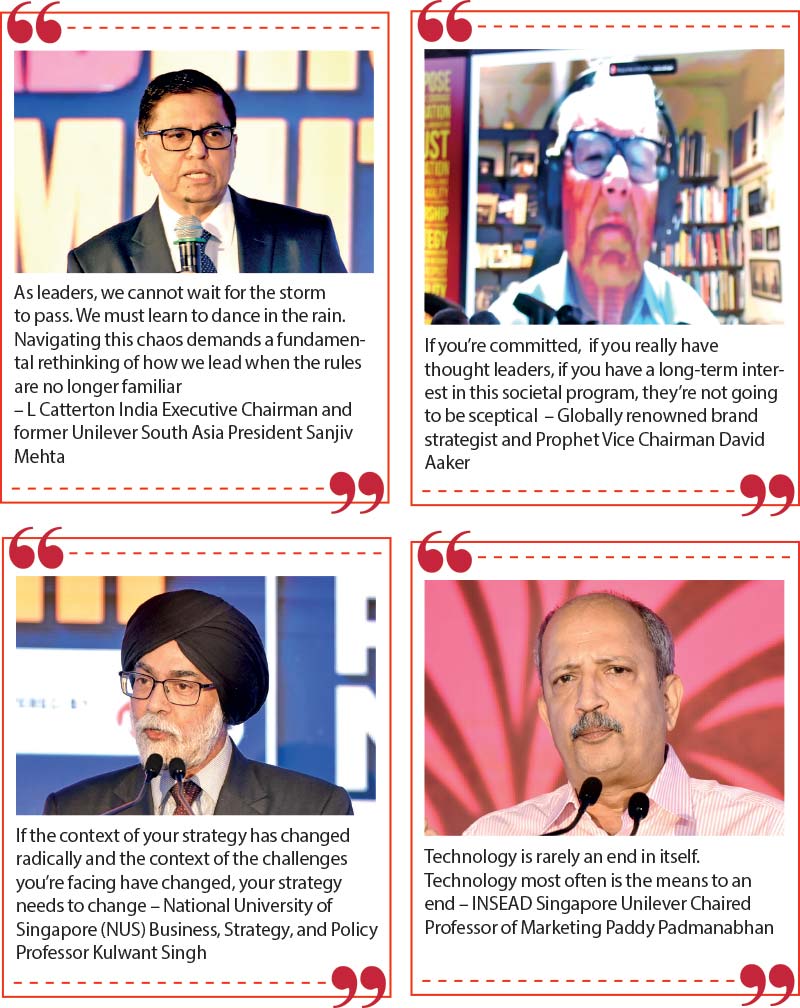
“A crisis never announces its arrival. It only announces the end of your whole strategy. As leaders, we cannot wait for the storm to pass. We must learn to dance in the rain. Navigating this chaos… demands a fundamental rethinking of how we lead when the rules are no longer familiar.”
The power of people-centric leadership
During crises, people-centric leadership becomes crucial, Mehta highlighted. He explained that employee trust became an organisation’s main asset during periods of instability.
“When I led Unilever through the Arab Spring and the COVID-19 pandemic, I operated by a very simple mantra: Look after your people, and your people will look after your business.”
He spoke of the unrest in North Africa and the Middle East during the Arab Spring, describing how the company had distributed cash packets and organised food supplies for employees after banking systems and markets had collapsed. He said that workers had later guarded factories themselves when civil order had deteriorated.
“That’s what happens when you look after your people… they don’t just take care of your business, they create an enduring legacy of trust that no storm can wash away.”
Mehta argued that leadership during crises could not revolve solely around performance metrics or shareholder returns anymore. Instead, empathy had become central to the survival of the organisation, he said, underlining the need for a shift from short-term shareholder-driven thinking toward “compassionate capitalism”.
He added that organisations needed to move beyond rigid command structures and instead build adaptability into decision-making itself. He also advised companies to focus less on predicting the future and more on developing the agility to adapt quickly to change.
“Please stop being a prophet, start being a sailor. Don’t waste your energy trying to fix the future. Spend it strengthening your change muscles.”
Branding and social purpose
Globally renowned brand strategist and Prophet Vice Chairman David Aaker also delivered a virtual keynote speech, discussing how businesses today were struggling to connect with increasingly sceptical audiences overwhelmed by information and advertising.
“We’ve got target audiences that are disinterested, they’re sceptical, they lack trust, they’re looking at information overload. And in response, they have active avoidance schemes. They forget, they distort, they counter-argue.”
According to him, traditional advertising alone was now not enough to build an emotional connection with the audience. Instead, companies needed to invest in long-term social programs, sponsorships, and partnerships connected to real societal issues that audiences viewed as credible rather than promotional.
“Society needs help from business” when it comes to issues such as climate change, inequality, and public health challenges, he said. However, Aaker added that many corporate social responsibility campaigns still failed because they lacked strategic direction and visibility.
“The opportunity is to create what I call signature social programs that will add to a business energy and image lift, differentiation, and engagement.”
Aaker discussed Dove’s ‘Real Beauty’ campaign as one of the strongest examples of purpose-driven branding. Launched after research, the campaign found that less than three percent of women considered themselves beautiful, and challenged conventional beauty standards for years, generating global engagement. The initiative had transformed both public perception and the business itself.
“If you’re committed, if you really have thought leaders, if you have a long-term interest in this societal program, they’re not going to be sceptical.”
He also highlighted the partnership between Habitat for Humanity and the US financial services company Thrivent as an example of how companies could also align themselves with established social initiatives instead of building entirely new programs from scratch.
Redesigning strategy for shocks
National University of Singapore (NUS) Business, Strategy, and Policy Professor Kulwant Singh also stressed that economic shocks were no longer rare disruptions, but structural features of the global economy that businesses must now start actively preparing and strategising for.
Citing data from the IMF›s World Uncertainty Index, Singh said global uncertainty had risen steadily over the past three decades, accelerated by geopolitical tensions, technological disruptions, and military conflict.
“These disruptions are structural. They›re not independent, random shocks that upset the world… what we are looking at now is a series of shocks where one shock is seen to have in its roots the subsequent shock.”
He explained that globalisation, global trade, dispersed supply chains, and technological diffusion, all contributed to increasing the speed with which shocks spread.
Using the airline industry as an example, Singh highlighted the financial strain faced by major carriers including Singapore Airlines, Emirates, and Spirit Airlines amid the fuel shortages and geopolitical instability.
However, he pointed out that resilience often depended on highly specific operational decisions rather than broad corporate decisions. He cited Singapore Airlines’ decision during the COVID-19 pandemic to spread limited flights across pilots in order to help them maintain their flying licenses.
Singh also urged companies to formally analyse how they responded to previous crises in order to prepare for future disruptions. “Learning from the last shock will help us prepare for the next,” he said, encouraging companies to examine missed opportunities, delayed actions, and decision-making failures during past crises.
“Strategy matters more in shock environments,” Singh said, advising businesses to prioritise recovery and renewal during crises, explaining that while purpose remained a long-term objective, firms facing shocks must focus first on short-term survival and adaptation.
“Identify new objectives for your business in the midst of a crisis: cash flows, profitability, market share, growth. If the context of your strategy has changed radically and the context of the challenges you›re facing have changed, your strategy needs to change.”
At the same time, companies also needed to move decision-making closer to the frontline teams and customers rather than concentrating authority entirely at the senior management levels, he said. He advised that leaders needed to balance stronger engagement with greater autonomy within organisations, allowing teams to respond faster to rapidly changing conditions while still operating within clear strategic boundaries.
He also warned against prioritising efficiency at the expense of resilience, noting that companies needed to maintain “slack” resources such as excess inventory, reserve capacity, and cross-trained employees in order to withstand shocks. “You cannot be fully efficient and yet be resilient.”
Facing disruption
In his keynote, INSEAD Singapore Unilever Chaired Professor of Marketing Paddy Padmanabhan said that the biggest risk companies faced today was not technology itself, but the failure of leaders to rethink how their businesses operated before competitors disrupted them.
Speaking on the rise of AI and digital disruption, he said that many executives were grappling with the same question of whether emerging technologies would allow new players to do existing business models “completely differently” and create greater value in the process.
He reflected on a conversation with the CEO of a German chemicals company in 2018, before the current AI boom, where the executive had already been overwhelmed by rapid technological changes such as blockchain, cloud computing, IoT, and additive manufacturing. “What Gupta (the German company’s CEO) was worried about was, might someone use all the things that were available in 2018 that were not available in 2017 to do the things that he was doing in 2017, but now do it completely differently?”
Padmanabhan noted that now, the same anxiety surrounded AI, where leaders were increasingly questioning whether competitors could use the technology to radically reshape industries, customer experiences, and value creation.
Using examples like Uber, Airbnb, Amazon, and the iPhone’s disruption of Nokia, Padmanabhan explained that technology itself was rarely the final objective. Its importance instead lay in enabling companies to redesign how their existing services were delivered. “Technology is rarely an end in itself. Technology most often is the means to an end.”
Padmanabhan also warned that successful companies and executives often became trapped by their own past achievements, focusing excessively on execution while neglecting experimentation and long-term reinvention.
He further discussed research conducted with senior executives at INSEAD, where findings showed that organisations often rewarded “doers” while sidelining employees who questioned established systems or explored alternative models. He stressed that leaders needed to balance operational execution with exploration and experimentation, noting that businesses that focused only on efficiency and short-term delivery risked becoming vulnerable to disruption.
Padmanabhan also described exercises that had been used with senior executives at INSEAD, where leadership teams had been asked to imagine creating entirely new companies designed to disrupt their own organisations. He said that these exercises often produced far more radical and innovative ideas than traditional corporate planning exercises. “If they don’t do it, someone else is going to do it for them,” he warned.
- Pix by Ruwan Walpola




