Thursday May 28, 2026
Thursday May 28, 2026
Friday, 23 January 2026 00:02 - - {{hitsCtrl.values.hits}}
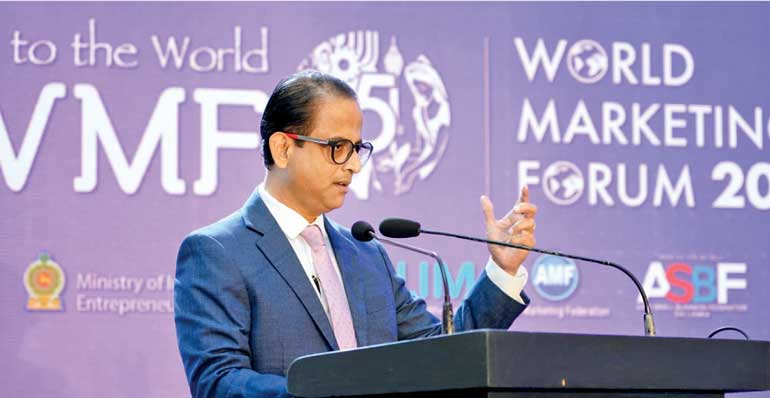
Bank of Ceylon Chairman Kavinda de Zoysa delivers the keynote address at the recently concluded World Marketing Forum in Sri Lanka
Bank of Ceylon Chairman Kavinda de Zoysa delivered a keynote address at the recently concluded World Marketing Forum in Sri Lanka, presenting a unified and forward-looking perspective on marketing, finance, technology and Sri Lanka’s accelerating economic recovery.
Drawing from his experience as a global marketer (FCIM–UK), accountant, finance professional and member of the global board of CIMA UK, he spoke of the country’s renewed confidence and the growing responsibility placed on marketers and financial institutions in shaping that momentum.
Reflecting on the bank’s recent achievements, he stated, “We achieved something phenomenal. Among multinational, global and local giants, Bank of Ceylon emerged as the number one most valued brand in Sri Lanka.” He attributed this milestone to strong leadership, a disciplined approach to marketing and a deeply embedded customer-focused culture that has guided the bank throughout its 86 years of service.
He recalled the recent establishment of BOC Connect in Analaitivu Island, accessible only by boat, as an example of BOC’s continued commitment to financial inclusion, adding that the facility now connects 3,000 residents to global banking services.
He explained that BOC’s nationwide presence, spanning more than 2,500 touchpoints and managing 36 percent of the country’s ATM transactions, supports a large share of Sri Lanka’s digital payments infrastructure. With nearly 15 million customers, the bank continues to advance digital transformation with high levels of reliability and security, a responsibility he said becomes even more significant as the country modernises its economy and expands its digital footprint.
Turning to the evolving nature of marketing, the Chairman noted that the discipline has moved well beyond product promotion. “Marketing sits at the intersection of human behaviour, economics and technology. It is about understanding why people think, feel, decide and act—,not about selling,” said de Zoysa, a professional Banker, Management Accountant, and Marketer.
 He described marketing as a social science shaped by psychology, sociology and anthropology, noting that consumers increasingly respond to symbolism, emotion and narrative, particularly at a time when research indicates attention spans are limited to nearly 20 seconds.
He also highlighted the influence of behavioural economics, observing that people make decisions emotionally and later justify them logically. He introduced the principles of cognitive consonance and cognitive dissonance, explaining that brand trust strengthens when promises are kept and erodes when expectations are unmet.
The Chairman reaffirmed BOC’s strengthened position locally and internationally, noting that “With humility, Bank of Ceylon stands tall as Sri Lanka’s number one brand.” He outlined the bank’s expanding global presence, including its operations in the United Kingdom, the India–Sri Lanka corridor, the Maldives and Africa through the Seychelles, which collectively support trade, investment and regional economic integration.
He stressed that marketing must remain aligned with economic conditions. Inflation shifts consumer behaviour toward value-driven choices, making promotional messaging more effective, while periods of stability allow brands to return to aspiration-led narratives.
Marketing, he said, should be recognised as a strategic investment that supports innovation, competitiveness, employment and national identity. With Sri Lanka reporting double-digit growth across several sectors, he noted that investor confidence is rising and the broader economic mood is turning favourable.
Addressing technological shifts, he spoke of the rapid expansion of agentic AI and its transition from experimental use to enterprise-level deployment. “AI can automate workflows and personalise creativity at scale, but human imagination remains irreplaceable.” He observed that marketers of the future must combine cultural awareness with technological fluency and a strong reliance on data-driven insights.
He also pointed to the expectations of a new generation of consumers. Gen Z, he said, demands transparency, authenticity and responsibility from brands, and the rise of “cancel culture” leaves little room for inconsistency between what brands communicate and what they practice. He reaffirmed BOC’s longstanding commitment to sustainability, noting that the bank has fulfilled all 17 UN Sustainable Development Goals and operates the country’s largest rooftop solar installation in the banking sector. Strong governance continues to guide the bank as it approaches its centenary.
Positioning Sri Lanka as a rising regional hub, he highlighted the country’s strategic location, modern communications infrastructure, resilient banking system and high quality of life. He noted that Sri Lanka’s sophisticated consumer behaviour makes it an attractive test market for global FMCG and technology brands ahead of regional rollouts, further strengthening the country’s competitive advantage.
In closing, he invited global investors to take note of the country’s renewed trajectory. “Those who come first will enjoy the first-mover advantage. Asset classes are strengthening, governance frameworks are improving, and Sri Lanka is ready for investment.”
He said the country today is defined not only by its traditional exports but by an educated talent pool, entrepreneurial energy and growing potential as an investment hub. “As Sri Lanka’s largest bank, BOC stands ready to support investors, entrepreneurs and communities as the nation moves confidently toward a new era of growth,” he concluded.




