Thursday May 28, 2026
Thursday May 28, 2026
Tuesday, 20 January 2026 04:27 - - {{hitsCtrl.values.hits}}
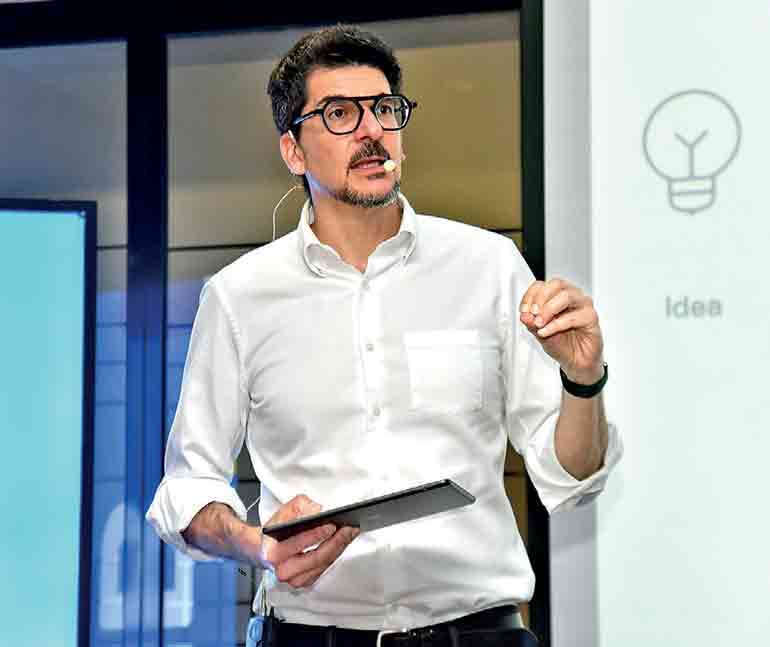
Swiss business theorist Alexander Osterwalder conducting ‘Beyond the Business Model Canvas’ masterclass - Pic by Upul Abayasekara
By Divya Thotawatte
Challenging a central assumption of start-up culture, Swiss business theorist Alexander Osterwalder in Colombo argued recently that companies were not built on great ideas or products alone, but through the frameworks that make them work.
This discussion with Osterwalder, the creator of the globally-adopted Business Model Canvas, took place at ‘Beyond the Business Model Canvas’, a masterclass held as part of the TiECon Sri Lanka 2026 event program. TiECon Sri Lanka 2026 marked the first flagship global entrepreneurship summit to be hosted in the country.
The session focused on going beyond frameworks to equip today’s business and industry leaders with clear, practical thinking tools for better strategic decision-making. Designed to help navigate uncertainty, build resilient organisations, and drive sustainable growth, it drew founders, CEOs, CXOs, and senior decision-makers of companies.
Addressing them, Osterwalder explained that for a business, what mattered more than ideas was a business model that turned those ideas into repeatable, defensible value. He discussed how startups, scale-ups, and global corporations could reduce uncertainty, create lock-in, and build something that could not easily be copied by competitors.
“Everything starts with an idea, and we tend to overemphasise the idea. Ideas are easy. What’s hard is to take an idea to find out what value propositions customers care about, and what business model can scale,” Osterwalder said.
He described company-building as a journey that moves from search to scale, a process he called “explore” and “exploit”. Start-ups must first explore by testing assumptions, learning quickly, and iterating based on customer feedback. Only later would it make sense to shift into execution, planning, and optimisation.
“Business plans are the death penalty of entrepreneurship and innovation,” he said, arguing that detailed plans made sense only once a model is proven. Earlier in the business process, rigid plans tended to create false confidence rather than reduce risk.
“What a lot of people, particularly in corporations, tend to do is overthink an under-experiment,” he said, urging teams to experiment more, reducing uncertainty when customer behaviour was still unknown.
Everything starts with an idea, and we tend to overemphasise the idea. Ideas are easy. What’s hard is to take an idea to find out what value propositions customers care about, and what business model can scale
Business models over ideas
Illustrating how competitive advantage often lay beyond products themselves, Osterwalder discussed case studies like Airbnb, IKEA, and Xerox. He argued that in each case, success was driven by business model innovation rather than product novelty alone.
Airbnb, he said, succeeded by building a double-sided platform that connected hosts and travellers, creating a powerful network effect. IKEA reshaped furniture retail by shifting assembly to customers, lowering costs and scaling globally. Meanwhile, Xerox transformed photocopying by leasing machines and charging per copy instead of selling expensive equipment outright.
“These types of business models, double-sided platforms and multi-sided platforms, are hard to create. But once you’ve created them, they’re practically invincible.”
Lock-in and recurring revenue
Osterwalder also highlighted how platforms such as operating systems and digital ecosystems created customer lock-in, making it difficult for users to switch even when alternatives existed. He discussed contemporary examples like Whoop, a wearable health device popularised by elite athletes including LeBron James, stressing that while the hardware measured heart rate and strain, the product itself was not where the real value lay.
“Sometimes we have tech entrepreneurs who say the product is the value proposition. No, the product is the product. What actually creates value are the insights.” Osterwalder explained that Whoop’s competitive strength came from its ability to collect long-term health data and convert it into continuous insights for users. Once customers committed their data to the platform, switching became difficult. “With AI, it gets even worse, because now this thing starts to really know me.”
Whoop had also adopted a subscription-based model from the outset, moving from one-off transactions toward recurring revenue. Osterwalder argued that this was a lesson many companies overlooked. He contrasted Whoop with the Oura Ring, a competing wearable that initially relied on device sales without subscriptions. “They did not start with subscriptions, which is basically entrepreneurial suicide because you’re going to run out of money.”
Data, platforms, and defensibility
Osterwalder also discussed John Deere as an example of a traditional manufacturer that transformed its business model. By embedding sensors into tractors and collecting real-time data, the company created a software platform where farmers could store and analyse operational information.
“They created a moat by getting the data to be in the tractors. They made money from the data, but what’s impossible to copy is the data.” John Deere had expanded this model by opening its platform to third-party developers, which Osterwalder called “the app store of tractors”. The move had created a new user base of software developers, further strengthening the company’s competitive position.
“They built another user base. The number of developers. So if now another tractor manufacturer starts this, they start from scratch.”
Osterwalder explained that such strategic thinking was often missing, especially in established organisations focused on execution rather than innovation.
Entrepreneurship as experimentation
He also emphasised that there was no fixed formula for building defensible businesses, particularly in markets characterised by uncertainty and low initial credibility. He explained that while Whoop had ultimately succeeded with the subscription-based model, this outcome was not guaranteed from the start.
Hardware businesses faced particular challenges. “Devices are harder, that’s why people call it hardware, it’s hard. But if you start to add recurring to it, hardware doesn’t get easier, but it gets easier to protect.”
He stressed that there was no recipe for business success, and that entrepreneurship depended on trial and error rather than rigid planning.
The same logic applied to international expansion. Entering new markets was not simply an operational challenge, but a process of discovery, Osterwalder argued, explaining, “Going into a new market is like creating a little start-up. It’s not an execution problem. It’s often a search problem.”
Companies must test whether their value propositions and channels resonated with customers in different contexts without assuming strategies would transfer unchanged. The process required experimentation under uncertainty, alongside the practical demands of execution, he said, adding that entering new markets “just with a plan is not a good recipe.”




