Saturday Oct 17, 2026
Saturday Oct 17, 2026
Monday, 6 April 2026 03:59 - - {{hitsCtrl.values.hits}}
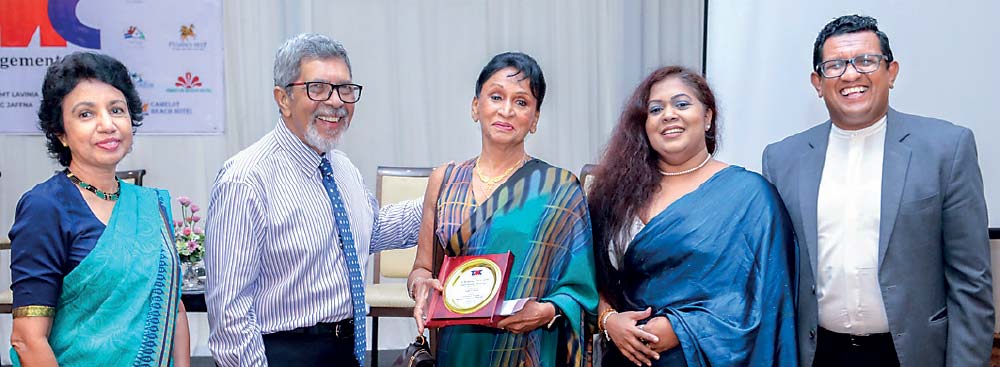
From Left: Project Chairperson Ajithaa Edirimane, TMC Founder Fayaz Saleem, former Supreme Court Justice Shiranee Tilakawardane, TMC Colombo Chairperson Duneeshya Bogoda, and moderator Mahesh Senanayake
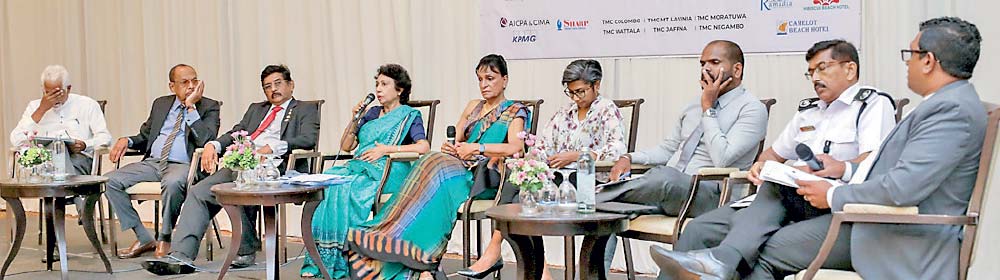
Panel discussion (from left): Saliya Wikramasinghe, Elmo Fernando, Dr. Rohana Bandara Herath, Project chairperson: Ajithaa Edirimane, former Supreme Court Justice Shiranee Tilakawardane, Natalie Warawita, Yasantha Perera from UDA, Colombo Municipal Council Assistant Fire Chief W.U. Dayananda, and moderator Mahesh Senanayake
 “Living in a condominium property will become stressful if there are no proper by-laws for administration and management and the Council does not fulfil its obligations owed to the unit owners,” said a resource person at a well-attended seminar on ‘Issues and Concerns of Stakeholders in Condominium Properties,’ organised by The Management Club (TMC) Colombo headed by Chairperson Duneeshya Boyagoda and her team at the Mahogany Hall, Cinnamon Grand Hotel on 24 March.
Former Supreme Court Judge Justice Shiranee Tilakawardana graced the occasion, giving a very insightful contribution towards resolution of disputes in condominium properties and stressed on the need to have mediation as the best method to resolve disputes amicably, where the parties decide on the outcome of the dispute with guidance by a mediator.
The interactive seminar with industry experts as resource persons gave an opportunity for condominium purchasers and sellers/developers to be informed on critical issues that have an impact on condominium sales and ownership, including management of condominium properties.
Ajithaa Edirimane, Attorney-at-Law, a legal practitioner with several years of experience in the practice of condominium property law, enlightened participants on key issues, such as the adverse effects of non-registration of a multi-storey building as a condominium property in which purchasers occupy without title deeds. She drew the attention of participants to Sec. 9 ( c) of the Common Amenities Board, Act No. 24 of 2003 (Condominium Management Authority Act), which makes it mandatory for the developer of a project registered as a Provisional Condominium Property to submit quarterly reports on the construction progress to the Institute of Certified Management Accountants (CMA). She added that making such registrations mandatory by the CMA will be beneficial for all stakeholders and said that the creation of separate registrations for each “deemed condominium unit” at the Land and Title Registries will prevent disgruntled purchasers registering caveats on the entire land, which addresses such problems faced by developers.
Further, banks granting financial assistance for a project will have their interests safeguarded with the regular monitoring of the project by the CMA and purchasers can be assured that their advance payments will not be misused.
Speaking further, she said that advances collected from purchasers should mandatorily be deposited in escrow accounts as required in developed countries, where condominium property laws are constantly revised and updated. The need to make it mandatory for major condominium property developments having more than a specific number of floors to publish a disclosure statement with the regulator CMA and in newspapers giving details of the project, location, number of floors, facilities and amenities offered, etc., was also pointed out as a feature that would lead to the systematic and orderly development of this industry, allowing people to make informed decisions and to prevent irregular approvals.
Another important suggestion that was made during the seminar was in the context of bank enforcement of mortgages of major condominium property projects midway of construction, when the owner/developer fails to settle financial obligations, especially during an economic downturn. In the US, financiers consider the entire project details, including construction, designing, and marketing, apart from title of owner/developer, when granting loan facilities, giving due consideration to the possibility of re-developing the seized asset with a financier and selling unsold units at a profit when the economy improves. This appears to be a solution for local banks, which find it difficult to auction such seized assets when there are no interested parties willing to take over a massive half-completed project.
Another suggestion was to explore the possibility of arranging a Government-funded insurance scheme for condominium property purchasers, which will assist banks if the developer fails to settle a loan.
Institute of Architects of Sri Lanka (IASL) former President Dr. Rohana Herath Bandara spoke on sustainable condominium property development and explained the features that architects consider in incorporating ‘sustainability’ as part of their design elements, for conserving water, minimising heat, reducing electricity consumption, and for sensible waste water management.
He also said that projects are designed to meet the objectives of developers and it becomes a matter of concern when requests for amendments are made midway requiring reconsideration of authority approvals after commencing the construction process.
Chartered Engineer and Chartered Quantity Surveyor Elmo Fernando highlighted an area of concern for both management corporations and unit owners, i.e., defects in condominium properties. He explained how such defects can be identified and the course of action one should take when encountering wall cracks, water seepages, structural flaws, and settlement of soil, among other defects of serious concern.
A very enlightening and informative panel discussion took place thereafter, moderated by longstanding TMC Member Mahesh Senanayake, with the participation of Justice Tilakawardane, resource persons, and professionals involved in condominium construction and management.
Saliya Wickramasinghe, reputed condominium surveyor, explained the steps taken in converting an approved building plan into a condominium plan, creating subdivisions of the building and allocating share values. Natalie Warawita, Chartered Accountant and Treasurer of a major condominium property discussed the due diligence undertaken during the management process by a condominium council.
Yasantha Perera of the Urban Development Authority (UDA) – Metro Division was queried on the steps the UDA takes in approving multi-storey projects for condominiums and he agreed improvements can be made to the regulatory process for the stakeholders’ benefit.
Colombo Municipal Council (CMC) Assistant Fire Chief W.U. Dayananda enlightened the participants on the importance of addressing fire risks in multi-storey buildings and stressed the need to educate condominium residents on these issues, insisting that it should be the focus of condominium management corporations.
Minoli Wickramasinghe representing Capital Trust Properties, the main sponsor of the seminar, said that they have been lobbying to regulate property transactions and have submitted proposals to the Financial Intelligence Unit (FIU) of the Central Bank to ensure such transactions are done on strict moral grounds and to prevent non-citizens from engaging in property brokering.
The seminar was co-sponsored by ICC, another major condominium property developer.




