Tuesday Aug 25, 2026
Tuesday Aug 25, 2026
Friday, 21 August 2026 00:18 - - {{hitsCtrl.values.hits}}
 There was a time when the performance of a business could be explained largely through its financial statements. Revenue growth, profitability, cash flows and earnings per share shaped investment decisions, informed Boards and reflected corporate success. Those measures remain fundamental, but they no longer tell the complete story. Investors, customers, lenders, employees and regulators increasingly want to understand not only how much value an organisation creates, but how it creates that value and whether it can continue to do so.
This has changed the conversation in boardrooms around the world, including in Sri Lanka. Climate resilience, workforce practices, supply-chain vulnerabilities and governance are increasingly discussed alongside margins, cash flows and capital expenditure. Environmental, Social and Governance considerations, or ESG, have therefore, moved beyond the sustainability report. They are becoming part of the wider question of how businesses protect and create long-term value.
The evidence suggests that businesses themselves recognise this shift. BDO's Global Sustainability Services Survey 2025 found that 87% of respondents considered sustainability important to their business strategy, while 83% reported gaining competitive advantage from an embedded sustainability programme. Yet only 25% described their sustainability programme as mature.
That gap is revealing. The corporate world does not appear to have an ESG ambition problem. It has an execution problem.
Recognising sustainability as strategically important is one thing; embedding it into the way a business operates is another. Commitments need to become measurable targets, targets need clear ownership, and fragmented data needs to become controlled information that can withstand scrutiny. Sustainability-related risks and opportunities must ultimately find their way into investment decisions, risk management, performance measurement and accountability. Otherwise, ESG may remain visible in corporate reporting without becoming meaningful in corporate decision-making.
This is where ESG becomes a business information challenge.
Closing the execution gap requires more than collecting ESG data. The information itself must be good enough to support decisions. Can a Board rely on it when approving a major investment? Can a lender incorporate it into a credit assessment? Can an investor compare it across businesses? Can management explain the assumptions behind a sustainability target, demonstrate how progress is measured and account for performance when the organisation falls short? These are not simply sustainability questions. They are questions of governance, measurement and ultimately confidence.
For Sri Lankan businesses, this distinction is particularly important because ESG expectations do not always arrive through domestic regulation. They can arrive through the market. A Sri Lankan exporter may encounter them through the sustainability requirements of a multinational buyer. A local company seeking international finance may face them through a lender's risk assessment. Businesses participating in global value chains may increasingly be expected to provide information on emissions, resource use, labour practices or supply-chain controls even where the immediate request originates thousands of kilometers away.
In that sense, sustainability expectations increasingly travel across borders through customers, capital and supply chains. The implication is commercial, not merely regulatory. ESG can influence access to customers, financing and supply chains and, ultimately, the competitiveness of a business. For Sri Lankan companies, therefore, waiting for every expectation to become a local regulatory requirement may mean responding only after the commercial pressure has already arrived.
Every major transformation in business creates a new information challenge. Sustainability is no different. As environmental and social factors increasingly influence economic decisions, businesses need systems capable of turning those factors into information that can be governed, compared and trusted.
And every new challenge of information eventually becomes a confidence challenge.
From expertise to decision-quality information
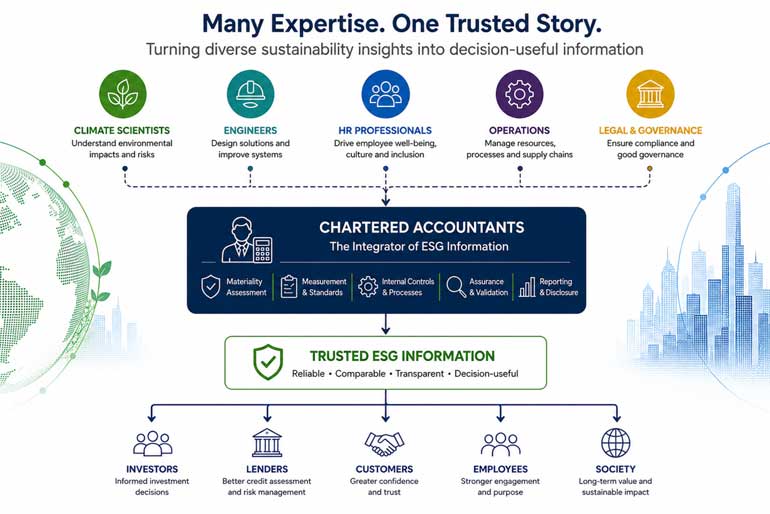
No single profession owns ESG. Environmental scientists understand climate and natural systems. Engineers develop technical solutions. Human resource professionals understand people and organisational culture. Lawyers interpret regulations. Sustainability specialists coordinate transformation, while operational teams understand how these issues actually affect production, procurement and supply chains.
Yet multidisciplinary expertise does not automatically become business intelligence.
A climate scientist may identify a physical risk. An engineer may estimate the investment needed to mitigate it. Operations may assess the effect on production, while finance considers the implications for cash flow and capital expenditure. For a Board deciding whether to invest, these are not four separate conversations. They must ultimately make one coherent decision.
This is where Chartered Accountants become increasingly relevant to the ESG journey. Not because they know more about climate science than environmental experts or more about engineering than engineers, but because the profession is trained to connect information with economic decisions.
For generations, accountants have taken millions of individual transactions and converted them into information that Boards, investors and regulators can use with confidence. Sustainability expands the information set to emissions, water, workforce matters, supply-chain resilience, biodiversity and governance. The information has changed; the need for materiality, consistency, controls, professional judgement and comparability has not.
Consider materiality. Deciding whether water scarcity, carbon exposure or labour practices matter to a business is not simply about whether those issues exist. It requires understanding whether they could affect strategy, cash flow, access to finance, reputation or enterprise value. The question therefore, moves from "Is this environmentally or socially important?" to "How could this matter to the organisation and those making decisions about it?"
That translation is critical.
It is also why consistency matters. Investors compare businesses because they expect information to have been prepared using recognised principles. Boards make decisions because they believe the information before them is sufficiently complete and balanced. Lenders assess risk because they need confidence in both the numbers and the processes that produced them.
Confidence is rarely accidental. It is built through disciplined governance, consistent measurement, effective controls and independent challenges.
Recent evidence from more mature sustainability-reporting environments shows how difficult this transition can be. EFRAG's 2026 analysis of 905 assured sustainability statements found that 82% of companies had updated their double-materiality assessments and 69% disclosed climate transition plans. Nearly two-thirds linked sustainability performance to executive remuneration. Yet companies typically had measurable targets for only about half of the sustainability topics they had identified as material.
That tells us something important. Organisations may be getting better at identifying what matters faster than they are developing the systems needed to manage and measure it.
For a Board, identifying climate risk without a measurable response does not complete the job. Neither does announcing a sustainability ambition without assigning accountability, measuring performance or understanding the financial consequences. The challenge is to connect material issues to targets, targets to management action, and management action to performance.
This is precisely where the traditional disciplines of accounting become valuable in a new setting.
When sustainability information enters the decision room
Microsoft's internal carbon fee provides a useful example of what happens when sustainability information moves beyond reporting. By attaching an internal financial consequence to carbon emissions, environmental information became relevant to budgeting and resource-allocation decisions. Carbon was no longer simply a metric disclosed after the event; it became information capable of influencing behavior before decisions were made.
That is the real transition businesses should be seeking: from reporting sustainability to managing it.
It also changes the greenwashing discussion. Greenwashing is often understood as deliberately making claims that are untrue. But credibility can also be damaged without deliberate deception. A company may genuinely announce a climate target while relying on fragmented data, inconsistent methodologies or poorly defined boundaries. A sustainability report may technically contain the required topics while saying very little about how those issues affect the actual business. 
The greatest risk to ESG, is therefore, not necessarily the absence of data. It is the absence of decision-quality information.
This helps explain the growing importance of sustainability assurance. A global study by IFAC, AICPA and CIMA covering approximately 1,400 companies across 22 jurisdictions found that large companies were expanding both the breadth of sustainability reporting and the scope of assurance obtained over those disclosures. The direction of travel is clear: as sustainability information becomes more important to economic decisions, expectations around its credibility are rising with it.
Assurance does not make a company sustainable, nor does it replace management's responsibility. Its value lies elsewhere: independent challenge can test whether reported information is supported by appropriate processes, evidence and methodologies. In a market increasingly populated by sustainability claims, that distinction matters.
For Chartered Accountants, this creates a role broader than reporting itself. They can help organisations connect sustainability information with governance, risk, internal controls, performance measurement, capital allocation and ultimately assurance. In doing so, they become neither climate scientists nor engineers, but integrators of information produced across those disciplines.
This is not about accountants owning ESG. Sustainable business has never belonged to one profession.
It is about making ESG work as part of mainstream business.
What this means for Sri Lanka
Sri Lankan organisations have an interesting opportunity. Many are building their sustainability systems while global practice itself is still evolving. Rather than replicating reporting structures developed elsewhere, businesses can ask a more fundamental question: what sustainability information do we actually need to run this organisation better?
For an exporter, that may begin with understanding what international customers will expect from its supply chain. For a bank, it may mean understanding how climate and transition risks affect borrowers. For a manufacturer, it could mean connecting energy, water and resource efficiency with operating costs and investment decisions. For a listed company, it may involve giving the Board a clearer view of the sustainability-related risks and opportunities capable of affecting long-term value.
The strongest ESG systems will, therefore, not be those that produce the most indicators. They will be those that connect the right information to the right decisions.
That requires environmental and social expertise, engineering, operations, legal knowledge, technology and sustainability leadership. But it also requires disciplines familiar to the accounting profession: materiality, measurement, governance, controls, comparability, professional scepticism and assurance.
Perhaps this is why ESG should not be seen as a new chapter for Chartered Accountants, but as the continuation of an old one. For more than a century, the profession has helped businesses to reduce uncertainty by transforming complex information into reliable, decision-useful insights. Sustainability has expanded the information landscape, but the underlying purpose remains remarkably familiar. 
For Sri Lankan businesses, the immediate question is therefore, not whether they have begun an ESG journey or even whether they publish a sustainability report. The more useful question is whether sustainability is visible in the decisions that run the business. Reporting may demonstrate intention; execution is demonstrated through decisions, accountability and performance.
A business that identifies sustainability risks but cannot translate them into measurable responses has not yet closed the execution gap. Neither has one that announces ambitious targets without connecting them to management action and business performance. This is where Chartered Accountants can make a practical contribution: not by owning ESG, but by helping connect technical sustainability information with the governance, measurement and decision-making systems through which businesses are actually managed.
Ultimately, closing the gap means moving sustainability from the reporting agenda into the management agenda. It means allowing sustainability considerations to influence how businesses
allocate capital, manage risk, measure performance and hold people accountable. For Sri Lankan organisations, building that capability is not simply about being ready for the next reporting requirement; it is about being better prepared for the changing expectations of the markets in which they operate.
The next phase of ESG will not be defined by who produces the longest report or announces the boldest target. It will be defined by businesses that can demonstrate, through their decisions and performance, that sustainability has become part of how they are actually run. That is how the execution gap is closed.
(The author is an Associate Director – Audit, Assurance, Technical and Training, and an ESG Specialist at BDO Partners.)



