Saturday Oct 17, 2026
Saturday Oct 17, 2026
Friday, 15 May 2026 05:19 - - {{hitsCtrl.values.hits}}
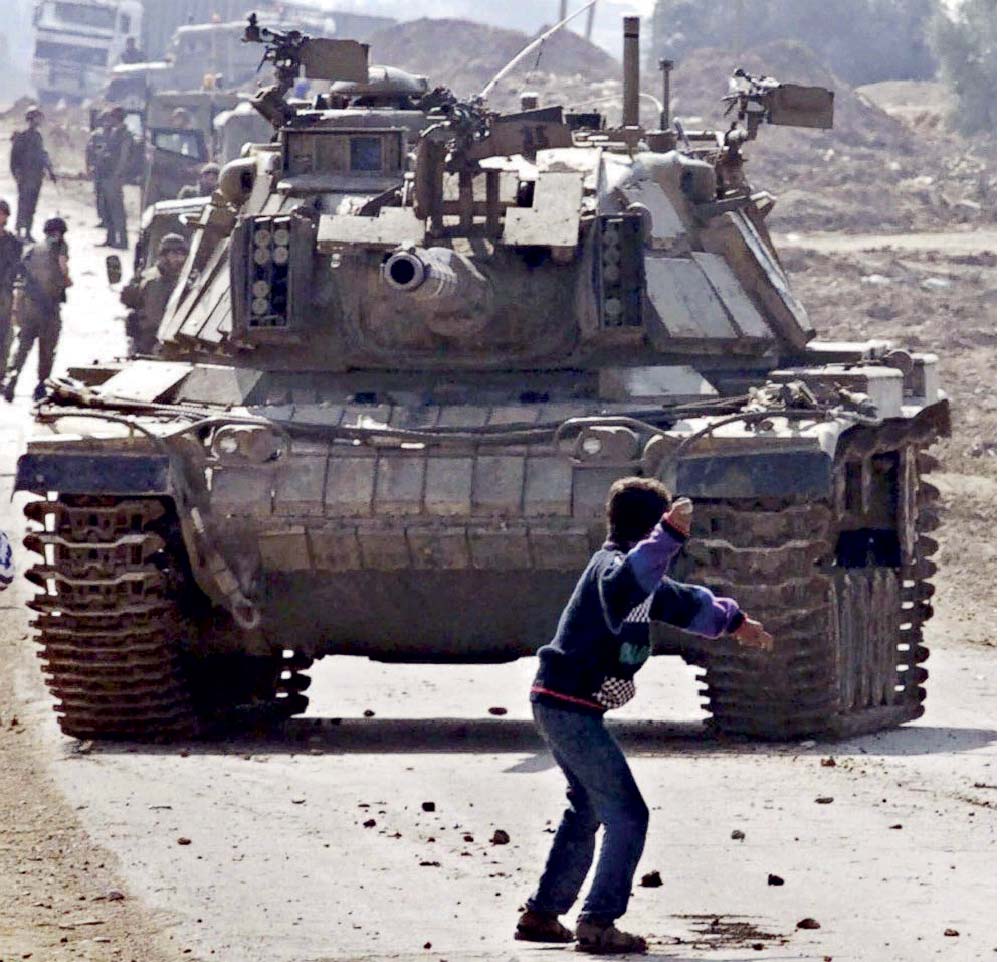
Faris Odeh (13) throwing stones at an Israeli tank in the Gaza strip on October 29, 2000. He was killed ten days later. Photo by Laurent Rebours/AP.
 Today is Nakba Day, the commemoration of the Palestinian catastrophe. It is made all the more ridiculous by how it commemorates a monumental injustice that continues to unfold even as we speak.
On 14 May, 1948, the state of Israel was established. For the Palestinians who were massacred and forcibly displaced from their native land for the creation of this new country, the day after, 15, is a moment to both mourn what has been consumed by the darkness of Zionist apartheid and resist those dark forces.
(Let me pre-emptively add a clarification here before the accusation is made, since there are those who conflate anti-Zionism with anti-Semitism, often aiming to silence dissenting voices: by Zionism, I mean the racist ideology that tends to co-opt Judaism in order to justify its settler-colonial project in Palestine).
For those of us reduced to being impotent witnesses of the genocide perpetrated by Israel, today is an opportunity to express our gratitude to the brave Palestinians, both living and martyred, for we have been freed by them. In their defiant struggle to affirm their humanity and free their land, they have also liberated us—we who have done little to deserve such charity—from some of our own neocolonial shackles, if not materially, at least mentally.
In other words, yes, ‘Free Palestine!’ unreservedly and unequivocally, but also, we have already been freed by Palestine.
Freed by the children
By bringing up children first as our saviours, I am inadvertently committing a folly Mohammed El-Kurd points out in his brilliant work, ‘Perfect Victims’ (Haymarket Books, 2025): I could be seen as resorting to the innocence of children as a means to appeal to a possibly apathetic reader. While there is nothing particularly wrong with this per se, it would also be to undermine what even the Palestinian children have done for us.
These are children who have grown old before they could grow up. Many of them, more than 20,000 of them in fact, have given up their lives in the Gaza genocide alone (not to mention the 17,000 that lost both their parents, 4,000 who lost limbs, and the hundreds of thousands who now survive in inhuman conditions).
Some of the grotesque scenes we had the misfortune of witnessing remain etched deeper in memory than others, even though every little life that has been affected is as precious as the other. For me, that memory is of late Hind Rajab, perhaps because she, like my own daughter, was five years old at the time. The car her family was traveling in was attacked by the Israeli forces, killing everyone but her. Hind’s phone call to the emergency number is the stuff of nightmares. When help finally arrived, IOF obliterated even that ambulance, killing the first responders. Forensic analysis determined that 335 bullets had been fired at Hind’s car from a tank positioned some dozen metres away, which should have had a clear view of the occupants of the vehicle.
There are literally thousands of Hind Rajabs, some of whose deaths we have seen shared on social media (which, for all of its shortcomings, has been a way for us to circumvent the complicit propaganda of Western media outlets), and many thousands more now buried under the rubble, unseen. But we should not forget that there have been, and still are, thousands of little hands that throw stones at the tanks that loom large over them. Should we then be surprised that, when those hands grow bigger, in the face of lifelong repression, they grab things more lethal than mere stones?
Freed by the women
It is through the same social media that I got to know about Fatima Khamees Alyaan Abu-Shammala, a 90-year-old survivor of the original Nakba of 1948, who was again displaced in the current genocide. In her interview with Abubaker Abed in 2024, Fatima related how all her family members from her mother’s side had been killed in Khan Younis (a city that has since been reduced to a diabolical mix of skeletons and rubble). Two years later, I have no idea if Fatima herself has survived.
Fatima’s resilience is reflected in her younger compatriots like Bisan Owda and Plestia Alaqad. Both young journalists in their twenties survived the genocide (in fact, the former has a sardonically named show on Al Jazeera titled ‘It’s Bisan from Gaza, I’m still alive’), and remain defiant, loud voices speaking on behalf of their people. Other female voices, like that of Mariam Dagga, were silenced in the genocide, much in the same way the legendary Shireen Abu Akleh was murdered in 2022 while she was covering an Israeli raid on the Jenin refugee camp.
These brave women are channelling the suffering and the resilience of a million others, and we get a glimpse of it in the murders that happen even during the so-called ceasefire. Just last month, 9-year-old Ritaj Rihan was killed by gunfire while she was studying in a makeshift classroom in Beit Lahia, right in front of her friends. I watched (on social media, as usual) her mother, Ola Rihan, mourn the death of her daughter, and wondered: who are we to expect anything other than world-ending rage from mothers like her?
Freed by the men
In aforementioned ‘Perfect Victims’, Mohamed El-Kurd refers to the Palestinian using the male pronoun, claiming he wants to ‘force the reader to come face to face with the Palestinian man’ and thereby ‘contend with that complex and contradictory demographic, and not just those assumed to be the gentle or the generous among us—not only the fathers, but the fighters as well.’
For not only has Palestine produced such luminaries as Edward Said and Refaat Alareer, it has also produced fedayeen like Ghassan Khanafani, and a million other unnamed men who first took stones (as in the Intifada of Stones, 1987–1993), but then other things that are sharper, stronger, and more dangerous, when those stones failed. What drew the men (and their descendants) who welcomed the survivors of the Nazi holocaust—when sanctimonious Europe failed to rehouse them in their actual homelands, thus realising the Nazi objective after all—to eventually fight against their guests?
All answers, questioned long enough, inevitably point to the Nakba, which we commemorate today.
I am a Buddhist and a pacifist, so I shall draw inspiration from these men, in their plurality and complexity, in a way that aligns with the teachings I follow. In Theravada Buddhism, we talk of those who are ‘liberated by wisdom’ (paññāvimutta), the awakened disciples who have come to see things as they are, and are thus freed from the shackles of existence through that very knowledge.
In this worldly realm—the Islamic duniyā, if you will—we who do not belong to the Epstein class have been freed by Palestinian wisdom.
Therefore, it seems fitting to end this note of gratitude to our Palestinian liberators with a poem by the late, great, wise man, Mahmoud Darwish, the national poet of Palestine.
I come from there
I come from there and I have memories
Born as mortals are, I have a mother
And a house with many windows,
I have brothers, friends,
And a prison cell with a cold window.
Mine is the wave, snatched by sea-gulls,
I have my own view,
And an extra blade of grass.
Mine is the moon at the far edge of the words,
And the bounty of birds,
And the immortal olive tree.
I walked this land before the swords
Turned its living body into a laden table.
I come from there. I render the sky unto her mother
When the sky weeps for her mother.
And I weep to make myself known
To a returning cloud.
I learnt all the words worthy of the court of blood
So that I could break the rule.
I learnt all the words and broke them up
To make a single word: Homeland.
(The author is a social anthropologist based in Amsterdam.)




