Thursday Jun 11, 2026
Thursday Jun 11, 2026
Thursday, 11 June 2026 00:30 - - {{hitsCtrl.values.hits}}
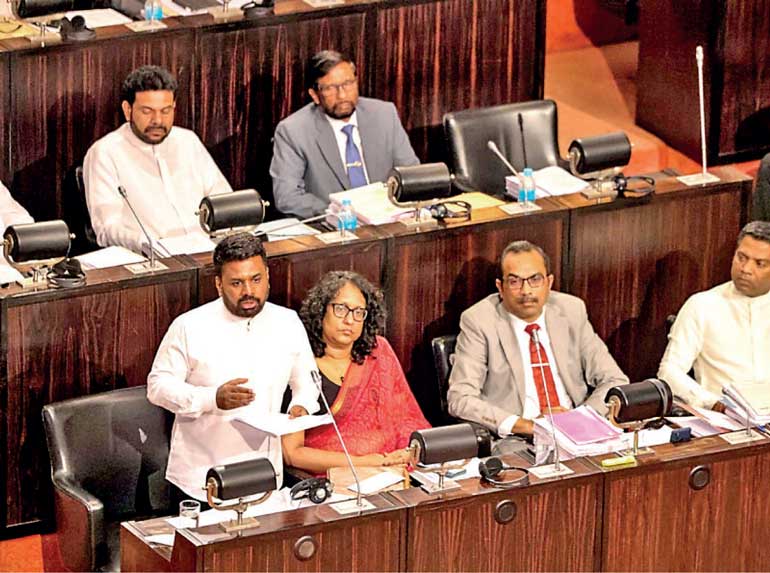
President Anura Kumara Dissanayake presenting the NPP’s Budget in Parliament on 7 December 2026

Transforming a nation from developing to developed status is one of the most ambitious undertakings any Government can pursue. For a country like Sri Lanka, rich in human capital, strategically located, and endowed with natural beauty, the potential is immense. Yet potential alone does not guarantee progress. Citizens in a democracy have both the right and the responsibility to expect certain standards of governance, policy direction, and national vision from their elected leaders.
This article outlines the core expectations citizens should have of a democratically elected government, which is NPP now in Sri Lanka, aiming to elevate a developing nation to developedcountry status. My representation of people’s expectation is supported by citing real life examples from around the world.
I am not a blind supporter or a blind critic of NPP.
First of all, it is people’s right to select a government. As a professional of chosen disciplines, I try to educate people with my opinions what kind of government would be suitable to move forward a country economically and socially? I may be right or wrong. It is up for debate. After people made their decision, irrespective of my liking of not about the decision, my job is to support the elected government when they do right things and criticise the things I believe they got wrong.
As a citizen, I want the NPP Government do the best which I am yet to see. As apolitical person who does not like party politics, I will try to analyse the present Government activities constructively.
Ideally, after appointment as a Government, NPP should have openly declared this is a Government for all and invite public, in particular all professions across the country to shed their political affiliations temporarily for five years and come forward to join the national effort to develop the country and suggest going back to their political affiliations at the end of five years to elect the next government or support another five years term for NPP, guarantying treatment of all merit basis, not based on any political affiliations including NPP and JVP. You may say I must be kidding.
In my personal circle of friends and family members, I argue with blind supporters of NPP on its poor performance and defend NPP against blind haters of NPP on its good but slow actions. I strongly believe that if NPP succeeds in its national endeavour it would be because of people like me rather than blind supporters. I hope NPP strong men and women understand it and listen to critics objectively.
Why NPP was elected
Sri Lanka’s traditional right-wing political movements have promoted various forms of capitalist aspirations. For over seven decades, many ordinary citizens repeatedly supported these parties, hoping that economic growth would improve country as well as their own circumstances. Instead, many perceived a widening gap between the wealthy and the poor.
Recognising these realities, the JVP understood that it would be difficult to attract broader electoral support without presenting a more moderate socio-economic vision. The NPP emerged as a front capable of appealing beyond the JVP’s traditional base. It gradually expanded by attracting professionals, middle-class voters, and individuals seeking cleaner governance and institutional reforms.
When the NPP sought national support, it offered a compelling vision of good governance and social transformation. However, appealing to a diverse electorate required more than a reform agenda alone. To gain widespread support, the NPP combined realistic policy objectives with highly attractive public promises that resonated across different social and economic groups.
This approach should not necessarily be viewed negatively. Political change often requires working within existing systems rather than attempting to transform them from outside. Many educated middle-class supporters understood that not every campaign promise would be fully achievable and viewed some of the rhetoric as part of a broader strategy to secure electoral victory and create an opportunity for reform. This strategy ultimately contributed to the NPP’s success in both the presidential and parliamentary elections.
The Journey so far and the General Reading of the NPP
Electoral success did not automatically translate into governing capability. While the NPP demonstrated a genuine commitment to changing political culture and improving governance standards, good intentions alone are insufficient. Effective governance requires robust systems, competent institutions, experienced professionals, and clearly defined implementation pathways.
A successful reform agenda requires a structured framework encompassing strategy, policy development, legislation, regulation, enforcement, monitoring, and continuous review. Such a framework must be supported by expert knowledge, professional administration, transparent decision-making, and extensive public consultation. In many respects, this is where the NPP appears to have struggled during its first year in office. It appears NPP is treating symptoms.
Mistake 1- Disproportionate representation of real voters of NPP in Parliament
The origins of the National People’s Power (NPP) can be traced to the Janatha Vimukthi Peramuna (JVP). Historically, the JVP’s core support base represented only a relatively small segment of the electorate like three percent. Many of these supporters were attracted by socialist ideals despite operating within a predominantly capitalist economic system. However, the NPP’s electoral success was achieved not through the support of traditional JVP voters alone, but through a much broader coalition of citizens, including many who neither identified with the JVP nor subscribed to its ideological foundations.
These voters supported the NPP because they believed in its promises of reform, good governance, and institutional change. Consequently, many expected that parliamentary candidates, regardless of their personal political backgrounds, would collectively pursue the policies and objectives presented by the NPP during the election campaign.
A key concern, however, is whether the current parliamentary representation adequately reflects the broad cross-section of voters who supported the NPP. There is a perception that many elected representatives and appointees continue to reflect the traditional JVP constituency more than the wider electorate that enabled the NPP’s victory. Similarly, many voters expected appointments to positions such as ministry secretaries, board directors, chairpersons, and other senior leadership roles to be made primarily on merit rather than political affiliation. Looking back at appointments made thus far, questions naturally arise as to whether the most suitable individuals have always been selected.
One possible explanation is that the NPP leadership, having limited practical experience in governing complex state institutions, may have preferred appointing individuals with whom they felt politically comfortable and who were easier to manage. While such appointments may strengthen political control, they do not necessarily guarantee administrative competence or policy delivery capability. The consequence has been an apparent difficulty in developing, reforming, and implementing policies, processes, and institutional frameworks capable of achieving the ambitious goals promised during the election campaign. As a result, meaningful governance reform and broader social transformation remain largely unrealised aspirations.
Mistake 2 - The inability to shed “Opposition” mindset
Equally concerning is the inconsistency in public messaging and the body language projected by various sections of the Government. Even after assuming power, the NPP often appears to behave as though it remains in opposition. Still NPP members talked about past Government mistakes and corruption. They were appointed because people did not approve past mistakes. This is a Government which has very clear two-third parliamentary majority enabling them to change the constitution, outdated and polarised laws and introduce governance reforms. NPP Government has all the power to remove any obstructions excreted by influential groups in society to enable progress.
Still, the energy of current NPP government is used to criticise opposition politicians rather than doing the job in hand. In Cricket, we say let the bat and ball talk.
With a clear collective change management plan, even if a referendum is required, NPP can win it now. People would support them wholeheartedly if a Court decided the change requires a referendum. However, that possibility would not be a reality if they continue the way they do now after one more year without having a clear plan seeking approval.
Mistake 3- Taking long to make the right decision
A government elected on a platform of change should demonstrate its commitment to good governance by clearly differentiating itself from previous administrations. This requires objective decision-making on time, equal treatment of all citizens, and the consistent application of the law without favouritism toward political, religious, or social interest groups.
When the former speaker was accused of faking his professional qualifications, until the matter is resolved, he should have been asked to resign immediately. It took so much time to do it and by that time indelible damage has happened to NPP brand which will never be recuperated. When cabinet spokesman or other NPP members addressed public and expressed anything to damage the NPP brand, the leadership should have the guts to declare they were wrong and removed them from making public announcements on behalf of Government. NPP Government if fear of English language. English is only a tool. It is not a symbol of prestige or importance. If a Government Minister needs to attend an international forum, he or she should not be fear of taking a language translator. If the last USSR leader Mikhail Gorbachev or the current President of China Xi Jinping use a translator, why cannot our parliamentarians do this? By the way, it is said that both these leaders could and can speak English well and used the time of translation for preparing for a well-rounded answer. However, I am of the strong opinion that Sri Lanka’s Foreign Minster should be a high calibre, politically and socially matured, multi-language skilled person with high negotiation powers. When an internationally embarrassing incidents happened due to poor English language skills, the top leadership should accept the mistake and make necessary changes to avoid repeating of the mistakes. People love to see accepting mistakes and taking swift actions. The list of mistakes goes on: Coal purchasing, international monetary transactions, public tendering, slow actions on alleged crimes committed by influential public figures. It took unbelievably long time to take right actions. It says justice delayed is justice denied.
The Government should not govern with the primary objective of securing the next election by appeasing own political friends and associates or influential constituencies. Rather, it should be prepared to uphold the principle that all individuals are equal before the establish procedure, regulations and the law, regardless of status, influence, or public popularity. If the NPP can maintain discipline within its own ranks and prevent elected representatives from becoming captive to external influences, it is likely to retain the support of a substantial portion of the electorate over the longer term.
Mistake 4- Wrong learning strategy and poor governance
Beneath the political leadership sits the public governance structure, the leadership of which is, in most cases, appointed by political authorities. Effective governance depends not only on political direction but also on the competence, experience, and professionalism of those entrusted with administrative leadership.
Organisational learning generally occurs through three primary mechanisms: practical experience, observation of others, and formal guidance from subject-matter experts. The governance leadership appointed under the NPP has understandably sought to learn through direct experience. However, this situation is largely a consequence of placing significant emphasis on political affiliation rather than professional capability, technical expertise, and administrative experience when making appointments. As a result, much of this learning appears to have occurred without the benefit of appropriate institutional structures, adequate preparation, or expert support. This is reflected in contradictory public statements, policy inconsistencies, and communication shortcomings when responding to public concerns and inquiries.
On numerous occasions, Government representatives have commented on complex policy and technical matters without sufficient subject knowledge or professional verification. Consequently, senior leaders have often been compelled to spend valuable time and resources managing controversies and correcting public misunderstandings rather than focusing on strategic governance priorities and reform implementation.
At the same time, opposition parties, despite their relatively limited parliamentary representation, have effectively capitalised on these weaknesses. Through selective presentation of facts, political narratives, and, at times, the introduction of racial or cultural dimensions into public discourse, they have succeeded in creating uncertainty among sections of the electorate.
Many middle-class voters who supported the NPP on the basis of its promises of professionalism, accountability, and reform have become increasingly frustrated by what they perceive as inconsistent responses and inadequately professional communication. As a result, only one year into a five-year mandate, the NPP finds itself at a critical juncture: possessing a strong electoral mandate and genuine reform aspirations, yet continuing to grapple with the practical challenges of governance, institutional transformation, and effective policy execution.
A significant concern is the apparent absence of a clearly articulated national action plan that establishes short-, medium-, and long-term objectives, accompanied by measurable performance indicators, transparent progress reporting, and independently verifiable outcomes. The publication of periodic progress reports, supported by factual data and a comprehensive public communication strategy, would enable citizens to assess achievements objectively and strengthen public confidence. In the absence of such a framework, misinformation can more easily gain traction, forcing the Government to expend considerable effort responding to criticism and political backlash rather than maintaining focus on reform delivery. This represents a largely avoidable distraction.
Ultimate success
Ultimately, the success of the NPP will depend not on the scale of its electoral victory, but on its ability to translate vision into measurable outcomes through competent leadership, merit-based appointments, professional administration, evidence-based decision-making, and disciplined governance. Sustained public confidence will be earned through demonstrable results rather than political rhetoric alone.
Positive and negative aspects of the NPP Government
Governance
Economy
Politics
Public Trust
Part II of this article further outlines strategic goals for Sri Lanka and presents global examples demonstrating how other countries have successfully achieved similar objectives.
(The author is an engineer currently working in the Australian NSW Local Government sector. He aims to share his perspectives on various social development issues alongside his professional expertise to inspire others to think critically and differently. He can be reached at [email protected])




