Tuesday Mar 10, 2026
Tuesday Mar 10, 2026
Monday, 9 March 2026 00:41 - - {{hitsCtrl.values.hits}}
 Every decline has underlying causes, and Sri Lanka’s current struggles are no exception. Focusing solely on immediate results or reacting to isolated defeats risks overlooking the deeper structural and systemic issues that shape performance. Without confronting these root causes, any response will remain superficial. A meaningful revival requires administrators, coaches, and stakeholders to examine these underlying issues honestly and commit to longterm reforms that strengthen the foundations of the game
 Where are we now?
For decades, cricket was the one arena in which Sri Lanka consistently stood shouldertoshoulder with the world’s best. It was through this sport that the nation showcased its skill, discipline, and resilience, producing performances that earned global respect and instilled deep pride among supporters. Those years established Sri Lanka as a formidable force in international cricket. Today, however, that sustained excellence has waned. While Sri Lanka continues to compete on the international stage, the sharp competitive edge that once defined the national team has noticeably diminished. In recent ICC tournaments, the side has struggled for consistency and has often played a peripheral role rather than shaping the direction of the competition.
There are still moments brief but inspiring when the brilliance of earlier eras resurfaces. Yet these flashes of promise are rarely sustained, frequently followed by disappointing performances. The challenge now is not simply to secure occasional victories, but to rebuild the consistency, discipline, and strategic clarity that once underpinned Sri Lanka’s cricketing success. Every decline has underlying causes, and Sri Lanka’s current struggles are no exception. Focusing solely on immediate results or reacting to isolated defeats risks overlooking the deeper structural and systemic issues that shape performance. Without confronting these root causes, any response will remain superficial. A meaningful revival requires administrators, coaches, and stakeholders to examine these underlying issues honestly and commit to longterm reforms that strengthen the foundations of the game.
 Systems and outcomes
Every outcome is the product of a system. To improve results or to achieve entirely different ones we must first examine and reform the systems that produce them. Systems operate through structures, policies, incentives, and practices. When these remain unchanged, the outcomes they generate are unlikely to change either. The familiar saying that “insanity is doing the same thing over and over again and expecting different results” captures this principle well. Applied to Sri Lankan cricket, it raises a difficult question: if the structures, methods, and decisionmaking processes remain largely the same, can we realistically expect significantly better performances?
Too often, responses to poor results have focused on individual players or shortterm coaching adjustments. Such reactions rarely address the deeper structural issues that shape performance. Without reviewing the broader framework from talent identification and development pathways to training methodologies, fitness improvement strategies and administrative decisionmaking; any improvements will be temporary.
Players perform within the environment created for them. When the system fails to evolve in response to the demands of modern international cricket, it is unrealistic to expect players alone to deliver different outcomes. At the same time, competing nations continue to advance, constantly raising the standard of the international game. Bridging this gap requires a sustained effort not only to catch up but also to move decisively ahead. Achieving lasting improvement therefore depends on recalibrating the operating framework that shapes player preparation, strategic planning, and overall performance. Only through comprehensive reform of the system can Sri Lanka position itself to produce consistently strong results on the international stage.
The system governing cricket in Sri Lanka
Understanding the challenges facing Sri Lankan cricket requires examining the system within which the sport is governed. Sri Lanka Cricket (SLC) administers the game through a structure that can be viewed across two dimensions: legal compliance and operational effectiveness.
From a legal standpoint, SLC largely meets the requirements of national law and the governance standards of the International Cricket Council (ICC). It functions as the internationally recognised authority for cricket in Sri Lanka. This also means that political authorities cannot unilaterally alter SLC’s legal structure without ICC consent; doing so risks sanctions or suspension. However, mere legal compliance does not guarantee operational effectiveness. While the formal structures exist, their ability to produce consistent, highquality cricketing outcomes has been widely questioned. A system may be legally sound yet operationally weak if it fails to deliver the results expected by players, supporters, and the broader public. In Sri Lanka’s case, this gap between structural legitimacy and practical performance has become increasingly evident.
This highlights the need to reassess and strengthen the operational mechanisms that govern the sport. Such a review must consider decisionmaking processes, talent development pathways, coaching structures, resource allocation, and accountability. Without improving these operational aspects, legal compliance alone cannot restore the nation’s cricketing success. Given cricket’s national importance, constructive engagement among key stakeholders is essential. The Government, led by the National People’s Power (NPP), could initiate dialogue with the ICC to explore avenues for strengthening governance and operational performance, while fully respecting international regulations that safeguard the autonomy of sporting bodies. Such engagement need not be viewed as political interference; rather, it can be positioned as a commitment to enhancing transparency, accountability, and institutional effectiveness.
Sri Lanka Cricket (SLC) clearly requires structural reforms. The Chitrasiri Report (prepared by a committee headed by retired justice K T Citrasiri), previously submitted to the former Sports Minister Roshan Ranasinghe, provides a solid foundation for the current Sports Minister under the NPP administration to use as a basis for informed negotiation with ICC and meaningful reforms. The ‘Chitrasiri Committee,’ proposed a structure to govern SLC by an 18-member board of directors. NPP Government can request ICC to approve a process to appoint independent board of directors.
At the same time, all organisations operating in Sri Lanka remain subject to national law. SLC activities must be audited by the Government Auditor annually. If any activities violate legal requirements, the judicial process applies. The goal, however, should be reform not confrontation ensuring that the governance of cricket evolves into a system that is both legally sound and operationally capable of delivering the results the nation expects.
Too often, responses to poor results have focused on individual players or shortterm coaching adjustments. Such reactions rarely address the deeper structural issues that shape performance. Without reviewing the broader framework from talent identification and development pathways to training methodologies, fitness improvement strategies and administrative decisionmaking; any improvements will be temporary
International comparisons
In 2024, SLC reduced the number of votes in its chairman election from 147 to 60, following sustained public pressure and advocacy from former cricketing legends. Even so, this number remains disproportionately high. For comparison, the Board of Control for Cricket in India (BCCI), serving a population of 1.47 billion, has only 47 votes.
Given Sri Lanka’s 25 administrative districts, a more logical approach would be to allocate one vote per district resulting in 25 votes each representing a premier cricket club officially recognised by SLC. Establishing a new constitution is essential with the support of the ICC to instil independence, integrity, transparency and accountability.
International benchmarks also highlight operational inefficiencies. Countries with similar populations, such as Australia (approximately 25 million), operate only six FirstClass teams. This concentrated structure allows them to focus resources on a smaller pool of elite players, strengthening domestic competition. Sri Lanka, by contrast, has nine provinces, some of which lack the capacity to develop highquality cricketers. A more strategic approach would be to consolidate these into five cricket zones (aligned with population distribution), each represented by a FirstClass team. This would strengthen the domestic framework and optimise talent development.
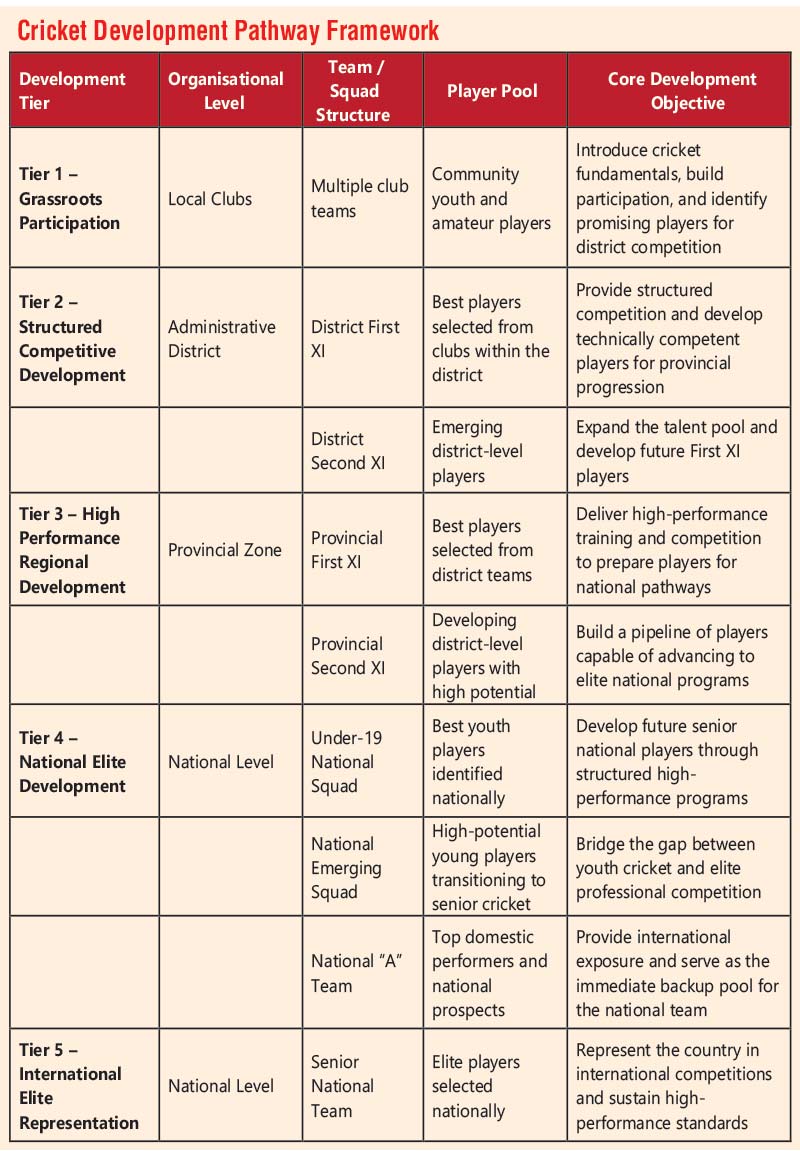
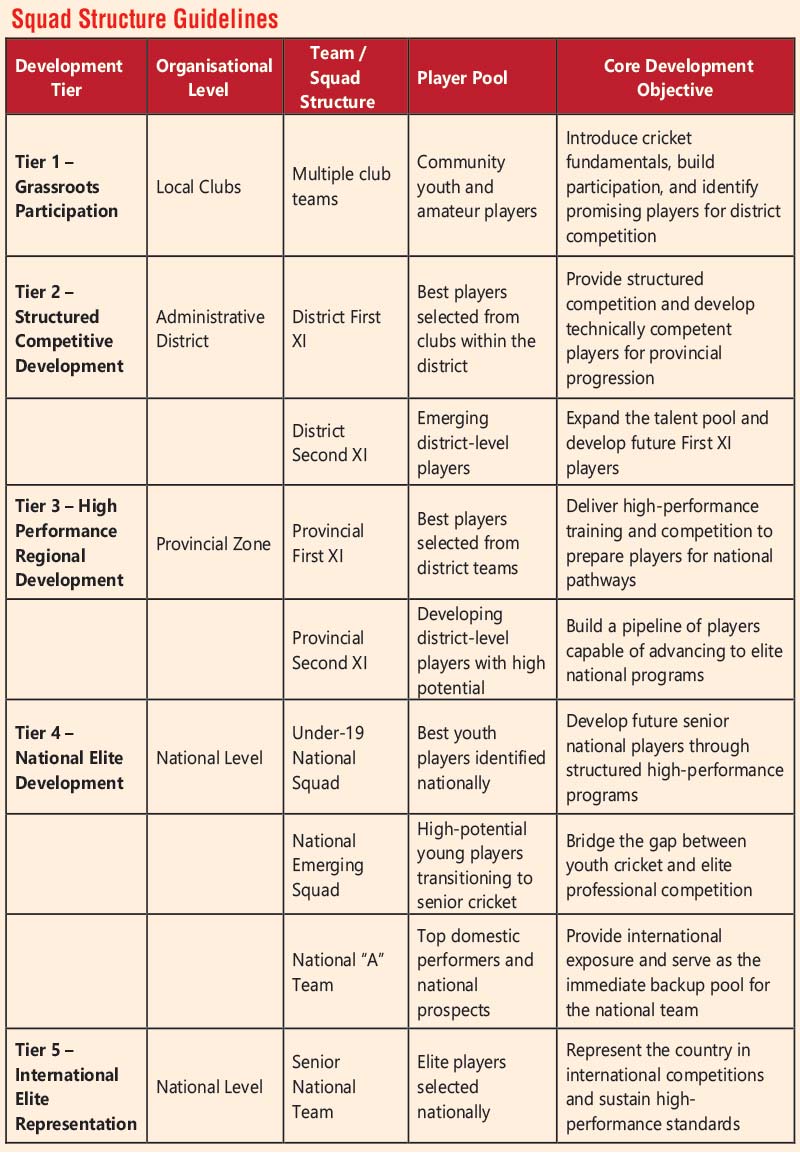
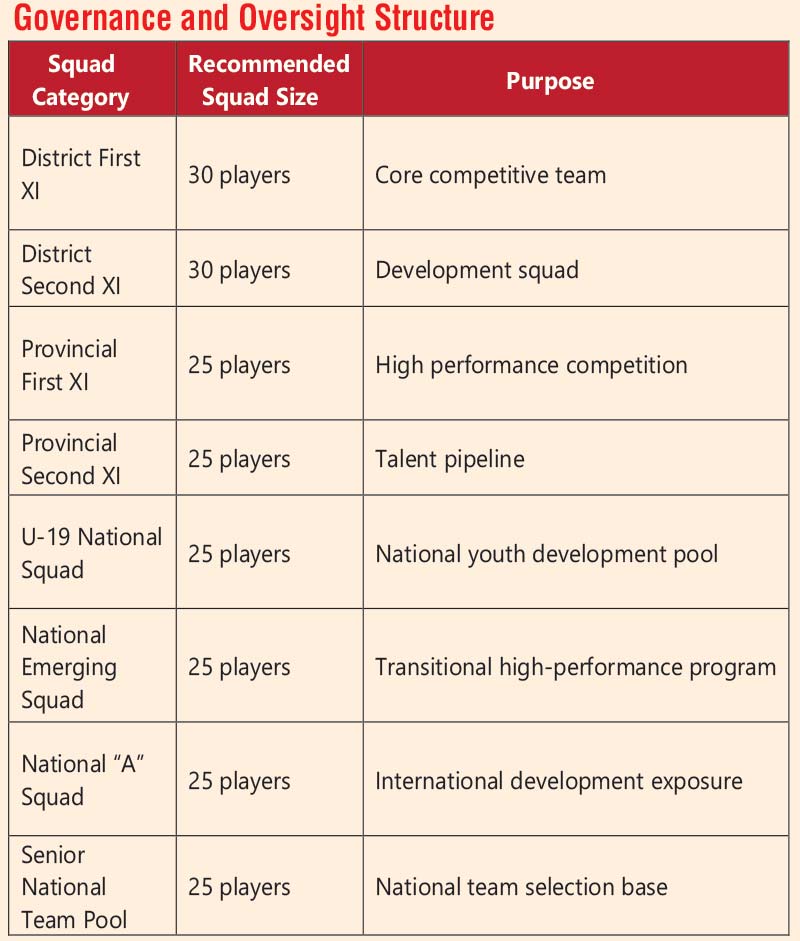
Within each administrative district, multiple small cricket clubs operate. Their primary purpose is to develop players who can progress to the District Team’s First XI and Second XI. District squads then feed into provincial teams, which similarly maintain First XI and Second XI squads that supply players to nationallevel programmes. At the national level, the player development structure comprises the Under-19 Team, the National Emerging Squad, the National “A” Squad, and the Senior National Squad. Ideally, at the local and district levels, each squad should consist of approximately 30 players. This allows the squad to be divided into two teams, facilitating player rotation, effective workload management, and regular competitive intra-squad practice. At the Provincial Zonal level and upwards, the squad size may be more appropriately limited to around 25 players, ensuring a balanced approach between maintaining a strong talent pool and providing sufficient opportunities for meaningful training and match exposure.
Player selection for squads should be guided by transparent, scientifically grounded criteria supported by objective evidence and verifiable data. Establishing a clear, merit-based framework ensures that selection decisions are fair, accountable, and aligned with performance standards, thereby strengthening confidence in the integrity of the process. At any given time, the system should be capable of generating an independent, evidence-based report on each player, drawing on verified performance data, fitness metrics, and developmental assessments. Such a capability would promote transparency, support objective decision-making, and ensure that player evaluations are consistent, accountable, and based on measurable criteria rather than subjective judgment.
There may be occasions when an extraordinary, unorthodox, and highly talented player emerges outside the established development structure. In such instances, there should be an independent and well-defined methodology to assess the player’s capabilities and potential, allowing for possible inclusion in a squad by bypassing the normal progression pathway. However, any such inclusion must be formally approved by the Board of Directors of Sri Lanka Cricket (SLC), and the decision should be documented transparently, with clear justification and supporting evidence recorded. If the player fails to demonstrate the required level of performance within the allocated evaluation period, the player should be removed from that squad and placed at the most appropriate tier within the development structure to continue progressing through the standard pathway.
Developing strong technical foundations at an early stage is essential for producing high-quality international cricketers. Therefore, the T20 format should not be introduced during the early stages of player development and it should be limited to the national level. At the developmental stages, longer formats of the game should be prioritised to cultivate discipline, technique, and match awareness. Accordingly, one-day competitions should be conducted at the local level, two-day matches at the district level, and four-day competitions at the provincial zonal level, ensuring a progressive development pathway that strengthens players’ technical and tactical capabilities before they are exposed to the shorter format of the game.
Part II of this article outlines the resource allocation framework required to support the above structure.
(The author is an engineer currently working in the Australian NSW Local Government sector. He aims to share his perspectives on various social development issues alongside his professional expertise to inspire others to think critically and differently. He can be reached at [email protected])




