Thursday Oct 22, 2026
Thursday Oct 22, 2026
Wednesday, 28 January 2026 00:24 - - {{hitsCtrl.values.hits}}
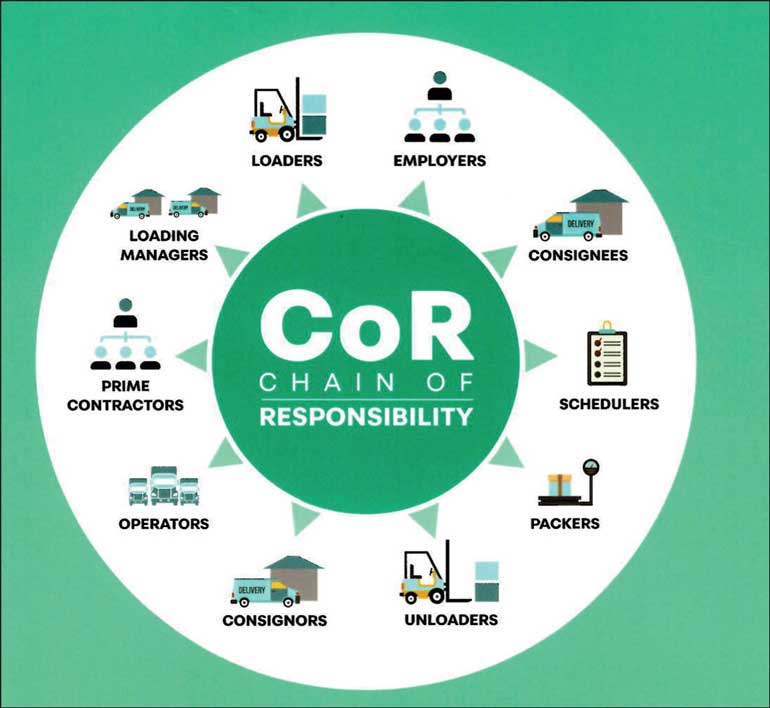
CoR ensures that safety is embedded across the entire transport supply chain, not left solely
to drivers
 THIS article provides a structured, highlevel overview of Chain of Responsibility (CoR) obligations, duties, and implications for organisations and their leaders and an overview of its application to Sri Lankan public sector organisations.
When a fatal road accident occurs on a Sri Lankan highway such as a heavy timber‑laden truck losing control, toppling, and colliding with another vehicle, the immediate response typically follows a structured sequence involving the public, emergency services, and regulatory authorities.
Immediate actions
Members of the public providing initial assistance: Bystanders often rush to the scene, assist any injured persons, and arrange transport to the nearest hospital. In many cases, an emergency ambulance is summoned via the national hotline 119.
Police arrival and scene management: The Sri Lanka Police take charge of the accident site, ensure that fatalities are formally certified by medical authorities, and arrange for injured individuals including the truck driver to be transported to hospital. If the driver is hospitalised, they remain under police supervision.
Mandatory medical testing of the driver: The driver of the heavy vehicle is subjected to medical examinations, including alcohol and toxicology testing, in accordance with Sri Lankan traffic law.
Investigation phase
Recording the driver’s statement and verifying documentation: Once the driver is medically fit, the Police obtain a formal statement regarding the incident. The driver is then placed in Police custody pending further investigation. Officers verify the validity of the driver’s licence, revenue licence, insurance coverage, and other required documents.
Referral to transport regulatory authorities: The Police notify the Department of Motor Traffic and, where relevant, the National Transport Commission. Technical officers assess the roadworthiness of the truck, review maintenance records, and confirm whether the vehicle was properly serviced and compliant with regulations.
Parallel investigation of the other vehicle: Similar checks are conducted on the second vehicle involved in the collision, including verification of the driver’s credentials, vehicle condition, and compliance with legal requirements.
Legal outcomes
 Determination of responsibility and legal action: Upon completion of the investigation, Police identify the party responsible for the accident, whether the driver, vehicle owner, or both. Legal proceedings are initiated under the applicable provisions of the Motor Traffic Act and the Penal Code, particularly in cases involving fatalities.
You may say “Not bad”. Really?
The following information was gathered from a detailed training session I had with the National Heavy Vehicle Regulator.
Let’s compare this with similar accident happened in Australia.
A fatal heavyvehicle crash in Australia triggers a multiagency response governed by the Heavy Vehicle National Law (HVNL) and Chain of Responsibility (CoR). The process is structured, methodical, and often spans months or years. Below is a complete, endtoend outline of what authorities typically do after such an incident.
Emergency services actions
Initial Police investigation
 Technical and forensic investigation phase
Crash reconstruction
Load and fatigue compliance checks
Regulatory investigation phase (National Heavy Vehicle Regulator- NVHR CoR)
Under the CoR, every party in the transport supply chain may be investigated, not just the driver.
Parties investigated
NHVR actions
Legal and enforcement phase
Criminal proceedings
Civil proceedings
Postincident compliance and industry actions
Operator obligations
Industrywide impact
 The above Australian methodology is considered the world’s best. Now, you could see where we are at this in Sri Lanka. The following information may be useful for Sri Lankan transport authorities to develop national methodology with a long-term plan to replicate Australian best practice.
Chain of Responsibility
In Australia, the term “Chain of Responsibility” is the part of Heavy Vehicle National Law that makes parties other than drivers responsible for the safety of heavy vehicles on the road.
The safe operation of heavy vehicles on Australian roads is not the responsibility of drivers alone. The CoR, established under the Heavy Vehicle National Law (HVNL), recognises that safety outcomes are shaped by every party that influences transport activities from executives and schedulers to loaders, consignors, and site managers.
What is the Chain of Responsibility?
The CoR is a legal framework that assigns shared accountability for heavy vehicle safety. Any person or business whose actions, decisions, or business practices influence how a heavy vehicle is operated becomes a Chain of Responsibility party.
This includes organisations that:
1. Employ or contract heavy vehicle drivers
2. Schedule transport tasks
3. Load or unload vehicles
4. Consign or receive goods
5. Manage premises where heavy vehicles operate
The primary duty
At the core of CoR is the primary duty. Every CoR party must, so far as is reasonably practicable, ensure the safety of their transport activities.
This duty requires organisations to:
The primary duty also prohibits any action direct or indirect that pressures drivers or other parties to breach the HVNL. This includes unrealistic schedules, unsafe loading requirements, or incentives that encourage speeding or fatigue.
Executive duty and due diligence
Executives, directors, senior managers, and others involved in organisational decisionmaking have a distinct legal obligation to exercise due diligence. This means they must:
Executives may be held personally liable if they fail to meet this duty, even if the organisation itself is not prosecuted.
Safety duty provisions
The HVNL contains number of specific safety duty provisions, including:
These provisions collectively ensure that all aspects of heavy vehicle operation from vehicle condition to scheduling are managed safely.
Executive liability
Executives may also be liable for certain offences if they knowingly authorise or permit unsafe conduct. This liability is separate from the due diligence duty and is based on common law principles. Executives must therefore ensure that organisational practices do not enable or encourage breaches of the HVNL.
Duties of drivers and employees
While drivers are not considered CoR parties unless they are owneroperators, they still have obligations under the HVNL and workplace health and safety laws. These include:
Employers must ensure drivers are trained, equipped, and supported to meet these obligations.
Responsibilities of other parties
Any person or business that uses heavy vehicle services can commit an offence if they make a prohibited request for example, asking a driver to meet a deadline that would require speeding or driving while fatigued. Significant penalties apply for such conduct.
Industry Codes of Practice
Registered Industry Codes of Practice, such as the Master Industry Code, provide practical guidance on identifying and managing risks. While not mandatory, these codes are influential: courts may consider them when assessing whether an organisation has taken reasonably practicable steps to ensure safety.
National Heavy Vehicle Accreditation Scheme (NHVAS)
The NHVAS is a voluntary accreditation system that helps operators manage risks associated with:
Accredited operators must meet defined standards and are subject to audits and compliance checks. Accreditation can improve safety performance and enhance business reputation.
Local Government as a CoR party
Local Governments frequently undertake activities that involve heavy vehicles, such as waste collection, road construction, maintenance, and facility operations. They may be CoR parties when they:
Local governments must therefore implement robust systems to manage transport risks across all relevant operations.
Meeting the primary duty
To comply with the HVNL, organisations should:
1. Identify all transport activities they influence or control
2. Assess the hazards and risks associated with those activities
3. Implement reasonably practicable controls
4. Monitor and review the effectiveness of those controls
This approach aligns closely with Work Health and Safety (WHS) risk management principles but applies more broadly to transport activities, including those occurring outside the workplace or Local Government area.
Legal consequences of noncompliance
Penalties for breaching CoR obligations are significant. Depending on the severity of the breach:
Importantly, a breach can be prosecuted even if no incident has occurred. Failure to manage risks is itself an offence.
The importance of proactive safety management
CoR is built on the principle that safety is a shared responsibility. Effective compliance requires:
By embedding safety into every stage of transport operations, organisations can reduce risk, protect workers and the public, and strengthen their operational integrity.
Application of Chain of Responsibility to good governance is discussed in Part II of this article.
(The author is an engineer currently working in the Australian NSW Local Government sector. He aims to share his perspectives on various social development issues alongside his professional expertise to inspire others to think critically and differently. He can be reached at [email protected])




