Wednesday Nov 11, 2026
Wednesday Nov 11, 2026
Wednesday, 11 November 2026 00:03 - - {{hitsCtrl.values.hits}}
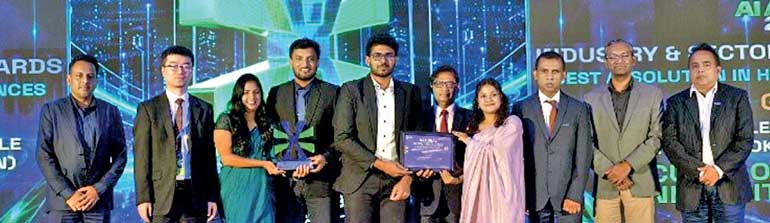
Award-winning teams at the National AI Awards 2026
The Faculty of Engineering, University of Ruhuna, secured three major honours at the National AI Awards 2026, earning two Gold Awards and a second-place recognition for innovations spanning healthcare, artificial intelligence and local-language technology. Held on September 30 at Monarch Imperial, Colombo, the awards ceremony brought together innovators from universities, industry and the wider technology sector.
Jointly organised by the Ministry of Digital Economy and SLT-MOBITEL, the National AI Awards recognise excellence in artificial intelligence while encouraging the development and adoption of innovative AI solutions in Sri Lanka. The Faculty was recognised for three projects addressing distinct areas of technological development: COGNI – AI-Enabled Wearable and Mobile System for Stroke Hand Rehabilitation, SinhalaLM by HelaAI – Sinhala Language Model & AI Web Platform, and iHeart – Multi-modal Cardiac Monitor for Emerging AI Health Applications.
AI innovation in stroke rehabilitation
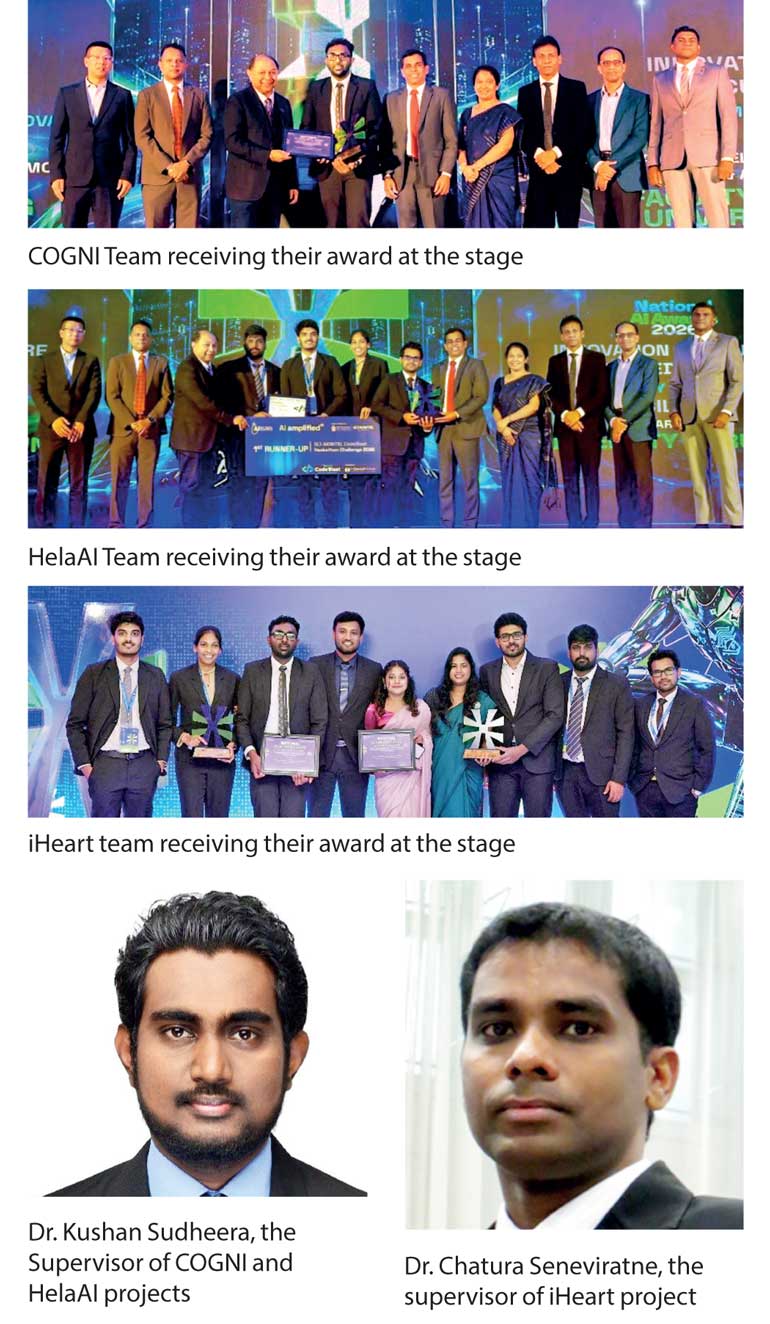
COGNI – AI-Enabled Wearable and Mobile System for Stroke Hand Rehabilitation received the Gold Award for Best AI Solution in Healthcare and Life Sciences under the Industry and Sector Excellence Awards. Developed by students of the 22nd Batch of Computer Engineering, COGNI is an integrated rehabilitation platform designed to support stroke survivors in recovering hand functionality through a combination of artificial intelligence, wearable sensing and interactive rehabilitation technologies.
The system combines an AI-powered mobile application, interactive rehabilitation games, real-time hand tracking and a wearable smart glove that measures hand force. Artificial intelligence supports personalised exercise recommendations based on patient performance, while a web-based platform allows doctors and therapists to remotely monitor rehabilitation progress. By integrating these technologies, COGNI seeks to make rehabilitation more engaging for patients while providing healthcare professionals with meaningful information to follow their recovery.
The student team comprised A.U.T. Iyenshi, R.P.M.R. Rajapaksha, W.H.S. Abesundara and R.M.M.P. Aberuwan, under the supervision of Dr. Kushan Sudheera of Faculty of Engineering, University of Ruhuna, Dr. Noleine W. Prins-Horton of College of Science and Engineering, University of Minnesota, and Prof. K.D. Pathirana of Faculty of Medicine, University of Ruhuna. The work demonstrates how collaboration across artificial intelligence, engineering, wearable technology and medicine can contribute to addressing practical challenges in rehabilitation and healthcare.
Advancing AI for Sinhala language
SinhalaLM by HelaAI – Sinhala Language Model and AI Web Platform received the Gold Award for Best Sinhala/Tamil AI and Localisation Innovation at the National AI Awards 2026. Developed by the HelaAI research team at the University of Ruhuna, SinhalaLM is a Sinhala-focused large language model designed to understand and generate natural Sinhala across different forms of real-world language use, addressing the limited availability of AI technologies optimised for Sinhala.
A key feature of SinhalaLM is its focus on efficient, locally deployable AI. The compact model is designed to operate with comparatively limited computing resources, making it more practical for deployment on lower-resource hardware and in environments where access to high-end computing infrastructure is limited. The project also incorporates a custom 64,000-token Sinhala tokeniser, developed to better handle the linguistic characteristics of Sinhala and reduce the tokenisation inefficiencies commonly encountered when applying general-purpose language models to the language.
The initiative was re-established during Rextro and subsequently developed further under HelaAI, with a broader focus on building sovereign AI technologies for Sinhala and Sri Lanka. The team comprises Chamara Vishwajith and Dr. Kushan Sudheera of Faculty of Engineering, University of Ruhuna, together with Dineth Jayakody, a PhD student at Old Dominion University, USA. The Gold Award recognises the team’s contribution to advancing Sinhala-language AI and locally relevant foundation models, while demonstrating the potential for Sri Lankan researchers to develop AI technologies that are both linguistically specialised and practical for local deployment.
AI innovation in cardiac monitoring
iHeart – Multi-modal Cardiac Monitor for Emerging AI Health Applications secured second place in the University AI Innovation Award under the Innovation & Future Focus category. The multi-modal cardiac monitoring system is designed to integrate multiple physiological signals for advanced cardiac assessment and emerging AI-based healthcare applications, providing a broader foundation for monitoring cardiac activity and future AI-supported analysis.
By combining information from different physiological measurements, iHeart explores how physiological sensing, engineering and artificial intelligence can work together in emerging healthcare applications. The student team comprised Sivanujan S., Attanayake A.M.S.P., Senevirathne S.M.K.H.T. and Wimalachandra R.D.M.K.T., under the supervision of Prof. Arjuna Madanayake of the Florida International University and Dr. Chatura Seneviratne of the University of Ruhuna. The recognition highlights the potential of university-led engineering research to contribute to the development of intelligent healthcare and monitoring technologies.
The three honours collectively reflect the breadth of innovation emerging from the Faculty of Engineering, University of Ruhuna. From supporting stroke rehabilitation and advancing Sinhala-language AI to exploring multi-modal cardiac monitoring, the projects demonstrate how engineering and emerging technologies can be applied to practical and socially relevant challenges. Their recognition alongside innovations from Sri Lanka’s wider technology and industrial sectors also highlights the growing contribution of university-led research to the country’s developing AI ecosystem.
The two Gold Awards and second-place honour represent a collective achievement for the students, academics, supervisors and collaborators involved. More broadly, the recognition demonstrates the potential of Sri Lankan university research to translate technical knowledge into locally relevant innovation and contribute to the country’s evolving artificial intelligence and technology landscape.



