Friday Oct 16, 2026
Friday Oct 16, 2026
Tuesday, 31 March 2026 05:08 - - {{hitsCtrl.values.hits}}
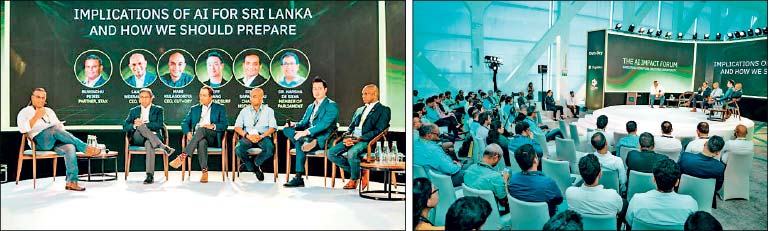
Industry leaders, technologists and policymakers came together this week at The AI-Impact Forum to explore how artificial intelligence is moving beyond hype into real-world application, and what that means for countries like Sri Lanka.
The event opened with remarks from Cut+Dry CTO and Co Dev Labs Co-Founder Shanil Fernando who set the stage for a morning centred on practical use, global trends and Sri Lanka’s role in an evolving AI landscape. Co Dev Labs, founded by Shanil Fernando and Mani Kulasooriya, is playing a key role in enabling the adoption of emerging AI technologies in Sri Lanka.
In a keynote that blended global perspective with candid insight, Windsurf CEO Jeff Wang addressed one of the most pressing concerns surrounding AI today — its impact on jobs. Opening with a question to the audience on whether they felt at risk, he reframed the conversation around how work itself is changing, rather than disappearing.
Wang highlighted that while AI capabilities continue to advance rapidly, the biggest constraint is no longer technology, but enablement — a gap that organisations like Co Dev Labs are actively working to bridge by helping teams adopt and integrate these tools effectively. “Our biggest bottleneck is enablement,” he noted, pointing to the gap between what these tools can do and how effectively teams are able to use them.
He added that as systems become more efficient, the constraints across the ecosystem are shifting — from power and infrastructure to compute and advanced chip manufacturing. He also pointed to a near-term shift in expectations around AI performance, suggesting that even imperfect outputs are becoming more acceptable as systems increasingly test and refine their own results.
The panel discussion that followed, moderated by STAX Partner – Client Delivery Network Ruwindhu Peiris, brought together WSO2 Founder and CEO Sanjiva Weerawarana, Cut+Dry CEO Mani Kulasooriya, hSenid Group Chairman Dinesh Saparamadu, Economist and Member of Parliament Dr. Harsha De Silva, and Windsurf CEO Jeff Wang.
A recurring theme throughout the discussion was the need for businesses to rethink how they operate in an AI-driven world. Mani Kulasooriya shared how Cut+Dry is already embedding AI into its workflows, including breaking down complex operations into structured data and rewriting large-scale systems using AI tools. “Everyone needs to rethink their entire business model,” he said.
However, the panel also introduced a grounded counterpoint. Sanjiva Weerawarana emphasised that while AI is a powerful tool, its adoption must be viewed in context. In many cases, he noted, it remains more cost-effective to rely on human engineers, particularly in markets where digital infrastructure is still developing. He also cautioned against unchecked acceleration, noting that “speed thrills, but kills.”
Dr. Harsha De Silva brought a national lens to the discussion, highlighting recent investments in AI infrastructure while stressing that job creation remains the country’s most urgent priority. He warned of the risk of widening inequality if adoption is not carefully managed, and pointed to sectors like agriculture as areas where Sri Lanka could see meaningful gains — provided foundational challenges such as connectivity and access to technology are addressed first.
The discussion also explored how the role of engineers is evolving. While AI tools are becoming increasingly capable of generating code and solving problems, the panel agreed that human value will shift towards defining problems, understanding domains and applying critical thinking. Dinesh Saparamadu noted that companies are moving away from hiring generalists, instead prioritising individuals with deep domain expertise who can leverage these tools effectively. Jeff Wang added that more experienced engineers are often the ones leaning most heavily on AI tools to increase productivity.
Following the panel, Sam Purtill of Cognition delivered a deeper dive into how these systems are being applied in practice. Drawing on over two decades of experience, he demonstrated how he built a cricket trivia game the night before the event using Devin, highlighting the speed and flexibility these tools now offer. He also unpacked how such systems operate — from launching isolated environments to running multiple processes in parallel and iteratively testing outputs — reinforcing a shift from writing code to orchestrating systems that can build, test and refine solutions at scale.
The session concluded with a forward-looking perspective on what Sri Lanka needs to prioritise in this moment — from targeted innovation strategies to fostering curiosity and entrepreneurship.
The Forum ultimately reinforced a shared understanding — that while AI is advancing at pace globally, the real opportunity lies in how boldly it is adopted and applied. For Sri Lanka, the message was clear: the tools are here, the talent exists, and the moment to act is now.




