Thursday Oct 22, 2026
Thursday Oct 22, 2026
Wednesday, 15 July 2026 00:00 - - {{hitsCtrl.values.hits}}
 As SLASSCOM prepares to hold its Annual General Meeting today, the association reflects on a year that expanded opportunities for talent, entrepreneurs, businesses and policymakers while continuing to strengthen Sri Lanka’s knowledge and innovation industry.
The past year has been a significant one for the sector. In 2025, Sri Lanka’s knowledge and innovation industry reached an estimated export value of $2 billion, making it the country’s third-largest export sector. Today, the industry comprises more than 680 IT and BPM companies, over 700 active startups and a workforce of approximately 175,000 professionals, contributing 45% of Sri Lanka’s services exports. With around 17,000 graduates entering the workforce annually and the industry continuing to grow at a healthy pace, the focus is increasingly shifting towards ensuring the country has the talent, innovation, partnerships and policy environment needed to sustain that momentum.
Against this backdrop, the Board led by Chairperson Shehani Seneviratne focused on initiatives that would strengthen the industry’s long-term competitiveness while creating greater value for members and the wider ecosystem.
“Our industry has reached an important milestone, but our ambition remains much bigger,” said Seneviratne. “The past year has been about creating opportunities that strengthen the industry for the long term, whether through talent, entrepreneurship, policy engagement or international partnerships. Those are the building blocks that will determine how successfully we compete in the years ahead.”
Developing industry-ready talent remained one of SLASSCOM’s strongest priorities
Graduate Personas were introduced to help students better understand employer expectations while providing universities with a practical framework to align graduates with evolving industry needs. The launch of the Apprentice Internship Platform created a structured pathway connecting students with project-based internships offered by member companies, helping bridge the gap between academic requirements and meaningful industry exposure.
Alongside preparing new entrants to the workforce, the association also placed considerable emphasis on reskilling and upskilling existing professionals to ensure Sri Lanka’s talent continues to meet the demands of a rapidly evolving technology landscape.
These initiatives formed part of a broader talent agenda that gathered momentum throughout the year. More than 2,600 school students and undergraduates participated in IT/BPM Exploration Days, while over 700 students benefited from the Bridging the Skill Gap program delivered by industry practitioners. Through Tech Kids, more than 500 schoolchildren across 20 schools were introduced to coding and computational thinking. The Academia Immersion Program connected more than 70 university lecturers with leading technology companies, and the newly introduced University Roundtable strengthened collaboration between academia and industry on future workforce priorities.
The SLASSCOM Academy also continued to expand its impact, delivering more than 13,000 learning hours to over 1,900 participants through programs covering artificial intelligence, leadership, analytical capability and professional development. In parallel, the NextGen Leadership Program equipped more than 110 emerging leaders through four completed cohorts.
Entrepreneurship and innovation continued to gather momentum during the year
A landmark initiative enabled 25 Sri Lankan startups to participate in the fully funded IIT Madras Pravartak entrepreneurship program, providing international exposure, mentorship and access to one of South Asia’s leading innovation ecosystems. This complemented the Xcellerate Accelerator, which supported 21 high-potential technology startups, alongside Fast Forward for Women, Hack Like a Girl, the Startup Sri Lanka platform and continued efforts to improve access to funding and mentorship for founders.
Innovation was also celebrated through the SLASSCOM National Ingenuity Awards, which continued to recognise outstanding achievements across schools, startups, corporates and universities, attracting more than 330 submissions.
SLASSCOM also strengthened its role as a trusted voice for the industry
The introduction of the Policy Council created a dedicated platform for engagement between industry leaders and the leadership of SLASSCOM. Constant interaction with policymakers was maintained through the association’s active participation in the industry advisory committee, National AI Strategy, the Digital Transformation of Education Taskforce, the National Export Development Plan, World Bank advisory forums, Central Bank stakeholder committee and several national policy discussions. Recommendations submitted for Budget 2026 reflected the industry’s priorities around talent, taxation, startups, innovation and global competitiveness.
The Association also expanded its international engagement
In addition to strengthening partnerships with NASSCOM, SLASSCOM launched the Industry Ambassador v2 program across Norway and the Philippines while continuing to work closely with its existing network of industry ambassadors. Engagements with foreign missions, investment agencies and technology ecosystems across India, Germany, Australia, Dubai, Sweden, the United Kingdom and the United States continued to position Sri Lanka as a competitive destination for technology, innovation and knowledge services.
Member engagement also reached new levels
The introduction of Member Personas enabled more tailored engagement across SLASSCOM’s growing membership, while CEO Breakfasts, CFO Breakfasts, TGIT networking events, the inaugural Member Townhall and the annual CEO Retreat brought business leaders together to exchange ideas, address common challenges and shape the future of the industry. Today, SLASSCOM represents a membership of 331 companies spanning multinational organisations, large enterprises, SMEs and startups.
Beyond industry growth, the association continued to champion inclusive and sustainable development through Women in Technology initiatives, STEM4Her, leadership development programs, the establishment of an Accessibility Testing and Quality Assurance Lab to create employment opportunities for persons with disabilities, the rebuilding of six schools in partnership with member companies and the introduction of an industry ESG Dashboard.
Reflecting on the year, Seneviratne said the association’s greatest achievement was not any single initiative, but the stronger connections built across the industry and the collective progress made during the year through numerous initiatives.
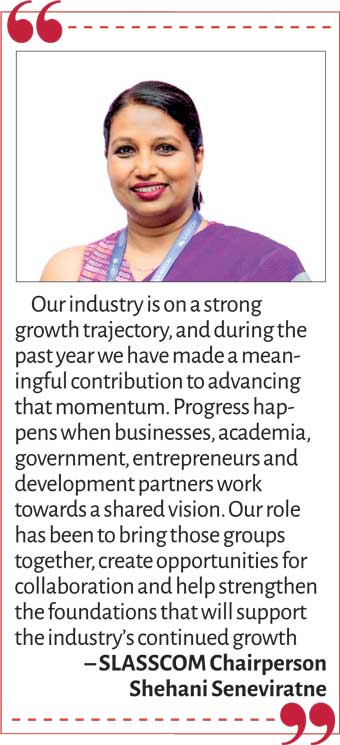
“Our industry is on a strong growth trajectory, and during the past year we have made a meaningful contribution to advancing that momentum. Progress happens when businesses, academia, government, entrepreneurs and development partners work towards a shared vision. Our role has been to bring those groups together, create opportunities for collaboration and help strengthen the foundations that will support the industry’s continued growth.”
As members gather for the Annual General Meeting, the year stands as one of stronger partnerships, broader engagement and meaningful progress across multiple fronts. More importantly, it leaves the incoming Board with stronger platforms, deeper industry relationships and new opportunities to build on the momentum that continues to position Sri Lanka’s knowledge and innovation industry among the country’s most important economic sectors.




