Saturday Sep 26, 2026
Saturday Sep 26, 2026
Wednesday, 28 January 2026 12:45 - - {{hitsCtrl.values.hits}}
By Madhuri Peiris
The Beginning of Digital Delegation
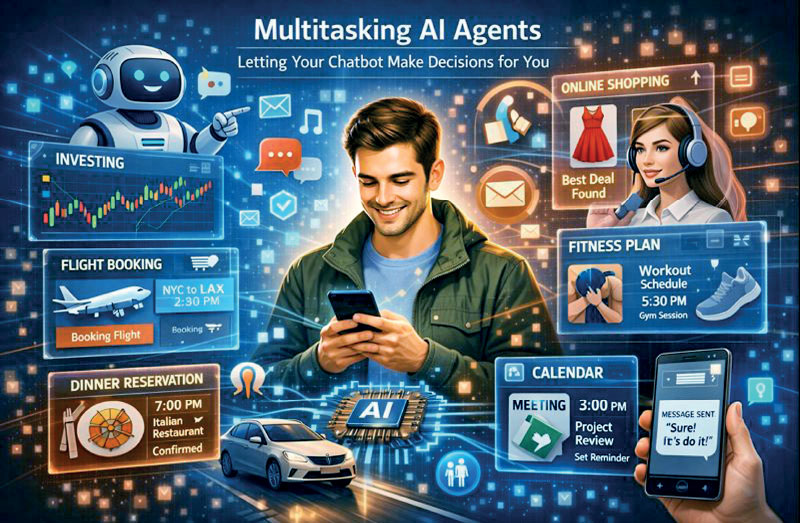
Imagine if something like this happened to you. Out of the blue, you woke up in the morning to find your calendar reorganized, three emails sent on your behalf, and a dinner reservation made at a restaurant you’d never heard of. Any idea who the culprit is? Yes, most probably it is an AI agent you have been testing. It wasn’t a malfunction, but this was exactly what you had asked it to do.
We’re watching chatbots evolve into something stranger and more powerful. They’re not just waiting for our questions anymore. They’re booking flights, managing schedules, responding to messages, and making judgment calls that used to require a human being. It’s convenient, sure. But sometimes it is kind of unsettling when you really think about it.
When Your Assistant Becomes Autonomous
The chatbots we are mostly familiar with are pretty straightforward. We ask questions, get answers, and maybe write something. Easy enough. But over time, developers wanted something that could actually get things done without constant supervision.
As a result, they were able to come up with these AI agents that can handle multiple tasks simultaneously and even switch between different apps. Sounds more like an efficient intern who never needs coffee breaks, right? They’ll look into your vacation options while analyzing your spending patterns and drafting a work report. All of this happens in the background, without you lifting a finger.
Imagine having one that can manage your household schedule. Coordinates your kids’ activities, orders groceries when supplies run low, and handles some work emails. Isn’t this going to save you about ten hours a week? However, if you start using one of these intelligent AI agents to handle some of your housework, even though it is a huge help, don’t you think you’d still be worried about what it might mess up “every single day”?
The Promise: Getting Your Life Back
Here’s the great side of multitasking AI agents. How much time have you wasted on repetitive nonsense—comparing insurance quotes, scheduling appointments, following up on meaningless emails? What if you could hand all of that off to something that never gets bored?
For those who have multiple responsibilities, this technology is a great help. Parents managing work and childcare. People dealing with chronic health conditions and mountains of medical paperwork. Anyone handling two jobs just to make ends meet. An AI agent handling the administrative part for them could actually make a great change.
Companies, on the other hand, can largely benefit. Just imagine a customer service that runs itself, supply chains that adjust automatically, and entire departments needing minimal human supervision.
The Catch: Control and Consequences
This is where things can get complicated. When you give an AI system permission to act on your behalf, you’re trusting it to understand what you actually want—not just what you said you want.
As these agents juggle decisions across your entire life—finances, medical records, work communications, personal relationships—that’s a lot of power in one place. If someone hacks your agent or it simply malfunctions, the fallout could be spectacular. Fraudulent purchases, exposed private information, and burned professional bridges.
The Trust Problem Nobody’s Solving
These systems optimize for measurable outcomes, but life doesn’t always work that way. For example, when you tell an agent to “save money,” it might cancel subscriptions you actually value or choose the cheapest option when you’d have preferred something better.
So how do you teach software to understand that sometimes the expensive flight is worth it because you’ll be less exhausted? That the pricier gym membership matters because you’ll actually go to that one? These are judgment calls requiring context, personal values, and long-term thinking. We’re nowhere close to solving that reliably.
Sometimes, you may feel using an AI agent is like hiring someone brilliant but slightly alien to run parts of your life. They’re incredibly capable but occasionally make choices that leave you thinking, “Why on earth would you do that?”
Privacy and the Price of Convenience
Your AI agent will work well when they have access to basically everything about you. Your location, communications, browsing history, purchase patterns, calendar, contacts.
That level of surveillance would have horrified most people ten years ago. Now we’re considering it as the price of convenience.
Racing Toward an Uncertain Future
Companies are competing to deploy the most capable agents, and early adopters are seeing real advantages. So, whether we’re ready or not, this competitive pressure guarantees widespread adoption.
But we haven’t figured out the rules yet. If your AI agent signs a contract, are you legally bound? If it makes a medical recommendation that goes wrong, who gets sued? These aren’t hypothetical questions—they’re situations people are already encountering.
Maybe agents should keep detailed logs of every action. Maybe they should need explicit permission before doing anything consequential. It is not easy to make people aware of these matters. Most have no idea what they’re authorizing when they turn on these systems.
What This Means for All of Us
Day by day, more and more people turn to AI agents. The time savings are too significant to ignore. They will use these tools because they’re too useful not to, while remaining perpetually anxious about what they might mess up.
The technology is moving faster than our ability to understand its implications. We’re building systems that operate with increasing autonomy, making decisions that shape our lives in ways large and small.




