Sunday Sep 27, 2026
Sunday Sep 27, 2026
Tuesday, 4 August 2026 02:53 - - {{hitsCtrl.values.hits}}
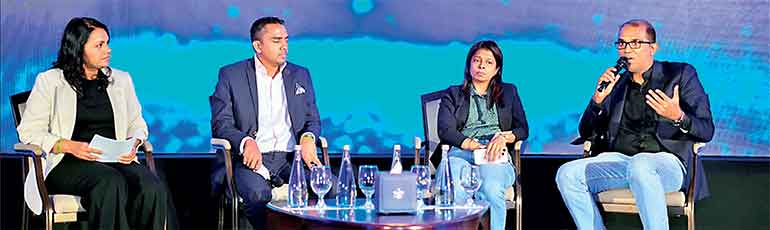
From left: Inivos Consulting Chief Operating Officer Ayomi Gunawardena, Lanka Milk Foods Chief Executive Officer Sasanka Perera, TVS Sri Lanka Chief Financial Officer Dayani Thulshika, and DSI Senior Deputy General Manager Dr. Aloka Jayawardena
By Safna Malik
Inivos Consulting recently hosted its annual flagship event, Transform 3.0 – Empowering Enterprise Growth, bringing together corporate executives, technology experts, and industry professionals to discuss strategies for sustainable business growth through digital transformation, modern leadership, and enterprise platforms such as IFS.
Inivos CEO Asanga Marasinghe emphasised that the company's focus has always been on delivering outcomes rather than simply completing projects. He noted that AI is no longer a future concept but a present reality transforming modern enterprise operations. To support this, he stated that Inivos plans to continue investing in AI-led implementation technologies while strengthening its enterprise solution expertise, adding that true transformation is ultimately about people, partnerships, and possibilities rather than technology alone.
"We believe in building deep expertise, not just in technology but also in understanding our customers' industries, challenges and ambitions," Marasinghe remarked. Reflecting on the journey since 2019, he explained that this specific approach has enabled expansion across markets and industries through consulting, advisory, and systems implementation services.
Being future-ready was one of the main considerations for us. Technology is always geared toward the future, and investing in it keeps a business future-ready - TVS Sri Lanka CFO Dayani Thulshika
Moving from strategy to practice, the panel discussion titled "Leaders Who Made the Move," explored the operational and strategic shifts organisations undergo when migrating to advanced enterprise resource planning (ERP) systems. The discussion, moderated by Inivos Consulting COO Ayomi Gunawardena, featured TVS Sri Lanka CFO Dayani Thulshika, Lanka Milk Foods CEO Sasanka Perera, and DSI Senior Deputy General Manager Dr. Aloka Jayawardena.
The decision to invest in IFS Cloud
Speaking on the restrictions that impacted the automotive industry in recent years, Thulshika noted that the decision to invest in IFS Cloud during that difficult period was driven by market limitations. TVS Sri Lanka’s leadership viewed technology "as a primary means to build a future-ready business enterprise," she explained. By using the downturn to strengthen internal systems, the company ensured it was positioned to capture immediate opportunities once trade resumed, rather than waiting for a market recovery before investing.
Perera said that continuing to operate in the same way would limit an organisation’s ability to grow, noting that this lesson had also held true for Lanka Milk Foods over the past three years. He said meaningful change requires businesses to adopt a different approach, as repeating existing processes would not lead to genuine transformation.
He emphasised that transformation requires differentiation, with companies willing to go beyond their original plans and challenge conventional ways of working. He noted that periods of success can often create a sense of comfort with existing processes, but organisations seeking exceptional transformation cannot rely on incremental improvements alone. Instead, they must be willing to make timely decisions, introduce necessary operational changes and move beyond conventional approaches to achieve sustained growth and competitiveness.
DSS (D. Samson and Sons) is the retail, marketing, and distribution arm of the parent company, DSI has been using IFS for more than 20 years and opted to invest in IFS Cloud in 2020. Dr. Jayawardena said that nearly a year after the system went live, the most visible change had been the shift from managing infrastructure to focusing on the business itself.
“Moving to the cloud lets us focus on our core business instead of on servers,” Dr. Jayawardena said, adding that the change has brought greater flexibility, particularly in scalability. He said the difference was especially evident when compared with on-premises systems, which require organisations to manage data centres, ageing servers, capital expenditure and other practical concerns.
Dr. Jayawardena said another major advantage was the ability to keep pace with continuous product development. He noted that leading ERP platforms such as IFS and SAP invest heavily each year to improve their products, but organisations using on-premises systems can fall behind because of financial or operational constraints. “With IFS Cloud, all the new versions and features are made available to us automatically,” he said. “We stay on the same path, with the system continuously updated with the latest features and technology.”
If you keep doing the same thing, you will not grow. If you want exceptional transformation, to become the industry’s royalty, dominate the market and be a champion, you need to make changes swiftly - Lanka Milk Foods CEO Sasanka Perera
Turning information into decisions, and leading the change
With IFS Cloud serving as TVS Lanka’s central data backbone, Thulshika highlighted how access to connected and reliable information has strengthened the company’s decision-making process.
She said her priority was to ensure the organisation had the right information available, allowing teams to cross-check data across functions before making decisions. “We rely heavily on our stock data for this,” Thulshika said, adding that the company has worked to make information available seamlessly across all business units.
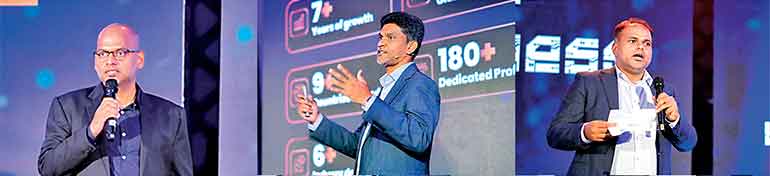
IFS Vice President – Engineering Rifki Razick, Inivos CEO Asanga Marasinghe, Inivos Technology CTO Lahiru Karunatilake
She explained that having quality and reliable information accessible across the organisation has helped teams make the right decisions at the right time, contributing to the company’s continued growth. Thulshika said the integration of data across functions has also improved reporting capabilities, enabling leadership teams to work with validated information when making strategic decisions.
For Lanka Milk Foods, which is still in the early stages of its IFS transformation journey, Perera said the success of the project would depend largely on how effectively the organisation manages the human side of change.
Acknowledging that shifting long-established practices can be challenging, he said people can naturally be resistant to change. However, he emphasised that successful transformation begins with leadership. “Change starts with leadership,” Perera said, explaining that the direction of an organisation depends on the commitment and alignment of those at the top.
Perera said when leaders actively drive the vision, address challenges and resolve gaps during the transformation process, employees are more likely to adapt to new ways of working. “The change isn’t really about the people; it’s about the leader,” Perera said, adding that once leadership is aligned with the transformation goals, the organisation can move forward and embrace new processes.
For DSS, Dr. Jayawardena said the key challenge in its transformation journey was managing scale, given the company’s extensive retail, distribution and operational networks. He explained that DSS operates across multiple channels, including nearly 300 retail showrooms, e-commerce platforms, overseas markets and a large distribution ecosystem that extends beyond its own outlets. Through its wholesale network, the company distributes products to more than 4,000 independent dealers and partners across the island, adding further complexity to its operations.
“Ultimately, it gives us one whole system, one whole view of our data,” Dr. Jayawardena said, describing the role of IFS Cloud in bringing together information from different areas of the business. He said this unified view represented a significant business transformation, enabling the organisation to access information more effectively and support faster decision-making.
Dr. Jayawardena added IFS remained the core system supporting the company’s ability to scale while maintaining accessibility and flexibility.
He also highlighted the continued support from the implementation partner throughout the transformation, noting that the process remains ongoing. “It’s a challenge, but it’s also very achievable,” Dr. Jayawardena said, adding that DSS remains focused on connecting the right resources and capabilities to further strengthen the business.
Future growth and innovation with AI
Looking ahead, Thulshika said IFS Cloud has enabled TVS Lanka to integrate multiple business solutions beyond its core financial operations, creating a connected ecosystem to support sales, customer management and future growth.
She explained that the company has integrated IFS with its original equipment manufacturer (OEM) software, while its sales operations are linked to a cloud based platform covering around 500 authorised dealer locations. Through this integration, TVS Lanka tracks the customer journey across three stages, from lead generation to final sales conversion, while supporting sales and digital administration on the front end. Thulshika said IFS has played a key role in bringing these systems together.
On the operational side, she said TVS Lanka is also integrating its network of over 5,000 service touchpoints through a specialised “gate to gate” dealer management system. The integration enables service information from dealer service centres to flow into a single centralised platform, giving the company greater visibility across its after sales operations.
She also highlighted the company’s newly launched quick commerce application, which connects management teams with nearly 1,500 product groups and automatically matches customer and dealer orders with available inventory.
“Developing these integrated models has allowed us to introduce new business frameworks that were previously impossible,” Thulshika said, adding that the new capabilities have expanded the company’s operational potential beyond its initial expectations.
Addressing the challenge of balancing future growth with maintaining current operations, Perera said organisations need adaptable teams capable of managing both priorities simultaneously. He compared the approach to a T20 cricket match, where success depends on having all rounders who can take on multiple responsibilities. “The future is changing radically; we don’t know what will happen tomorrow,” Perera said, stressing that business continuity remains critical amid an unpredictable global environment.
Organisations today need people who are willing to adapt, embrace change and manage multiple priorities while keeping an eye on both present operations and future opportunities. Perera noted that traditional long term planning has become increasingly challenging as market conditions continue to shift rapidly.
What AI can really offer, especially around customer experience and operational excellence, is where companies like ours can genuinely create value - DSI Senior Deputy General Manager Dr. Aloka Jayawardena
Dr. Jayawardena said DSS’s AI journey is focused on identifying practical applications that can create value within real business environments, particularly in retail operations and customer experience.
DSS’s internal technology incubator is exploring several AI-driven applications, including initiatives focused on enhancing retail experiences. One such example is being implemented in its premium running footwear segment, where AI-enabled cameras and sensors are used to analyse customers’ movement patterns.
He explained that unlike a conventional footwear purchase, where customers select a product based on comfort and preference, DSS’s approach focuses on understanding how the shoe interacts with an individual’s movement. This allows DSS to offer a more personalised retail experience rather than simply selling a standard product, adding that it has created a unique customer experience within the local market.
Another area being explored is improving ecommerce conversion through virtual fitting solutions. He said customers are often hesitant to purchase clothing and footwear online because they cannot physically try products before buying them. By introducing virtual fitting technologies, DSS aims to improve customer confidence and reduce drop-offs during the purchasing journey.
Turning to fashion retail, Dr. Jayawardena said AI could play an important role in improving demand forecasting, which remains a critical challenge due to the seasonal nature of the industry.
He said AI can provide greater accuracy in predicting demand and improving planning. “Stock is money,” he said, highlighting the impact of unsold inventory on profitability. In fashion retail, products that remain unsold for more than around 180 days often have to be discounted by up to 50%.
He said DSS is currently trialing AI-based use cases focused on prediction, demand planning and forecasting. While these solutions are still being developed and are not yet fully scaled, he said they represent opportunities for the business to improve inventory management.
Dr. Jayawardena added that DSS is also exploring emerging technology platforms through the wider IFS community to identify solutions that can support its digital transformation goals. He said the focus remains on testing applications that strengthen operational efficiency, enhance customer experiences and support future growth.
AI roadmap for enterprise readiness
Following the panel discussion, Inivos Technology CTO Lahiru Karunatilake delivered a session on “AI Roadmap for Enterprise Readiness”, focusing on how organisations can prepare for AI adoption and build the capabilities required to integrate AI into their business operations.
Joining him, IFS Vice President Engineering Rifki Razick shared his perspectives on the future of AI within enterprise technology, highlighting emerging innovations, enterprise adoption strategies and the opportunities AI creates to improve business performance and accelerate growth.
Inivos Senior Manager, Growth and Marketing Akmal Afzal said clear leadership commitment and structured decision-making remain key factors in determining the success of any enterprise transformation journey. He said Transform 3.0 highlighted the need for businesses to move beyond understanding new technologies and focus on applying them effectively through the right strategy, leadership and organisational readiness. As AI and digital transformation continue to evolve, Inivos remains focused on supporting conversations that help businesses navigate change and build future-ready capabilities.




