- Daily FT-CICRA CEO Forum calls for stronger boardroom accountability, faster security responses and organisation-wide resilience as Sri Lanka prepares for new cybersecurity legislation
By Hiyal Biyagamage
Artificial intelligence (AI) is fundamentally reshaping the cybersecurity landscape, forcing organisations to rethink how they manage digital risks, protect critical information and respond to increasingly sophisticated threats, with industry leaders warning that cybersecurity can no longer remain the sole responsibility of IT departments.
The 12th Annual Cyber Security Summit CEO Forum, jointly organised by the Daily FT and CICRA under the theme “Leading through AI-powered cyber attacks”, brought together senior Government officials, technology experts and corporate leaders to examine whether Sri Lankan organisations are adequately prepared for a rapidly evolving threat environment.
A central message emerging from the discussion was that cybersecurity must move beyond technology investments and become an integral part of corporate governance, operational resilience and board-level accountability.
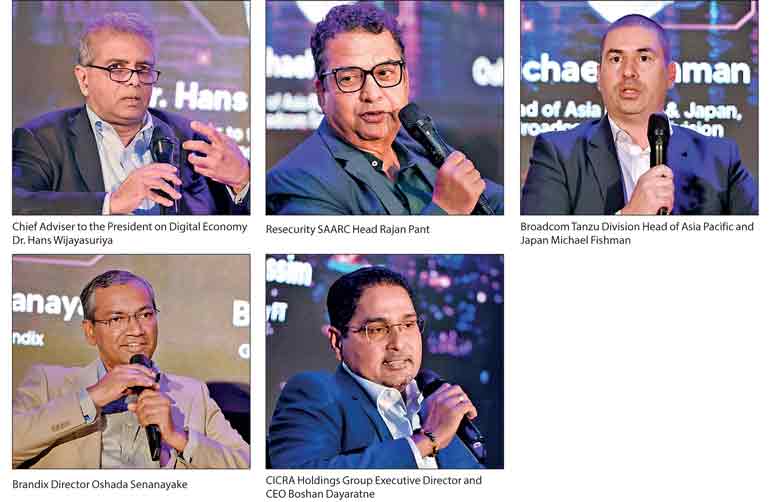
The forum featured President's Chief Adviser on Digital Economy and GovTech Chairman Dr. Hans Wijayasuriya, Resecurity Head of SAARC Rajan Patan, Broadcom Tanzu Division Head of Asia Pacific and Japan Michael Fishman, Brandix Director Oshada Senanayake and CICRA Holdings Group Executive Director/CEO Boshan Dayaratne.
The discussion highlighted a growing disconnect between the speed at which cyber threats are evolving and the pace at which organisations traditionally assess risks, allocate resources and implement protective measures.
For corporate leaders, the challenge is no longer simply preventing cyberattacks, but ensuring that their organisations can withstand, respond to and recover from incidents without compromising business continuity or stakeholder confidence.
Cybersecurity must become a boardroom priority
Dr. Wijayasuriya stressed that cybersecurity should be treated with the same governance discipline applied to financial auditing and regulatory compliance, with clear accountability at the highest levels of an organisation.
He argued that Chief Information Security Officers (CISOs) should report directly to board-level risk and compliance committees rather than operating under Chief Information Officers or Chief Technology Officers.
“The CISO should definitely not report to the CIO, definitely not report to the CTO,” he said, emphasising the importance of maintaining independence in cybersecurity oversight.
Dr. Wijayasuriya explained that cybersecurity decisions should not be driven exclusively by commercial considerations, particularly when failures could expose organisations to significant operational, financial and reputational consequences. Drawing comparisons with internal audit functions, he noted that essential risk and compliance requirements must be addressed irrespective of whether they generate an immediate financial return.
He recommended that companies establish dedicated board risk and compliance committees capable of independently assessing cybersecurity threats, challenging management decisions and ensuring that appropriate resources are allocated.
Responding to concerns about whether Sri Lankan boardrooms were ready for such a transformation, Dr. Wijayasuriya said the necessary governance structures could be strengthened through existing corporate governance rules without necessarily requiring separate legislation.
The forum also examined the tendency among some organisations to refer cybersecurity concerns immediately to IT teams, rather than recognising them as enterprise-wide risks demanding senior management attention.
Patan reinforced this concern, arguing that while cybersecurity professionals could manage and reduce risks, ultimate accountability rested with corporate boards. He cautioned that technical teams could not independently carry responsibility for threats that could affect an organisation’s entire operations.
The discussion underscored a fundamental governance principle: cybersecurity expertise may sit within specialist departments, but responsibility for managing its consequences must extend to the highest levels of leadership.
AI transforms the speed and scale of cyber threats
Fishman highlighted the dramatic acceleration in software vulnerability discovery enabled by advanced AI models, warning that conventional security maintenance practices were becoming increasingly inadequate. Drawing on Broadcom’s experience with the widely used Spring framework, he explained that the organisation previously identified approximately four to five vulnerabilities monthly.
However, with advanced AI models capable of examining software code, that figure had increased to approximately 90 vulnerabilities per month, according to the figures he presented. Fishman stressed that this acceleration was fundamentally changing the relationship between attackers and defenders.
Once a vulnerability becomes publicly disclosed, organisations face immediate pressure to deploy security updates before malicious actors can exploit the weakness.
“Now everybody who has access to an AI model can start exploring the code,” he observed.
The implication for businesses is significant. Security patching processes traditionally conducted quarterly or monthly may need to be accelerated to weekly or even daily cycles. Fishman emphasised the need for earlier access to vulnerability information, greater automation and the ability to deploy critical security updates independently of regular software development schedules.
He warned that organisations frequently adopted a reactive approach, strengthening cybersecurity only after experiencing a serious incident.
“In an AI-enabled environment, however, the speed of vulnerability discovery means that organisations must anticipate threats rather than wait for them to materialise. This reinforces one broader concern, which is that technology is advancing faster than many institutional decision-making and governance processes can accommodate,” said Fishman.
Resilience matters more than promises of complete protection
Senanayake offered a practical corporate perspective, arguing that AI was not necessarily creating entirely new cybersecurity threats but was amplifying weaknesses that already existed within organisations. He said traditional approaches centred on firewalls and perimeter defences were becoming insufficient as digital infrastructure grew increasingly interconnected.
Rather than attempting to guarantee complete protection against every possible cyberattack, he urged corporate leaders to consider how resilient their organisations would be when an incident occurred. Senanayake highlighted the complexity of managing cybersecurity risks, drawing on recent experiences involving unexpected authentication changes and suspicious digital activity.
“Identifying the underlying causes of such incidents could be challenging, particularly where technical errors and potential security threats presented similar warning signs. The experiences demonstrate why organisations needed continuous monitoring, layered security controls and effective incident-response mechanisms, rather than relying exclusively on preventive technologies,” said Senanayake.
He also highlighted the growing sophistication of social engineering and personalised phishing attacks, including the potential for AI-generated voices to impersonate trusted colleagues and senior executives. According to him, even sophisticated technological safeguards could prove inadequate if employees were unable to recognise and respond appropriately to suspicious communications.
“Stronger employee awareness, regular security simulations and greater accountability across organisations are a must. Importantly, I would like to caution against treating AI exclusively as a threat; the same technologies could strengthen cybersecurity detection and response capabilities. The challenge, therefore, is to ensure that organisations effectively harness AI for defence while remaining vigilant against its misuse,” stressed Senanayake.
Credential exposure and intelligence-led defence
Patan drew attention to the growing risks associated with compromised digital identities, warning that stolen credentials could provide attackers with access to corporate systems without requiring conventional malware. He highlighted the potential consequences of exposed email passwords, directory credentials and other authentication information circulating through criminal networks.
“With AI tools becoming increasingly accessible, malicious actors could potentially exploit such information more efficiently and develop sophisticated methods of accessing organisational systems. The importance of early warning systems and threat intelligence capabilities will help to identify exposed credentials and emerging risks before they result in serious incidents.”
He also advocated using AI-powered defensive capabilities while retaining human oversight over critical security decisions. The discussion reinforced the need to move beyond traditional infrastructure protection towards more proactive monitoring of identities, credentials and external threats.
This broader focus on prevention and intelligence is increasingly relevant as businesses expand their digital operations and rely on interconnected platforms, cloud services and third-party providers, said Patan.
Sri Lanka prepares stronger regulatory framework
Addressing developments at the national level, Dr. Wijayasuriya outlined measures being pursued to strengthen Sri Lanka’s cybersecurity architecture as the Government accelerates its digital transformation agenda.
He said, “Security-by-design principles are being incorporated into major digital public infrastructure projects, including the national digital identity system, national data exchange and sovereign cloud infrastructure. Sri Lanka’s relatively later development of certain digital platforms, compared with regional counterparts such as India, provide an opportunity to incorporate cybersecurity protections from the outset.”
However, he acknowledged that stronger technological safeguards needed to be supported by appropriate legislation and institutional capacity. Dr. Wijayasuriya said the long-awaited Cybersecurity Bill was expected to reach Parliament in early 2027, following multiple rounds of legal revisions and consultations.
The proposed legislation would establish a dedicated Cybersecurity Regulatory Authority with powers to introduce cybersecurity requirements covering both public and private sector institutions. These would include regulatory guidelines, compliance obligations and penalties for non-compliance.
He described the proposed legislation as a significant step towards establishing enforceable cybersecurity standards in Sri Lanka. Nevertheless, he cautioned that establishing the authority would be only the beginning, with adequate resources and institutional expertise essential to ensuring effective implementation. The Government is also pursuing plans to establish digital transformation units within major public institutions, supported by senior officers responsible for cybersecurity, AI, data and digital transformation.
Dr. Wijayasuriya acknowledged that these measures would not independently resolve the challenges facing the public sector, stressing the need for stronger enforcement, institutional awareness and organisational change.
From awareness to accountability
The forum’s wider discussion reflected a central challenge facing Sri Lankan businesses: translating growing awareness of cybersecurity threats into meaningful changes in organisational behaviour.
CICRA Holdings Group Executive Director/CEO Boshan Dayaratne emphasised that the growing sophistication of AI-powered cyber threats required a fundamental shift in how organisations approached cybersecurity, moving beyond technological safeguards towards stronger leadership, governance and institutional preparedness.
“Cybersecurity is no longer simply an IT responsibility. It is a strategic business risk that demands the attention of every CEO and corporate board. Organisations must recognise that investing in advanced security technologies alone is insufficient without clear accountability, timely decision-making and a workforce equipped to identify and respond to emerging threats,” he said.
Dayaratne further stressed the importance of collaboration between Government, regulators, technology providers and the private sector in strengthening Sri Lanka’s overall cyber resilience.
“As Sri Lanka moves towards a stronger cybersecurity regulatory framework, businesses must move from awareness to action. The real measure of preparedness is not whether an organisation has invested in cybersecurity, but whether its leadership, people and systems can respond effectively when a threat materialises,” he added.
Ultimately, the CEO Forum delivered a clear message for corporate Sri Lanka: cybersecurity must evolve from an operational concern managed by IT departments into a strategic responsibility shared across the entire organisation.
In an environment where AI can accelerate both the discovery and exploitation of vulnerabilities, the ability to respond quickly, maintain business continuity and protect stakeholder confidence will increasingly distinguish resilient organisations from those left exposed. Cybersecurity is no longer a question of technological readiness for corporate boards. It is a test of leadership, governance and the capacity to protect institutional trust in an increasingly digital economy.
Strategic partner of the Cyber Security Summit CEO Forum was Resecurity, Platinum partner was EY GDS Sri Lanka, Gold Partner was VMWare by Broadcom, Official Banking Partner was Bank of Ceylon, Hospitality Partner was Cinnamon Grand, and Brand Communications Partner was BBDO Sri Lanka.



